Explore Courses
Top University
Search anything
 Refer and Earn ₹ 5000
Learning Routes
Published on 17 July, 2026
Learning Routes Editorial Team
Reviewed and updated
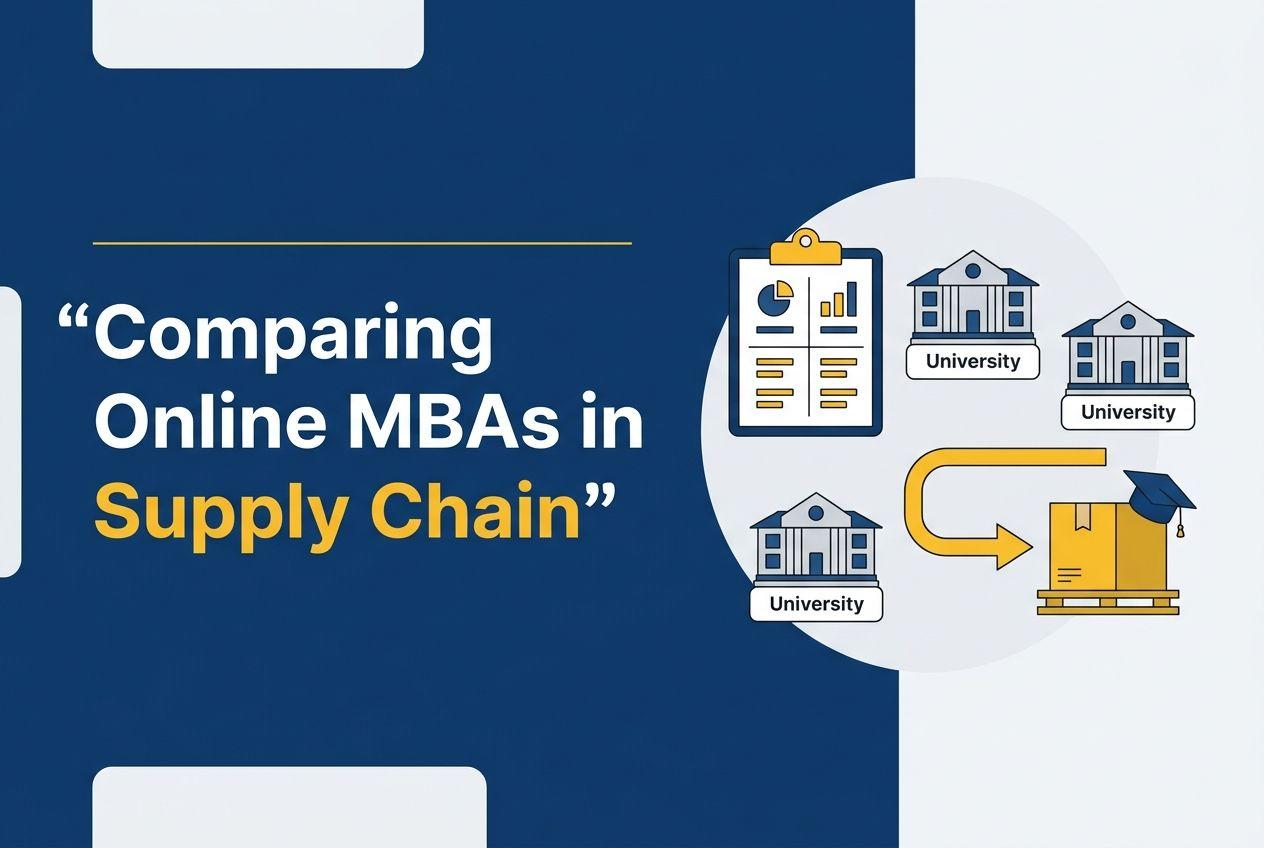
If you are comparing online MBA programmes in India for career growth, the real question is not “which brand sounds best?” It is which programme gives you the right mix of curriculum depth, faculty visibility, and practical exposure for an MBA in supply chain management (SCM) ? That matters even more if you are already working and need a degree that fits around your job, not one that adds noise to your week.
For this comparison, we are looking at the Supply Chain Management in LPU, Amity, and UPES. No other specialisations. No marketing gloss. Just the pieces that matter when you are trying to decide whether the investment is worth it.
The short version: LPU is the value-first pick, Amity is the most transparent on faculty, and UPES is the most specialised for logistics and supply chain depth. If you are stuck between them, the best LPU vs Amity vs UPES online MBA decision usually comes down to how much specialisation depth you want versus how much you want to pay.
Before comparing the universities, it helps to define what actually matters in a decision like this.
For a working professional, the right MBA for supply chain management should answer four questions:
That is the lens being used here. If you are looking at online MBA programmes in India, this is a safer way to compare them than relying on campus brand alone.
Here is a quick comparison table of LPU, Amity, and UPES online MBA programmes, helping you make an informed and effective decision:
If you want the leanest summary, here it is: LPU wins on cost, Amity wins on faculty visibility, and UPES wins on SCM depth.
LPU is the lowest-cost option in this comparison, and that alone will make it attractive to many working professionals. The effective programme cost is about ₹1,46,240 after a student grant of 20%, with the actual fee of INR 2,00,000. It is a 2-year minimum programme with a 4-year maximum window, so it gives you flexibility if work gets busy.
The degree is fully online, with live weekend sessions and recorded lectures. That matters if you are already juggling a job and cannot commit to rigid class timings. LPU also publishes a No-cost EMI option starting from INR 6,733 per month at the discounted price. Please note that the EMI shall vary depending on the duration you choose to pay the fee.
LPU’s supply chain management track is built on a wider MBA base and then narrows into supply chain in the final year. The first two semesters cover core business subjects like financial reporting, managerial economics, operations management, quantitative techniques, and research methodology. The specialisation arrives in semester 3, with subjects such as total quality management, inventory management, and supply chain strategy.
The capstone in semester 4 is tied to a supply chain management topic, which is useful, but the specialisation block itself is not as deep as UPES. The curriculum also mentions tools like SAP and Tally ERP, plus modern concepts such as IoT in SCM, Big Data analytics, RPA, and Digital Twins. The dossier is clear that the marketing mentions are there, but the depth of those topics in the coursework is not fully transparent.
LPU publicly names only a handful of faculty members for the online mode. The visible names include Dr Tanima Dutta, Dr Shikha Goyal, Anup Sharma, Rajeev Gupta, Pretty Bhalla, but their public profiles are not industry-specific. That does not make the programme weak, but it does mean the faculty story is less clear than Amity’s.
This is one of the reasons LPU feels like a general MBA with an SCM specialisation, not a specialised supply chain management school.
LPU includes a capstone project framed around a real-world SCM problem. The programme also references procurement and inventory models, including EOQ, JIT, and safety stock calculations. That is useful because it gives the curriculum some practical structure.
On the placement side, LPU says it offers placement assistance, resume building, mock interviews, and job portal access. Important caveat: that is assistance, not a guarantee. Also, the high salary numbers often quoted for LPU are from on-campus MBA reporting, not online MBA outcomes, so they should not be used here.
Choose LPU if your top priority is cost control, if you want a strong NAAC profile, and if you are comfortable with SCM being part of a broader business education rather than the entire centre of gravity.
Amity sits in the middle of the fee and is the most visible on the faculty disclosure. The total fee is INR 2,25,000, with INR 56,300 per semester. It also offers merit-based scholarship support for qualifying students, and EMI options are available through financing partners.
For a working professional who wants a recognisable private university brand and clearer faculty bios, Amity is easy to take seriously.
Amity’s curriculum is similar to LPU's in structure, which is why the real comparison in the LPU vs Amity online MBA debate often comes down to transparency rather than raw syllabus length. The first two semesters build the MBA foundation with subjects like management and organisational behaviour, managerial economics, accounting for managers, conflict resolution and management, financial management, and business research.
The supply chain management block appears in semester 3 with logistics management, inventory management, procurement and strategic sourcing, and warehouse management. Semester 4 adds global logistics, supply chain analytics, sustainability in SCM, and the capstone project.
This is a solid curriculum. It is current enough to feel relevant and practical enough to support an applied career move. But it is still a mid-depth specialisation, not the deepest one in the group.
This is where Amity stands out. It publicly names more faculty than the other two programmes. Out of all the profiles, one is especially relevant: Dr Sunil Kumar, who has prior industry experience at Pepsi and Calpro in supply chain and quality functions. That is the clearest supply chain management industry background across the three programmes.
For a buyer who is sceptical of marketing, that matters. It does not prove teaching quality by itself, but it does reduce uncertainty. In a field like SCM, where practical context matters, visible industry grounding is a real plus.
Amity references live industry projects and a final capstone. Its partner wall is broad and includes names like Amazon, Flipkart, Reliance, EY, Deloitte, Samsung, TCS, IBM, HDFC, SBI, Cognizant, and DHL. Just remember that these walls are ecosystem signals, not guarantees of recruiter access for every SCM learner.
The university also markets career tools such as an AI-powered career discovery platform, resume help, mock interviews, and an easy-apply job portal. Online MBA outcomes are still not independently audited, though aggregator estimates place online graduate salaries in a broad range.
Choose Amity if you want the strongest faculty transparency, a broad brand presence, and a balanced SCM specialisation that still leaves room for mobility across business roles.
If your goal is specifically logistics and supply chain, UPES is the strongest academic fit in this comparison. It is also the most expensive, with a total fee of INR 2,14,000 and a 24-month structure. The EMI option is about INR 9,773 per month.
UPES is the kind of programme you choose when you want specialisation depth to be the main event.
UPES has the most SCM-specific curriculum block of the three. The first two semesters cover the usual MBA foundation, but semester 3 moves into a stronger logistics and supply chain management sequence, international logistics and SCM, introduction to logistics and supply chain Fundamentals, international finance and risk management, procurement and supplier relationship management, and lean supply chain management.
Then, semester 4 adds strategic management, supply chain modelling and simulation, logistics planning and strategy, innovation and entrepreneurship, and the dissertation or capstone.
That simulation-based capstone is a meaningful differentiator. So is the explicit Lean SCM course and the logistics-specific accounting course. These are not generic add-ons. They signal a programme designed around the logistics domain rather than one that simply borrowed the label.
UPES publicly lists fewer SCM-relevant faculty members for the online mode. Dr Arvind Kumar Jain, Dr Kabir Sharma, and Dr Shikha Chauhan are visible, but the public record does not give you the same SCM-industry clarity that Amity does. The university does use adjunct faculty from industry, but specific names are not fully public.
So while the curriculum is the deepest, the faculty transparency is only moderate.
UPES leans into simulation-based learning and logistics-focused industry adjacency. Its cited hiring partner list is narrower and more domain-specific, with names like Adani, VRL, TCI, and Aegis. That is actually useful if you want a logistics-heavy career path, because the signal is tighter and more relevant than a broad recruiter wall.
Career services include resume building, mock interviews, LinkedIn profile guidance, and networking support. The online placement figures circulating for UPES are aggregator-reported, not independently audited, so they should be treated cautiously.
Choose UPES if your goal is not just an MBA, but a clear move into logistics and supply chain work. It is the strongest option in terms of curriculum depth, even if you pay more for it.
Here is a practical way to understand the online MBA comparison between LP vs Amity vs UPES.
UPES has the strongest SCM block. Five or more dedicated SCM courses, plus simulation and logistics-specific accounting, make it the most domain-focused programme here.
Amity publishes the most faculty names and the clearest SCM-industry credentials through Dr Sunil Kumar’s background in supply chain and quality functions.
LPU is the cheapest option for an online MBA after the student grant, and that makes it the most budget-friendly path for a working professional who wants an SCM credential without stretching too far.
Amity has the broadest visible partner wall and additional international accreditation signals through WASC, WES, and QAA. That does not automatically mean better outcomes, but it does give the brand a wider recognition footprint.
If you already know you want to work in logistics, supply chain planning, or warehouse and distribution-heavy roles, UPES looks the most aligned.
This is where you might overthink the wrong thing.
For online MBA programmes in India, the actual return is rarely just a salary number. For many working professionals, ROI comes from one of three things:
That is why the most expensive programme is not always the best one. If you already have operations or business exposure, LPU may be enough. If you need a recognisable brand and clearer faculty visibility, Amity can reduce risk. If your target is SCM and logistics specifically, UPES is the most focused bet.
Also, do not confuse “placement assistance” with a full campus placement engine. All three universities describe support in terms of resumes, interviews, and job portals. None of them publishes audited online MBA placement outcomes for SCM learners. So if you are buying this for a career lift, judge the curriculum and the fit first.
Use this as your shortcut.
If we had to reduce the LPU vs Amity vs UPES online MBA choice to one sentence: LPU is the safer value buy, Amity is the safer brand-and-faculty buy, and UPES is the safer specialisation buy.
Yes. All three universities are UGC-DEB entitled, and their degrees are valid for employment and further study, subject to employer or recruiter policy.
Yes, the mode of delivery is mentioned on the certificate. That is normal and does not affect the degree’s equivalence.
Yes. These programmes are designed for working professionals, with online delivery, recorded content, and flexible scheduling.
LPU is the cheapest in effective total cost. UPES is next, and Amity is the most expensive.
UPES. It has the deepest SCM-specific course block and a simulation-based capstone.
No. All three offer placement assistance, not guaranteed placement.
No entrance exam is required for the online mode in any of the three programmes.
If you want the honest answer, there is no single winner for everyone. There is only a best fit for your situation.
For a cost-sensitive buyer, LPU is the practical choice. For someone who wants stronger faculty visibility and broad brand comfort, Amity is a solid middle path. For someone who wants the most SCM-specific learning, UPES is the strongest academic match.
That is the real decision. Not which university sounds the loudest, but which one gives you the right balance of cost, credibility, and supply chain depth for the next stage of your career.
Our team of experts, or experienced individuals, will answer it over online meet. Book your slot now!
Book Free Online CounsellingGet Free Career Guidance