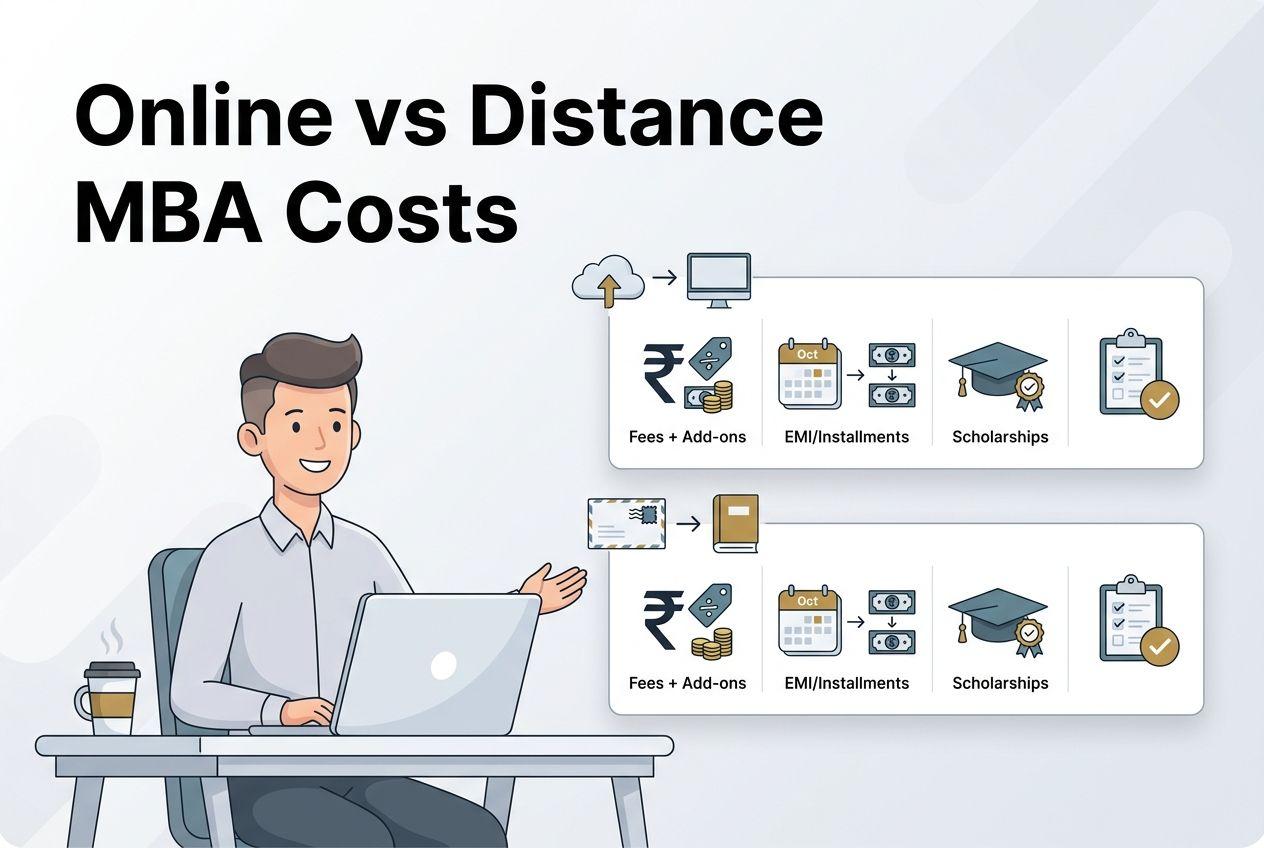
Online vs. Distance MBA Costs: A Detailed Comparison of Program Fees, EMI Options, and Scholarships

Learning Routes profile
Author

Learning Routes

Published on 09 May, 2026

Online vs. Distance MBA Costs: A Detailed Comparison of Program Fees, EMI Options, and Scholarships

You’ve been comparing program pages for weeks, and the numbers don't add up. One university advertises ₹1.5 lakhs in fees, another says ₹2.8 lakhs. The problem is, neither figure seems to include exams, the learning platform, or that “nominal alumni fee” buried in the FAQ.

This is the core issue when comparing MBAs. The "cheaper" program isn't always the one with the lower sticker price. Your real cost includes hidden fees, financing terms, and the quality of career support that determines your return on investment. Online and distance MBAs are priced and supported differently. This guide will help you compare them like a true purchase decision, not a brochure scan.


The only fair way to compare MBA costs: think “total cost,” not just tuition

Most people start by comparing tuition fees. That’s a mistake. The only fair way to compare MBA costs is to think in terms of “total cost,” not just tuition. Your actual spend is several line items, not just one. Before you can make a sound comparison between an online and a distance MBA, you need a complete picture of what you'll pay, both directly and indirectly.

Total Cost of Ownership (TCO) checklist

Copy this into a note or spreadsheet (seriously, do this) and fill it in for each program you're evaluating.

Direct fees:

  • Tuition/program fees (per semester or lump sum)
  • Examination fees (per attempt or per semester, as some programs charge separately)
  • Technology/LMS access fee (for the platform, app, or digital library)
  • Registration or enrollment fee (one-time and often non-refundable)
  • Project submission or dissertation fee
  • Convocation or degree-issuance fee
  • Study material charges (if not included)
  • Alumni membership fee (sometimes mandatory)

Financing costs:

  • Processing fee on installment plans
  • Interest charges (if an EMI is not truly zero-cost)
  • Late payment penalties

Indirect/opportunity costs:

  • Cost of time spent studying instead of upskilling elsewhere
  • Any exam prep materials or coaching you'll need
  • Travel costs for in-person exams (some distance programs require physical exam centers)

That last category matters more than most candidates account for.

Opportunity cost: why “keep working” changes the math

The biggest financial advantage of both online and distance MBA formats is the one people forget to count: you don't stop earning. A two-year full-time MBA at a residential program might cost ₹15–25 lakhs in fees alone, but you also lose two years of salary. That opportunity cost can easily exceed ₹20–40 lakhs depending on your current CTC.

When you study online or by distance, you keep your income. Your employment history stays uninterrupted. Your employer may even reimburse part of your fees. This is what makes a ₹2.5 lakh online MBA genuinely more affordable than a ₹10 lakh residential program for a working professional, even if it looks far more expensive than a ₹90,000 distance program when you just compare tuition.


Program fees compared: what you’ll typically pay in Online MBA vs Distance MBA

Both formats are more affordable than full-time residential programs, but they aren't structured the same way. Those structural differences affect where financial surprises show up.

Tuition vs program fees: what’s usually included (and what isn’t)

When a university publishes a fee, they usually mean tuition, which is the academic delivery component. What this includes varies considerably.

  • Online MBA programs often bundle LMS access, live session recordings, and digital study materials into the program fee. Exam fees, however, are frequently separate. So are project evaluations, certification add-ons, and convocation registration.
  • Distance MBA programs may keep tuition lower, but study materials (especially printed ones), exam fees per semester, and exam center access charges are often listed separately. Sometimes they aren't listed at all until you're at the fee payment stage.

Neither format is inherently more transparent. Before treating any figure as final, you have to ask what the published fee does not include.

Common add-ons that change your total (admin, tech/LMS, exam, projects, misc.)

Here are the categories where candidates most often encounter unexpected costs:

Exam fees: Some programs charge ₹500–2,000 per exam, per attempt. Over a full program with multiple semesters, that accumulates. If the program allows re-attempts, confirm whether re-exam fees apply.

Technology fees: Online MBA programs may have a platform or LMS access fee that's separate from tuition. This can be a one-time or annual charge. Distance programs with online portals may charge similarly.

Project/dissertation fees: Fees for end-of-program project submission, viva voce, or dissertation evaluation are common and rarely included in the headline number.

Convocation and degree fees: The fee for your actual certificate issuance is sometimes separate, particularly for distance programs affiliated with state open universities.

Late fees: If you miss a fee deadline, late payment charges can apply. Some programs have fixed penalty windows while others are more flexible. Know this policy before you're in a cash-flow squeeze.

Real-world comparison method: build a one-page fee summary for each shortlist program

For each program on your shortlist, request a complete, semester-wise fee schedule in writing. Then, use it to fill in your TCO checklist. Once you have three to five programs on a one-pager, you'll often find that a mid-range program with bundled fees and good EMI terms is a better value than the one with the lowest headline price.

Learning Routes' AI-based College Finder can help you shortlist and compare programs side by side before you talk to five different admissions teams. Compare first, then apply the checklist to your shortlist. That sequence saves time.


EMI and installment options: how they work, what terms to confirm, and red flags

Most working professionals prefer to pay in installments, so nearly every MBA program offers a payment plan. The challenge is figuring out if that plan is truly affordable once you read the fine print.

EMI vs installments: what programs usually mean by each

These terms are often used interchangeably, but they describe different payment mechanisms.

Installments are typically semester-based or term-based fee splits arranged directly with the university. You pay at fixed intervals, for example, at the beginning of each semester. No third-party lender is involved. There's often no interest, but there may be a small processing fee or mandatory down payment.

EMI (Equated Monthly Installment) usually means a formal financing arrangement through a bank, NBFC, or education loan partner. You make equal monthly payments over a fixed tenure. The interest structure is what matters here. "0% EMI" offers may carry a processing fee, and the monthly amount is fixed regardless of your cash flow situation.

Some programs offer both options.

Terms to check before you say yes (tenure, interest/fees, down payment, penalties, refunds)

Before you agree to any payment plan, confirm the following in writing:

  • Tenure: How many months or semesters does the plan span? Does payment extend beyond graduation?
  • Interest rate or processing fee: "0% interest" doesn't mean zero cost. Ask specifically about any processing fees, pre-closure penalties, or late payment charges.
  • Down payment: Is there a mandatory lump sum at enrollment? For tight budgets, a ₹15,000–25,000 upfront requirement is a big deal.
  • Refund policy: If you need to exit the program early, what is the refund timeline and amount? Are per-semester installments already paid considered non-refundable?
  • Penalty for late payment: Some programs charge a fixed late fee. Others may hold your semester results or exam registration.

A red flag to watch for: if a university can't provide a written fee schedule and installment terms before you pay the enrollment fee, it’s a sign their structure isn't well-organized. This increases your financial exposure.

“Affordable per month” calculation (simple steps)

To evaluate if a program fits your budget, do this simple math before you get attached to a program.

  1. Take the full TCO from your checklist (tuition plus all add-ons).
  2. Add any financing costs like processing fees or interest.
  3. Divide by the number of months you'll be paying.
  4. Compare that monthly figure against what you can realistically set aside after your current expenses.

If the monthly number works, you're evaluating the right program tier. If it doesn't, even for a "low-cost" option, that program will create financial stress. Financial stress is a key reason people don't complete their degrees.

During admissions planning, a counsellor from Learning Routes can help you confirm installment availability, understand fee payment steps, and prepare documentation for enrollment, all before you've committed anything financially.


Scholarships and financial aid: what exists, what’s more common, and how to improve your chances

Scholarships for online and distance MBAs are available, but they aren't always well-publicized. Researching them early is critical to managing your total cost.

Scholarship categories to look for (merit, need-based, women, corporate, alumni, early-bird, etc.)

Here are the main scholarship types that show up across programs:

  • Merit-based: Based on academic performance like graduation percentage or entrance exam scores.
  • Need-based: Based on household income documentation. These are more common at open universities.
  • Women in leadership scholarships: Several private online MBA providers offer these, so ask specifically.
  • Defence / ex-serviceman scholarships: Often available at government-affiliated universities.
  • Early-bird discounts: If you pay by a certain date before the semester starts, a percentage comes off. It’s technically a discount, but it functions like a scholarship for planning purposes.
  • Corporate/employer sponsorship: Your employer may have a tie-up with a university or an education reimbursement policy.
  • Alumni referral discounts: If you know someone who completed the program, ask them about this. It's a surprisingly common and under-utilized discount.
  • Entrance exam toppers: Some programs waive fees partially for candidates with strong GMAT, CAT, or equivalent scores.

Online MBA programs tend to offer more structured scholarship programs, as they are often run by private universities with dedicated admissions budgets. Distance programs, particularly from open or state universities, may offer need-based and category-based scholarships through government schemes.

How to validate eligibility and deadlines (and avoid scholarship “marketing”)

Not every scholarship listed on a program page is current or easy to claim. Before factoring a scholarship into your budget, ask the admissions team for specifics:

  • The exact scholarship name, amount, and application deadline.
  • The required documents (mark sheets, income certificate, etc.).
  • The application process (is it automatic or a separate application?).
  • Which fees the scholarship covers (tuition only, or all components?).

If a program can't answer these questions, mark that scholarship as unconfirmed in your TCO worksheet.

Stackability: combining scholarships + employer reimbursement + installments

Here's a move many candidates don't try: stack your affordability levers. An early-bird discount (say, 10%) combined with an employer reimbursement policy (even a partial one of ₹30,000–50,000 per year is common) and a semester-based installment plan can significantly reduce your out-of-pocket cost.

Check your company's HR policy on education reimbursement before assuming it doesn't exist. Many employees discover this benefit only after they've already paid in full.

Learning Routes counselling can help you identify scholarship options and match them against your eligibility, so you're not leaving money on the table.


ROI and employer perception: which format protects your career upside?

Cost comparisons only make sense if the credential delivers real career value. A cheap program from an unrecognized university isn't affordable. It's an expensive mistake. The key is to evaluate which format best protects your career upside.

Employer perception: online vs distance—what tends to matter in practice

Employers, especially in sectors like IT, consulting, and large corporations, tend to evaluate MBA credentials on a few practical signals.

  • University recognition: Is the university UGC-approved and NAAC-accredited in India? Is the online program delivered under the Distance Education Bureau (DEB) framework?
  • Program structure: Online MBA programs delivered through live sessions and proctored assessments are increasingly viewed as rigorous. Distance programs with a pure correspondence delivery may carry lower perceived weight in certain sectors.
  • University brand: A well-known university's online MBA often carries more recognition than an unknown university's in-person MBA. Brand still matters.
  • Degree certificate language: Does the certificate specify "online" or "distance"? This varies by university and can affect how an HR team reads the degree.

None of this means distance MBAs are unrecognized. Many carry genuine credibility, especially from reputed open universities. But employer perception isn't uniform, and it's a variable you should verify before enrolling.

Career services & alumni network: how to evaluate quality before enrolling

Many programs list "career support" in their brochures. What that actually means can range from an active placement cell to a PDF of job sites. Ask these questions:

  • Does the program offer structured placement assistance, or is it self-service?
  • Can online and distance students access the same career portal as full-time students?
  • Is there a live alumni network with actual community activity (like events and mentorship), or is it just a directory?
  • What is the typical outcome for students in your industry or role profile?

The answers often determine whether a ₹2 lakh program or a ₹4 lakh program is the better investment.

ROI checklist: when the "cheaper" option becomes the expensive mistake

A program is a poor ROI if:

  • The university isn't recognized by the relevant regulatory body in your country.
  • The program provides no meaningful career support beyond a certificate.
  • Employers in your target sector don't recognize the credential for promotions or hiring.
  • The payment terms create financial stress that affects your work performance.

The cheapest program that checks all four of these boxes is still a bad deal. The moderately priced program that passes all four is the correct trade-off.


Decision checklist: choose Online MBA vs Distance MBA based on your constraints

Choose an Online MBA if…

  • You want structured, live interaction with faculty and peers and will actually attend the sessions.
  • Your target employers are in sectors like IT, BFSI, or consulting where credential perception matters.
  • You're comfortable with a slightly higher fee in exchange for better career support and live learning.
  • Your schedule is fixed enough to commit to synchronous class sessions each week.

Choose a Distance MBA if…

  • Your schedule is highly unpredictable and self-paced study genuinely fits your life better.
  • Your target role or employer is less credential-sensitive and mainly cares that you hold an MBA.
  • You're pursuing the degree primarily for internal promotion at your current employer, who already knows your work.
  • You need the absolute lowest monthly payment and a program from an accredited university meets your needs.

Questions to ask universities before paying any fee (copy/paste script)

Use this on your next admissions call or email:

  1. Can you send me a complete, semester-wise fee schedule including all charges, such as exams, technology, project, convocation, and registration?
  2. What is your installment or EMI structure? Is there a down payment, processing fees, or interest charges?
  3. What is your refund policy if I need to withdraw after paying the first installment?
  4. Are there active scholarships available right now? What are the eligibility criteria, amount, and application deadline?
  5. Is this program recognized under UGC-DEB (or the equivalent regulatory body for my country)?
  6. Does the degree certificate mention "online" or "distance"? How does that typically read in your placement reports?
  7. Do online and distance students get access to the career services portal and alumni network?
  8. What is your late payment policy if I miss a fee deadline?

If a university can't answer these questions specifically and in writing, that's your answer.


Shortlist and compare MBA programs (with fee and payment clarity)

The next step is to use this framework on a real shortlist of programs. Use Learning Routes' AI-based College Finder to compare online and distance MBA options, then get a free counselling session to verify the fee structures, payment plans, and admission steps for the universities you're considering.

Enquire now to get your free career consultation and compare your shortlist with full cost and payment clarity.

Every query is necessary.

Our team of experts, or experienced individuals, will answer it over online meet. Book your slot now!

Book Free Online Counselling
Learning Routes - Author

Learning Routes Content Expert

Read more
Learning Routes Editorial Team - Editor

Edited by: Learning Routes Editorial Team Content Editor

Reviewed and verified by the Learning Routes editorial team.


Get Free Career Guidance

enquiry
logo
The intend of Learning Routes is to provide unbiased, precise information & comparative guidance on Universities and its Programmes of Study to the Admission Aspirants. The contents of the Learning Routes Site, such as Texts, Graphics, Images, Blogs, Videos University Logos, and other materials (collectively, 'Content') are for information purpose only. The content is not intended to be a substitute for in any form on offerings of its academia partners. Infringing on intellectual property or associated rights is not intended or deliberately acted upon. The information provided by Learning Routes on www.learningroutes.in is for general information purposes only. All information on the site is provided in good faith with accuracy and to the best of our knowledge, however, we make no representation or warranty of any kind, express or implied, regarding the accuracy, adequacy, validity, reliability, or completeness of any information on the Site. Learning Routes & its fraternity will not be liable for any errors, omissions, damages, or losses resultant, if any, from the usage of fit information.
Contact Us:
Get Free Counselling
07965800489

Scholarships UPTO 10% for online degrees

Enquire Now