Top Digital Marketing Trends in 2026: AI, Personalization & the Future of Marketing

Top Digital Marketing Trends in 2026: AI, Personalization & the Future of Marketing

Did you know 60% of consumers in 2026 are influenced by different digital content for discovering new brands, leading to decision-making? This is not a coincidence; it is the power of digital marketing. More than 72% of the marketing budget has been allocated to digital marketing channels over the past few years. 

But why should you know this? Because 43% of of the digital marketing trends make brand interactions more personalised, leading to positive outcomes and higher visibility. It matters more in 2026 as 62% of consumers say that they are likely to purchase from a brand which has personalised communication. 

Today, digital marketing is about AI-powered personalisation, hyper-personalisation, and human-driven content. The digital marketing landscape is evolving at the speed of light, and if you don’t keep up with it, you will be left behind. If you are a digital marketing professional, business owner or someone looking to break into this field, having a thorough understanding of the current market trends is crucial. In this detailed guide, we have discussed the top digital marketing trends for 2026 to help you stay on top of the curve. 
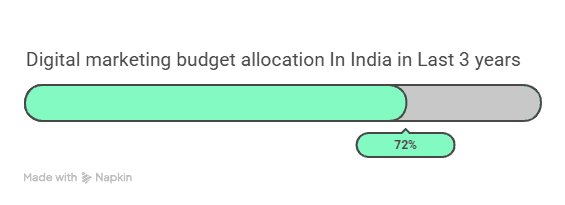
image.png

What is Digital Marketing?

Before exploring the trends, let’s quickly understand digital marketing. In technical terms, it is the practice of promoting products, brands or services using digital channels like search engines, websites, email, mobile apps and some messaging platforms. It covers everything from SEO and content marketing to influencer collaborations and customer engagement strategies.


To put it simply, digital marketing is about reaching your target audience on the platform where they spend most of their time. However, you don’t just have to be present online; you need to create meaningful connections, deliver value, and build trust.

Why is Digital Marketing Changing in 2026?

Digital marketing is a field which never stays the same. Based on the technological advancements and consumer behaviour, it constantly changes. Here’s what makes 2026 different from before: 

  • AI is now functional, not experimental: AI has moved beyond the pilot project phase and is now used fully in every workflow. According to the research, 70% of the marketing professionals are using or planning to use AI for content creation, campaign optimisation, personalised experience and customer insights. The winners are those who pair AI efficiency with human intelligence.
  • Data regulations have tightened: Browsers like Safari, Firefox, and Chrome are phasing out third-party cookies. This means that strict data laws are prevalent in Indian markets, according to which marketers must rely on first-party data. Therefore, building trust has become essential.
  • Search has become AI-driven and conversational: Gone are the days when people were typing keywords in search engines. Today, they ask full questions while expecting direct answers and sometimes use AI tools like ChatGPT for clear answers. You must have noticed that search engine results are not summarised by AI, which means that SEO strategies need a serious upgrade. The research states that approximately 26% of marketing professionals are using AI for generative AI in search. This shall make the content more relevant and insightful.

Also Read: Top 10 Entry-Level Digital Marketing Jobs & Salaries in India

In the last two years, marketing professionals have been searching for AI tools and what to do with them. In 2026, everyone wants to know how to leverage AI at its full capacity to make a real impact. With this in mind, let’s explore the top digital marketing trends of 2026. 

AI Agents Taking Over Execution: 

AI has already streamlined much of the marketing team's content production. According to the HubSpot State of Marketing Report, 2026, suggests that 47% of marketers are already shifting from old SEO trends to automation. This shall make the marketing processes more streamlined and efficient. While 92% of marketers are leveraging AI agents and automation for data analysis and reporting. 

And many of them plan to extend their usage to day-to-day operations. These agents are embedded in AI tools which help manage your customer relationship management data, analyse data performance, provide campaign insights and adjust ad bids for paid campaigns in real time. 

Example: You can use an AI agent to enhance your customer service interaction with a virtual assistant. So in simple terms, AI agents are systems that follow instructions, make decisions, take actions, and optimise without human intervention. Here are some of the platforms which are leading the way: 

Platforms 

Used for

Jasper AI, Copy.ai, Writer

for AI-assisted content marketing

Salesforce, Hubspot 

for CRM and campaign automation 

Google Gemini, Meta AI Studio 

for ad creatives and optimisation 

ChatGPT, Claude

for internal workflow automation 

Also Read: Digital Marketing Course by Google: All you Need to Know

Optimisation Becoming Mandatory: 

The default mindset of search on Google is over now. For the last few years, search everywhere' has been in the market; today, it has become a baseline for survival. SEO has become more of a search-everywhere optimisation and less of a search engine optimisation. The audience is not just Googling it; they are asking questions and seeking validity across platforms. 

Example: A Reddit user wants deep and authentic discussion, and YouTube demands longer, high-value content with strong engagement. Here’s what people are searching for in 2026: 

  • Search engine results pages (SERPs) now lead with AI-generated summaries, which means your content must be structured to be quoted by AI, not just ranked on page one.
  • The world's second-largest search engine. Users search YouTube for tutorials, product reviews, how-tos, and comparisons. Today, long-form, high-value video content with strong engagement signals dominate here.
  • Platforms like Reddit are increasingly preferred for authentic, unfiltered discussions and recommendations.
  • Nowadays, visual search is booming. That is why users search platforms like Instagram and Pinterest for aesthetics, fashion, food, home décor, and travel inspiration. 

So, you should audit where your target audience searches, create platform-specific content for each channel, and optimise every piece of content to be quoted, saved, and shared. 

Hyper-Personalisation and Conversational Ecommerce:

Marketers are increasingly striving for personalisation. And that’s the pain point AI has targeted. According to another recent report, the hyper-personalisation market size shall grow at a CAGR of 18.1%. Using AI agents as a primary interface between marketers and users, companies are transforming how consumers interact with products and services. For example, some e-commerce companies plan to add AI-powered price recommendations and an image search tool. 

Let’s see what’s hyper personalisation in today’s market: 

  • Dynamic website content: E-commerce platforms now display different homepages, product carousels, and pricing based on a user's browsing history, location, loyalty tier, and real-time behaviour.
  • AI-driven recommendation: Azon, Myntra, and Nykaa are already doing this, but now, even mid-sized companies can deploy recommendation engines.
  • WhatsApp market: In India,  WhatsApp has emerged as a powerful e-commerce channel. Some of the top brands are using WhatsApp Business to send personalised product catalogues, handle orders, and run engagement campaigns.
  • Image and visual search: Tools like Google Lens allow users to search with photos instead of words. These days, brands optimising product images for visual search are gaining a significant advantage. 

Micro-Moment and Context-Driven Marketing: 

Readers skim content online. Delivering small, highly useful content assets at the exact moment is useful. Micro-assets like tables, checklists, and one-page PDFs get saved and shared. They are also favoured by AI summaries for precise and helpful information. Therefore, in 2026, downloadable mini assets will answer one specific question or event-triggered WhatsApp messages. Here is an overview of the micro-moment content ideas that work today. 

  • Short explainers, FAQ snippets, and definition sections are quite in.
  • Step-by-step checklists, how-to videos under 60 seconds, and downloadable templates.
  • Comparison tables, review summaries, and price-at-a-glance cards. These micro-assets are especially powerful when delivered through paid ads.
  • Abandoned cart reminders, birthday offers, post-purchase follow-ups, and re-engagement sequences based on inactivity windows. 

Social Platforms Function as Search Engines 

As mentioned above, the search-everywhere trend is at the top. Based on various reports, many people treat social media as their starting point for search and product reviews. For example, people search YouTube to see how things work and Instagram to see fashion trends. 

What does this mean for marketers? Each platform has its own ecosystem with its own algorithm, content format preferences, and audience behaviour. A one-size-fits-all social strategy no longer works. You need platform-specific content strategies and native format content creation for each channel. 

Focus on Ad Creatives:

Even paid advertising has become challenging, even when you have fixed parameters and a niche target audience. More and more platforms are integrating with AI, so automation has now become important rather than a choice. For example, Reuters reported Meta’s platforms aim to enable brands to create and target advertisements entirely with AI-integrated tools by the end of 2026. Make sure you have a good number of creatives and formats to test what works.  Here are some of the Ads Ruling 2026: 

  • Search Ads
  • Social media ads
  • Influencer and creator ads
  • OTT ads

Invest in a diverse creative library, multiple formats, aspect ratios, and messaging angles. You should test constantly. The AI-powered ad platforms reward advertisers who give them more creative variation to work with. A good rule of thumb is to have at least 5–10 creative variants per campaign. 

Actionable Framework you can use Today

Here are some of the ready-to-use tips that can be used immediately. 

  1. The WhatsApp care model to help you deliver an advanced customer service experience, including four steps: Calm, assist, reassure, and execute.
  2. The brand targeting Indian audiences should follow the India stack playbook, in which you should have native video proofs, create content in English and Hindi, etc.
  3. Prioritise the first-party data ladder to collect customer data progressively.
  4. Use the generative engine optimisation (GEO) canvas so that every section of your content becomes quotable by AI. 

Related: Top 10 Career Options After MBA in Digital Marketing

What Skills Do Digital Marketers Need in 2026?

Digital marketing is not a theoretical field. The skill set required to thrive in digital marketing has expanded significantly. It's no longer enough to know how to run meta ads or write blog posts; today's digital marketers need a blend of technical competence, creative thinking, and data literacy. The focus is now on generating quality leads that shall come with personalisation,  mastering marketing analytics, creating customer personas, focusing on story, and finally providing value.

Here are some of the digital marketing skills you must focus on in 2026:

  • Learn AI prompt writing: The ability to write effective prompts for tools like ChatGPT, Claude, Gemini, and Jasper is quickly becoming a foundational skill. Those of you who can direct AI tools precisely will produce better output faster.
  • Master data analytics: Having proficiency in analytics tools and techniques can give you an edge in the market.
  • Understanding of marketing automation: You should focus on gaining hands-on experience in automation tools and their real-time application.
  • Paid media management: Having an understanding of campaign structure, bidding strategies, audience segmentation, and creative testing across various platforms is beneficial.
  • Learn about consumer psychology as a marketer: Understanding why people make decisions makes every campaign more effective.  

Best Courses to Learn Digital Marketing 

Whether you are starting from scratch or looking to upskill, the following courses and platforms offer structured, industry-relevant learning. Let’s take a look at the popular digital marketing certifications in 2026

Course Name 

Offered by 

Fees

Digital Marketing Certification Course 

HubSpot

Free

Digital Marketing Specialisation at University of Illinois

Coursera 

Subscription based 


Advanced Certificate in Digital Marketing 

upGrad

INR 65,000

AI for Everyone by DeepLearning AI 

Coursera 

Subscription based 

Advanced Certification in Digital Marketing and Communication at MICA 

upGrad

NA

Also Read: Best Online Certificates in Digital Marketing to Study

Summing Up 

Digital marketing has moved at an unimaginable speed. In 2026, it is all about finding the perfect balance between technology and humanity. This is where AI can help you scale, personalise and optimise your marketing strategies. You don’t have to implement everything at once; start with the one that aligns best with your business goals and interests. If you wish to stay ahead in the fast-changing scenario of digital marketing, keep up with the latest trends. 

FAQs 

Q1. Is digital marketing still in demand in 2026?

Digital marketing is one of the most promising career paths in 2026. Many businesses across different industries now depend on online platforms to reach out to customers. 

Q2. Will AI replace digital marketers?

No, AI will not completely replace digital marketing professionals. However, it will reshape the workflow and operations of the field. It can be used to automate your tasks and increase your efficiency. 

Q3. What is the scope of digital marketing in 2026?

The scope of digital marketing is extremely high as businesses are evolving with a digital-first approach. That is why demand for skilled professionals is increasing, and so is the scope for higher earning potential. 

Q4. What are the top 7 types of digital marketing?

Search engine optimisation, social media marketing, content marketing, pay-per-click (PPC), email marketing, influencer marketing and affiliate marketing are the top 7 types of digital marketing. 


Every query is necessary.

Our team of experts, or experienced individuals, will answer it over online meet. Book your slot now!

Book Free Online Counselling

Aarshi - Author

Aarshi Content writing / Copywriting

LinkedIn Profile

Aarshi Katiyar is a lawyer-turned web content writer at Learning Routes, where she brings over two years of experience in crafting impactful educational digital content. She specialises in education-focused blogs, SEO-driven narratives, and compelling social media posts. She aims to deliver insightful, research-backed writing that resonates with students and professionals alike.

Read more
Isha - Editor

Edited by: Isha Education Counsellor / Editor

LinkedIn Profile

Isha Jain holds a Bachelor's degree in Literature along with a Diploma in Digital Marketing, bringing a strong foundation in communication and content creation. With over 7 years of hands-on experience in the education domain, she has crafted impactful content across various formats - ranging from educational blogs and news articles to video scripts, newsletters, and learner-focused campaigns. As the editorial lead at Learning Routes, Isha plays a key role in shaping content that empowers students and working professionals to make confident choices about online courses and career-building certifications. Her deep understanding of the online education space is reflected in her writing, which aims to simplify complex decisions and provide real-world clarity to learners. Beyond her professional role, Isha has also written extensively on lifestyle and digital learning trends. She is passionate about guiding students and loves engaging in conversations around career development on platforms like LinkedIn, Quora, and Reddit. Whether it's recommending the right upskilling path or demystifying online education, she has helped countless learners take confident steps toward their goals. In her spare time, you’ll find Isha reading, traveling, or playing sports to stay active and inspired.


Get Free Career Guidance

enquiry
logo
The intend of Learning Routes is to provide unbiased, precise information & comparative guidance on Universities and its Programmes of Study to the Admission Aspirants. The contents of the Learning Routes Site, such as Texts, Graphics, Images, Blogs, Videos University Logos, and other materials (collectively, 'Content') are for information purpose only. The content is not intended to be a substitute for in any form on offerings of its academia partners. Infringing on intellectual property or associated rights is not intended or deliberately acted upon. The information provided by Learning Routes on www.learningroutes.in is for general information purposes only. All information on the site is provided in good faith with accuracy and to the best of our knowledge, however, we make no representation or warranty of any kind, express or implied, regarding the accuracy, adequacy, validity, reliability, or completeness of any information on the Site. Learning Routes & its fraternity will not be liable for any errors, omissions, damages, or losses resultant, if any, from the usage of fit information.
Contact Us:
Get Free Counselling
07965800489

Scholarships UPTO 10% for online degrees

Enquire Now