
Explore Courses
Top University
Search anything
 Refer and Earn ₹ 5000
Jagpreet
Published on 23 April, 2026

Learning Routes Editorial Team
Reviewed and updated

A Bachelor of Arts is one of the most sought-after graduation degrees, pursued at the UG level in India. However, individuals often feel stuck after completing a BA, as the follow-up course is mostly a Master of Arts (MA) in a similar subject. However, that's not a limitation.
An MBA degree is one of the courses that do not require you to have a graduation in a particular domain. Whether it's BA, BCom, BCA, or BBA, you can always pursue an MBA for career growth. Having an MBA after BA degree could broaden your career choices, job options, and salary potential. This blog discusses the benefits of pursuing an MBA after a BA, along with career opportunities and salary prospects. Learn about the eligibility criteria for MBA after BA, the admission process, scholarships available, and more.
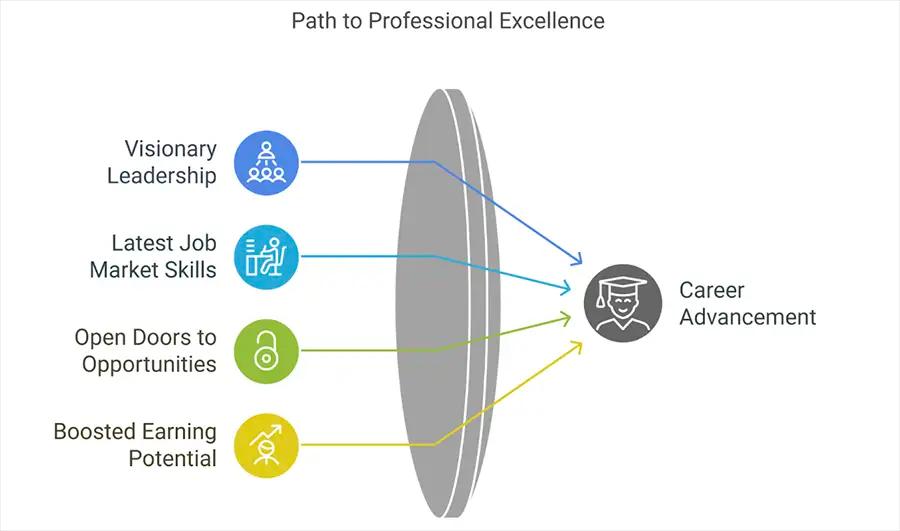
There are multiple benefits of doing an MBA after a BA. MBA after BA is a smart choice for graduates aiming to enhance their career growth. It offers you industry-ready skills in various domains. Moreover, MBA grads are highly in demand among employers for managerial and senior-level positions. Check out several more benefits of pursuing an MBA after BA here:
Take the reins of your career. An MBA will open the doors of multiple job roles and industries for you. After an MBA, you can apply for jobs in different sectors, including IT, finance, HR, and more. The career advancement path for a BA graduate after completing an MBA is filled with multiple opportunities. One of the most outstanding examples of career advancement after an MBA is that you can transition your career to any position you want, from working as a financial analyst to working as a project manager. The chances are high. The career potential rises post-MBA after a BA.
The MBA programme is not just a degree programme; it is filled with subjects, projects, workshops, and webinars to enhance your skills, including your problem-solving or analytical skills. An MBA programme will give you the ninja expertise to gear up with the latest skills for the job market requirements. Through the meticulous coursework, you would also get to enhance your soft and hard skills.
The scope of MBA after BA is vast, offering wide career paths. Break free from traditional career paths associated with your BA. An MBA opens doors to a vast array of exciting possibilities, allowing you to explore new fields and ignite your passion for business. There are multiple modes to complete an MBA after a BA. You can pursue an MBA while you work full-time or part-time.
An MBA is delivered in different modes. You select this based on your personal lifestyle, time schedule, work schedule, budget, and location. With the right specialisation, the scope of MBA after BA includes opportunities in startups, consulting firms, and even government sectors.
Here are some of the modes of delivery for an MBA programme across the nation, and who the ideal student is for each mode of delivery:
Part-time MBA: Working professionals, career changers and residents
Full-time MBA: Recent graduates, career accelerators, international students
Online MBA: Busy professionals, self-motivated learners, geographically remote students
Distance MBA: Remote workers, independent learners, cost-conscious students
One of the key benefits of MBA after BA is the ability to shift into various sectors. MBAs are highly valued credentials in the business world. Graduates of an MBA often command significantly higher salaries than those with just a BA degree. Once you complete an MBA after a BA, you would be increasing your income to at least double what you could get after a BA.
For example:
BA Graduate Salary: The average salary for a BA graduate ranges from INR 2,00,000 to INR 5,00,000 per year.
MBA Graduate Salary: The average salary after an MBA in India ranges from INR 4,00,000 to INR 23,00,000 per year.
As you can see, the difference between the salaries is double-fold. This proves that an MBA after a BA can provide you with a higher salary package depending on your industry, experience, skills, university, and interests.
Are you still wondering why an MBA after a BA is a powerful move? Well, there’s more on the plate of an MBA. Here is why:
Now that we have covered the different aspects of an MBA after a BA, let’s take a look at the list to find out if you are the right fit for an MBA or not. Here is a quick list to find out if an MBA after a BA is the perfect choice for you:
The beauty of an MBA lies in its diverse specialisations. An MBA has multiple specialisation options; excitingly, you can also choose a dual specialisation course. Students pursuing an MBA after BA can choose fields like marketing, international business, HR, or operations to align with their interests and job market trends. One of the most crucial choices you need to make after a BA is to pick the right specialisation for an MBA. You can pick an MBA specialisation based on your:
✅ Skills
✅ Career Interest
✅ Limited Budget
✅ Location
| MBA after BA Specialisations | MBA Specialisations after BA |
| 1. MBA in General Management | 13. MBA in Business Analytics |
| 2. MBA in Marketing Management | 14. MBA in Entrepreneurship |
| 3. MBA in Digital Marketing | 15. MBA in International Business |
| 4. MBA in Human Resources | 16. MBA in Leadership |
| 5. MBA in Finance | 17. MBA in Project Management |
| 6. MBA in Operations Management | 18. MBA in Banking and Finance Management |
| 7. MBA in Healthcare Management | 19. MBA in Finance and Accounting |
| 8. MBA in Information Technology | 20. MBA in Hospitality Management |
| 9. MBA in Rural Management | 21. MBA in International Trade Management |
| 10. MBA in Logistics & Supply Chain Management | 22. MBA in Retail Management |
| 11. MBA in Event Management | 23. MBA in Business Management |
| 12. MBA in Accounting |
The biggest question right now for you is, “Am I eligible?” Well, the BA degree has taught you tonnes of skills, including research, analysis, report writing and critical thinking. You can benefit from these skills to pursue an MBA course after a BA. Moreover, if you have completed your BA graduation with at least 50% - 55% marks from a recognised institution, then yes, you can pursue an MBA after BA. However, here are some of the eligibility criteria you need to tick to get admission to an MBA programme.
Here’s how to determine your eligibility for an MBA after a BA:
Make sure you have scanned copies of your ID card, passport, degree certificate, and any other documents requested by the universities you target.
Yes, an MBA degree is open to everyone regardless of the specialisation. Unless you choose an MBA in AI, data science, or statistics-related fields, you would not need a mathematical background at most institutes. An MBA is considered one of the best options after BA, as it offers you many lucrative career opportunities. Additionally, it does not have specific subject requirements in a BA course, making it an ideal choice for every BA graduate.
To apply for an MBA after BA, you should first decide on the mode of education. Whether you want to pursue an MBA full-time, regular, online, part-time, or distance learning. Then you are required to choose a recognised MBA college and check for eligibility. If you are eligible for an MBA, depending on the requirements of your chosen college, you can apply for an MBA after BA. Here is the detailed step-by-step process to apply for an MBA after BA course:
Research & Explore: Research the different MBA programmes you are interested in, especially the specialisation that you want to pursue.
Target Your Universities: Shortlist universities that offer the programmes you want and that fit your budget and location preferences.
Eligibility Check: Make sure you tick all the eligibility criteria
Entrance Exam Preparation: Start preparing for entrance exams (CAT, XAT, MAT, etc.)
Take the Exams: Schedule and take the required entrance exams.
Secure Recommendations: Request strong letters of recommendation from professors or past employers.
Craft a Compelling Personal Statement: Write a compelling personal statement that highlights your academic achievements, career aspirations, and unique value proposition.
Application Time: Carefully complete application forms for your chosen universities, ensuring accuracy and completeness.
Gather & Submit: Collect all necessary documents (transcripts, certificates, essays), pay the fees, and submit them with your applications.
Track Your Progress: Follow up with universities to confirm receipt of your application and monitor the selection process.
*Note: Many top colleges allow you to pursue an MBA after BA without an entrance exam. In that case, you just need to apply online for the MBA course, submit documents, pay fees in person (if required) and get your admission done.
Pursuing an MBA after a BA offers more advantages than it may appear at first glance. If you have worked after a BA, then it would also count as a plus point in your favour for admission into some of the top B schools in the country. If you have worked in fields such as research, content creation, analysis, marketing management, or human resource management, it can greatly enhance your chances of being accepted into top business schools in your city.
Gaining work experience before pursuing an MBA is advantageous as it allows you to apply practical knowledge to your studies and highlight it on your CV. Many MBA programmes value applicants with professional experience, and several universities, including IIM Ahmedabad, ISB Hyderabad, INSEAD, the London Business School, Harvard Business School, and the Stanford Graduate School of Business, prefer candidates who have prior work experience before undertaking an MBA.
So, can you do an MBA after a BA? Yes! However, having relevant work experience from 1-3 years after a BA in history can also increase your chances of getting into a better MBA college.
A Bachelor of Arts is basically a foundational course in your chosen area. Regardless of the discipline, it emphasises research, report writing, brainstorming ideas, etc, making you an ideal candidate for an MBA. If you want to check your skills for an MBA after a BA, then here are some essential skills that you might have already developed after a BA, which are necessary in the MBA programme:
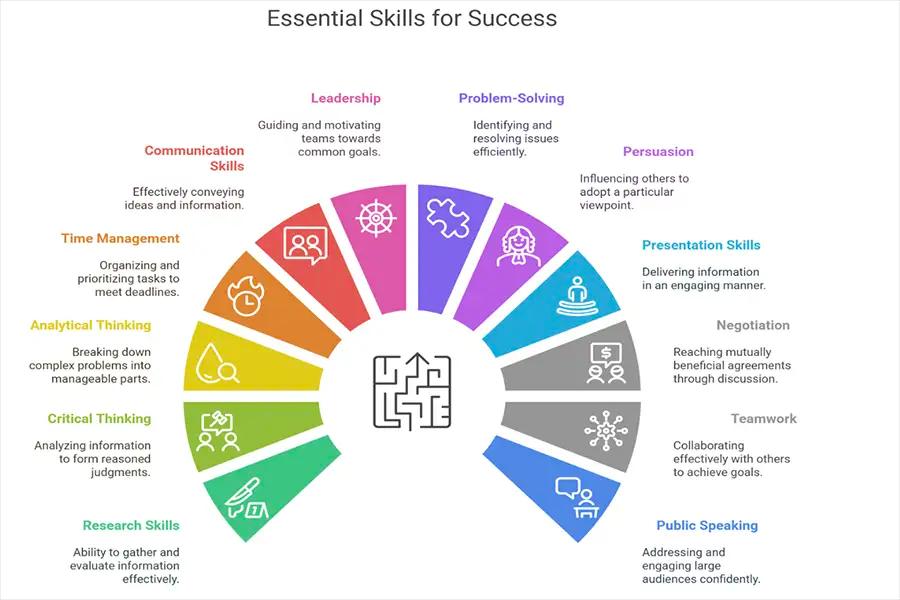
| MBA after BA Skills | Complementary Skill |
|---|---|
| Research Skills | Critical Thinking |
| Analytical Thinking | Time Management |
| Communication Skills | Leadership |
| Problem-Solving | Persuasion |
| Presentation Skills | Negotiation |
| Teamwork | Public Speaking |
The cost of an MBA can be a hurdle, but don’t let it demotivate you. There are multiple ways to fund your MBA programme in India. Some of the ways include various financial aids, fee waivers, and scholarships (private and Government) that are available to help ease the burden:
Here are some top universities, institutions, and private organisations that provide scholarships for MBA students:
Aditya Birla Group Scholarship
T. Thomas Scholarship (IIM Ahmedabad)
IDFC FIRST Bank MBA Scholarship
IIM Ahmedabad MBA Scholarships
Merit Cum Means Scholarship for Professional and Technical Courses CS (Minorities)
IIMA Special Needs Scholarship (IIM Ahmedabad)
IMT EWS Scholarships
Central Sector Scheme of Scholarship
IIM Lucknow MBA Scholarship
BML Munjal University MBA Scholarship
Scholarship for SC/ST candidates (IIM Ahmedabad)
ONGC Scholarship
IIM Bangalore MBA Scholarships
NHFDC Scholarship
Pursuing an MBA after BA can offer you a broader range of job opportunities across various domains. With a BA + MBA degree, you can work in marketing, finance, HR, operations, CRM, public relations, and various other departments. Depending on your expertise with an MBA, you can earn INR 4-6 LPA as a fresher. Salary expectations can go much higher with growing work experience. Here are some of the popular job roles that you can land after completing an MBA after BA:
| Job Roles after MBA | Average Annual Salary Range (INR) |
|---|---|
| Financial Planning and Analysis Manager | INR 5.2 LPA – INR 22.5 LPA |
| Product Manager | INR 5.7 LPA – INR 17 LPA |
| General Manager | INR 6 LPA – INR 39.9 LPA |
| Merger and Acquisition Manager | INR 4.2 LPA – INR 21 LPA |
| Management Consultant | INR 7 LPA – INR 20.9 LPA |
| Analyst | INR 3.8 LPA – INR 7.6 LPA |
| Information Systems Manager | INR 4.8 LPA – INR 17.3 LPA |
| Public Relations Manager | INR 3.8 LPA – INR 7.7 LPA |
| Marketing Executive | INR 3.1 LPA –INR 5.7 LPA |
Source: AmbitionBox
Opting for an MBA after BA is an ideal choice for you if you are looking to enhance your career, change your career path, double your average salary package, and get leadership job roles. An MBA programme includes practical learning of the real-life business and management world, where theory meets practical reality. It is now your chance to take your career into a better world of opportunities. An MBA after a BA is the trend in the job market. Take your notebook and start listing your dream B schools today!
You can pursue an MBA after completing your BA degree. You need to check the eligibility for your desired college or university to enroll for an MBA after a BA.
The top trending MBA specialisations are healthcare, finance, banking, marketing, HRM, and information technology.
After you complete an MBA, your salary can go from INR 2 LPA to INR 10 LPA on average. This shows that an MBA can increase your salary package.
Yes, you can go for a specialisation in human resource management MBA after a BA. You should be eligible for a passing degree from a recognised college and pass an entrance test required by the university.
Yes, you can go for MBA in HR after BA and work professionally as a marketing manager, PR manager, advertiser, HR executive, etc.
Our team of experts, or experienced individuals, will answer it over online meet. Book your slot now!
Book Free Online Counselling
Get Free Career Guidance