
Explore Courses
Top University
Search anything
 Refer and Earn ₹ 5000
Learning Routes
Published on 06 July, 2026
Learning Routes Editorial Team
Reviewed and updated
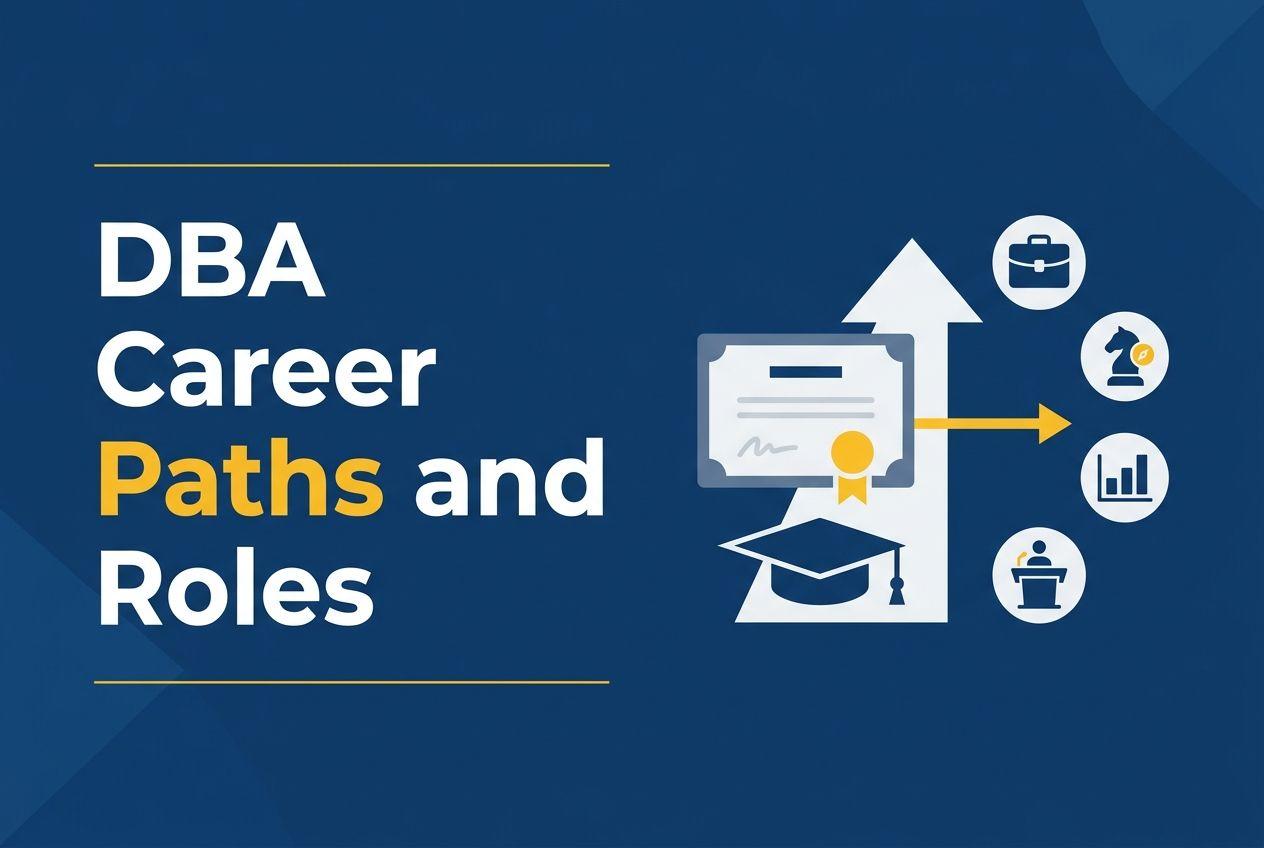
You've spent a decade building real expertise. You've led teams, driven results, and still, when the Director or VP role opens up, someone else gets it. Sometimes the deciding factor is a credential. Sometimes it's the perception of strategic depth. Often, it's both.
A Doctor of Business Administration (DBA) is an applied doctorate designed for exactly this moment. Unlike a PhD, which is built around generating academic knowledge, a DBA bridges rigorous research and real-world leadership. You learn to frame complex business problems, investigate them systematically, and lead decisions with evidence, not just instinct.
Let's walk through what a DBA actually qualifies you to do, which job families it maps to, and how to build a practical transition plan without stepping away from your current role. Whether you're eyeing a C-suite track, consulting, or a specialised corporate leadership position, the goal is to help you match the degree's strengths to a career path that fits your background and ambitions.
Most senior managers are technically excellent in their domain. What a DBA adds is a different kind of thinking: structured, evidence-based, and built for problems that don't have obvious answers.
The core concept behind a DBA is the "scholar-practitioner" model. You're trained to take a real business problem (an organisational inefficiency, a market shift, a strategic failure) and turn it into a structured investigation with defensible conclusions. That's not something most MBAs or years of experience formally teach.
In practice, this shows up in four capability areas:
Strategic decision-making with empirical grounding. You stop relying on gut feelings and organisational consensus. You learn how to identify what evidence actually matters and how to use it.
Applied research and problem framing. You can define what a problem really is before jumping to solutions, a skill that's rarer than it sounds in leadership rooms.
Change management and communication. DBA programmes typically require you to present findings and drive adoption. You learn to translate complexity into action.
Digital and data literacy as a strategic lens. DBA coursework increasingly incorporates data-driven decision-making, AI strategy, and analytics as business levers, not just IT concerns.
Who gets the most out of this? Mid-career managers aiming for director or VP roles, people moving into consulting or transformation leadership, and anyone who wants to teach at the executive or university level. The DBA doesn't give you experience. It gives you a framework to extract more value from the experience you already have.
Rather than obsessing over a single title, it helps to think in job families. These are clusters of roles that share similar day-to-day demands and draw on the same core skills. DBA outcomes tend to cluster into a handful of repeatable families:
Executive and general management leadership: CEO, COO, Managing Director, General Manager, Business Unit Head
Consulting and advisory: Management Consultant, Strategy Consultant, Independent Advisor
Strategy, analytics, and transformation: Strategy Director, Transformation Lead, Chief of Staff, Data/Analytics leader
People and organisation leadership: HR Director, Organisational Development Manager, Chief People Officer
Academia, research, and education: Practitioner faculty, Lecturer, Adjunct Professor, Research Fellow
Entrepreneurship and independent practice: Founders, fractional executives, executive coaches with formal credentials
Government and nonprofit leadership: Policy leaders, programme directors, social sector strategy roles
It's also important to remember that titles aren't universal. A "Director" at a 500-person company isn't the same as a "Director" at a 50,000-person enterprise. Don't anchor on titles. Anchor on scope. The DBA strengthens your candidacy, but it doesn't erase the need for a domain track record in the job family you're targeting.
Executive roles (like CEO, COO, Managing Director, General Manager, or Business Unit Head) are the most aspirational DBA outcomes. They're also the ones that require the most honest self-assessment.
Here's what the day-to-day of these roles actually looks like: setting strategy and investment priorities, aligning stakeholders with competing agendas, translating incomplete information into firm decisions, and building operating rhythms that hold organisations accountable. It's less about knowing the right answer and more about creating conditions for good decisions to happen consistently.
A DBA helps here in specific ways. The research training sharpens your ability to spot weak reasoning, identify missing data, and stress-test assumptions. These are skills that separate good executives from reactive ones. The credential also signals intellectual credibility in rooms where you're being evaluated not just on what you've done, but on how you think.
Of course, a DBA alone doesn't put you in an executive chair. Hiring committees at that level are looking for demonstrated leadership scope: budget authority, P&L responsibility, cross-functional initiatives you've owned end-to-end, and measurable outcomes. The DBA strengthens your case. Your track record makes it.
Compensation at this level varies enormously by industry, company size, and geography, but executive roles typically sit at the top of most organisations' pay bands. For most DBA graduates, a more realistic near-term outcome is a strong VP or Senior Director role, with the executive track becoming more accessible over a 5–7 year horizon when paired with intentional positioning.
Consulting is arguably the most natural fit for a DBA graduate, and it's one of the more accessible career pivots, even for people without a traditional consulting background.
Here's why: clients hire consultants to bring structure to problems they can't solve internally. That's precisely what a DBA trains you to do. Where a consultant with an MBA might offer frameworks and pattern recognition, a DBA-trained consultant can layer in evidence: structured diagnostics, rigorous analysis of organisational data, and recommendations tied to defensible findings rather than industry intuition.
Where DBA-trained consultants are in highest demand:
Organisational change and transformation
Analytics-driven strategy and performance improvement
Digital transformation and operating model redesign
Leadership development and org effectiveness
Management consulting demand continues to grow, driven by companies trying to navigate digital disruption, workforce shifts, and pressure for data-backed strategy. That environment suits DBA skills well.
How to break in:
Turn your dissertation or applied research project into a point of view and a repeatable framework. That's your intellectual property and your differentiator.
Build case studies from workplace projects, not just academic work. Clients want to see that you've moved organisations, not just analysed them.
Let's address a common misconception: that the DBA is "too academic" for consulting. What makes academic work feel irrelevant in business is when it stays abstract. If you translate your research into actions, metrics, and business outcomes, it becomes a strength, not a liability.
Not everyone is chasing the C-suite, and not everyone wants to build a consulting practice. A wide range of senior corporate roles exist where DBA skills create a direct edge, and where the work is intellectually demanding without requiring the political exposure of an executive track.
| Role | What You Do | Why DBA Helps | Best Fit If You... |
|---|---|---|---|
| Senior Business Analyst | Frame complex decisions, build evidence-based recommendations | Research rigour + structured problem framing | Like solving ambiguous problems with measurable answers |
| Logistics/Operations Analyst | Optimise processes, forecast performance, measure outcomes | Quantitative methods + systems thinking | Prefer measurement and modeling over stakeholder politics |
| Information Systems Manager | Bridge business and technology strategy, lead system implementations | Ability to align technical decisions to business evidence | Enjoy the business-technology interface |
| Economist (Corporate) | Market analysis, forecasting, policy/regulatory implications | Applied research skills + analytical framework literacy | Like working with data and external trends |
| Strategy/Transformation Lead | Lead enterprise change programmes, define future-state operating models | Change management + research-informed decision-making | Thrive in ambiguity with cross-functional exposure |
The context of digital transformation matters here. As organisations embed AI tools, analytics platforms, and data governance into core operations, the ability to evaluate these investments with research rigour (not just enthusiasm) is increasingly scarce. DBA grads who develop fluency in data strategy and AI literacy find a strong lane in this space.
Quick guide to choosing:
Ambiguity + stakeholder management → Strategy or Transformation roles
Measurement + models → Analytics, Operations, or Economist-style roles
Business-technology bridge → Information Systems leadership
Organisational development (OD) and people strategy leadership are frequently overlooked in DBA career conversations, and they shouldn't be. These roles sit at the intersection of research methods and human behaviour, which is exactly where a DBA's training applies.
Roles in this family include: Organisational Development Manager, HR Director, Head of People Strategy, Chief People Officer (at scale), and adjacent positions focused on culture and workforce transformation.
What you'd own in these roles:
Diagnosing organisational problems through structured assessment like surveys, data analysis, and leadership interviews
Designing and implementing talent development programmes backed by evidence, not just best-practice copying
Leading culture and change initiatives that actually stick, because you understand adoption barriers and how to address them
Building governance frameworks for performance management and organisational effectiveness
The DBA's research training is a genuine advantage here. Most HR leaders diagnose problems through intuition or benchmarking. A DBA graduate can run a proper diagnostic: define the problem, collect the right data, identify root causes, and evaluate interventions before committing to them. That's a different level of rigor.
Compensation for senior OD and HR leadership roles is solid. An Organisational Development Manager, for instance, earns a competitive salary depending on company size. Demand for this kind of people strategy expertise has also grown recently, thanks to a wider emphasis on culture, retention, and workforce analytics.
Yes, and for many DBA graduates, this path offers something corporate roles don't: intellectual continuity, teaching impact, and a longer career runway that doesn't depend on organisational politics.
Typical roles include: Practitioner Faculty, Adjunct Professor, Lecturer, Visiting Professor, and Research Fellow. The "practitioner faculty" model, in particular, is well-suited to DBA graduates. Business schools increasingly seek instructors who bring industry credibility alongside academic credentials.
What makes this path attractive:
Stability, especially in tenured or long-term adjunct positions
The ability to teach from real experience while staying connected to current business problems
Continued connection to research and intellectual development
Growing demand for faculty who can bridge theory and practice for MBA and professional degree students
The realistic trade-offs:
Compensation is typically lower than top-end corporate or consulting roles, especially early in an academic career.
Research output expectations vary. Some institutions require publication; others value teaching quality and industry relevance.
Tenure-track positions are competitive. Many DBA graduates enter as adjuncts or visiting faculty and build from there.
How to prepare: Start building your academic credibility before you graduate. Guest lecture where you can, present applied research at conferences, and develop frameworks from your dissertation that translate into course content. The combination of industry track record and doctoral research is genuinely differentiated in the faculty market.
The DBA's value doesn't happen automatically. It comes from intentional positioning, which means aligning the degree to a target outcome and executing against it while you study. Here's a practical five-step plan.
Step 1: Pick your target lane early. Before you apply anywhere, identify two or three specific job titles you're working toward. Not a vague direction. Think actual titles in actual job families. This choice determines which programme format, research focus, and networking strategy makes sense.
Step 2: Map your gaps honestly. Compare where you are now to the prerequisites for your target roles. Common gaps include P&L ownership, cross-functional scope, analytics depth, people leadership, and "proof artifacts" like public frameworks or written thought leadership.
Step 3: Align your dissertation to a real problem hiring managers care about. A dissertation on supply chain resilience is more career-relevant than one on an abstract organisational theory if supply chain leadership is your target lane. Your research is also your portfolio.
Step 4: Build credibility while you study. Lead internal projects that generate measurable outcomes. Present findings in leadership meetings. Write about what you're learning in formats your professional network will see. When interviewers ask about your DBA, talk about decisions you shaped and results you produced, not the thesis title.
Step 5: Run a timeline.
0–3 months: Shortlist programmes aligned to your target role family and working constraints. An AI-based college finder can help you compare part-time and online DBA programmes across cost, duration, and format, so you're evaluating fit, not just brand names.
3–12 months: Stack internal visibility. Take on stretch projects and build proof of your impact.
12–24 months: Begin your pivot or promotion push with evidence to back it up.
If you're worried about choosing the right programme or aren't sure if your career goal is realistic, talking with an education advisor can help. They can pressure-test your assumptions and clarify the trade-offs before you commit. Once you decide to move forward, getting structured help with the admissions process (like documents, verification, and deadlines) can save a lot of time, especially when you're already busy.
Common pitfalls to avoid:
Choosing a programme based on brand recognition alone, without checking if the format and curriculum fit your goals.
Starting without a career hypothesis, which means knowing the degree without knowing why it matters for your next move.
Underestimating the workload and assuming you'll figure out support as you go.
A DBA is a real investment in time, money, and energy. The people who get the most from it treat it as a career tool with a specific job to do, not just a credential they earn and hope for the best.
Our team of experts, or experienced individuals, will answer it over online meet. Book your slot now!
Book Free Online CounsellingGet Free Career Guidance