
Explore Courses
Top University
Search anything
 Refer and Earn ₹ 5000
Indira Gandhi National Open University is an esteemed open university in India. IGNOU distance education degrees are valid for admissions to a 3 year LLB course through regular mode in India, as it has recognition from UGC-DEB. You should have earned at least 50%-55% marks in a IGNOU bachelor's degree to be eligible for an LLB course.
Apart from this, you are required to qualify a law entrance exam for LLB 3 years, such as NLSAT, CUET LLB, or LSAT. However, some colleges may offer direct admissions to LLB programmes based on merit in graduation and a personal interview. This blog is a comprehensive guide to LLB eligibility criteria, especially for IGNOU graduates. Also, discover the top LLB entrance exams for admissions. Continue reading to explore the LLB eligibility criteria after graduation for top colleges in India.
✅ IGNOU graduates are eligible to apply for a 3-year or 5-year integrated LLB course in regular mode.
✅ IGNOU degrees are approved by UGC-DEB, making them valid and accepted for LLB admissions.
✅ As per the Bar Council of India (BCI), an LLB course must be pursued in a face-to-face, regular mode of education.
✅ You need to appear for CUET LLB to secure admissions to LLB courses at Delhi University.
✅ NLSAT, CUET LLB, and LSAT are several popular entrance exams in India for LLB admissions.
Yes, a degree earned from IGNOU is valid to pursue LLB in India as it is recognised by the UGC-DEB. Indira Gandhi National Open University is one of the leading and oldest central open universities in India. It is a pioneering institute for providing open and distance learning education across India and abroad. The university holds NAAC A++ accreditation for ensuring the quality of education in its distance learning programmes.
IGNOU further holds various honoured recognitions, such as UGC and UGC-DEB, which make its degrees valid for higher education and jobs in any sector. Therefore, IGNOU degrees are considered valid to pursue a 3-year LLB in regular mode as well. However, you might have to take any law entrance exam for admissions to LLB as an IGNOU graduate, to avoid college-specific exceptions for distance learners.
An LLB stands for Legum Baccalaureus, and is also known as Bachelor of Laws. It is a professional undergraduate degree for law enthusiasts that focuses on introducing the legal system of India. LLB is generally a 3-year course for graduates. However, you can also pursue an integrated LLB course of five years, directly after 12th. The course covers crucial subjects such as constitutional law, contract law, criminal law, and family law over a curriculum of three years, comprising six semesters. The admissions to an LLB course are provided based on merit in graduation or through entrance exams. Here are essential details of the LLB course covered at a glance:
Yes, graduates of Indira Gandhi National Open University (IGNOU) can apply for a 3-year LLB course. IGNOU degrees are recognised by UGC-DEB and therefore are valid to enrol in an LLB course of three years. However, depending on the institute, you may need to clear a law entrance exam. Or you could research for law colleges providing admissions to LLB courses based on merit-marking in graduation. Moreover, if you are a graduate of IGNOU and wish to pursue LLB, you are advised to take the CLAT exam. Make sure that you have scored at least an aggregate of 55% marks in the final year of your graduation.
To enrol in an LLB course, you are required to fulfil the mandatory eligibility criteria and admission requirements that may vary by college. Although some colleges may have specific criteria, there are several general eligibility requirements that most colleges follow. You may check out the general 3 year LLB eligibility criteria:
✅ You should have a bachelor's degree in any discipline from a recognised institution.
✅ You must have scored 50% - 55% marks in graduation. There may be a relaxation of 5% marks provided to the reserved category students.
✅ Most law colleges require you to qualify for entrance exams such as the all India CLAT, LSAT, or state-specific exams. Some colleges have their own entrance exams for admission to an LLB course.
✅ Typically, there is no upper age limit criterion.
The LLB eligibility criteria in India depend on individual colleges or law schools. However, on a common note, you must have a bachelor's degree in any discipline with 45% - 55% marks from a recognised university or institution. Furthermore, you may need to take an entrance exam or appear for a personal interview for LLB admissions, depending on the colleges. Here we have listed the eligibility requirements for top colleges in India that you may consider:
📝 You must have a bachelor's or master's degree in any discipline from a recognised university.
📝 Students from the unreserved or EWS category are required to have 50% in graduation.
📝 OBC/CW/PwBD candidates can apply with 45% marks, while SC/ST candidates require 40% in graduation.
📝 You must appear and qualify for the CUET LLB entrance exam for admissions to LLB at Delhi University.
📝 Bachelor's degree in any discipline from a recognised university.
📝 You must have a minimum of 45% marks in graduation.
📝 Candidates belonging to SC/ST categories are required to have at least 40% marks for LLB admissions.
📝 You must have earned at least 50% marks in class 10th and class 12th in any stream.
📝 You should have a bachelor's degree in any discipline with a minimum of 50% marks.
📝 A personal interview would be conducted to shortlist candidates.
📝 Non-sponsored candidates are required to have a bachelor's degree with an aggregate of 50% marks.
📝 Sponsored students must have achieved 45% overall marks in graduation.
📝 Your enrollment is subject to qualifying for the interview round as per the selection process.
📝 Bachelor's degree in any discipline from a recognised national or international university.
📝 Having a minimum of 45% aggregate in graduation is mandatory for general category candidates.
📝 5% score relaxation would be provided to students belonging to SC/ST/OBC-NCL/PwD categories (40% marks in graduation).
📝 You must qualify for the NLSAT - LLB (National Law School Admission Test for 3-Year LLB course).
Applying for an LLB through an entrance exam gives your profile weightage. For IGNOU graduates, it is one of the best ways to take admission to an LLB programme. Besides, there are many national, state-level, and college-specific 3-year LLB entrance exams that you can consider. Here is the list of the top entrance exam for LLB 3 years course:
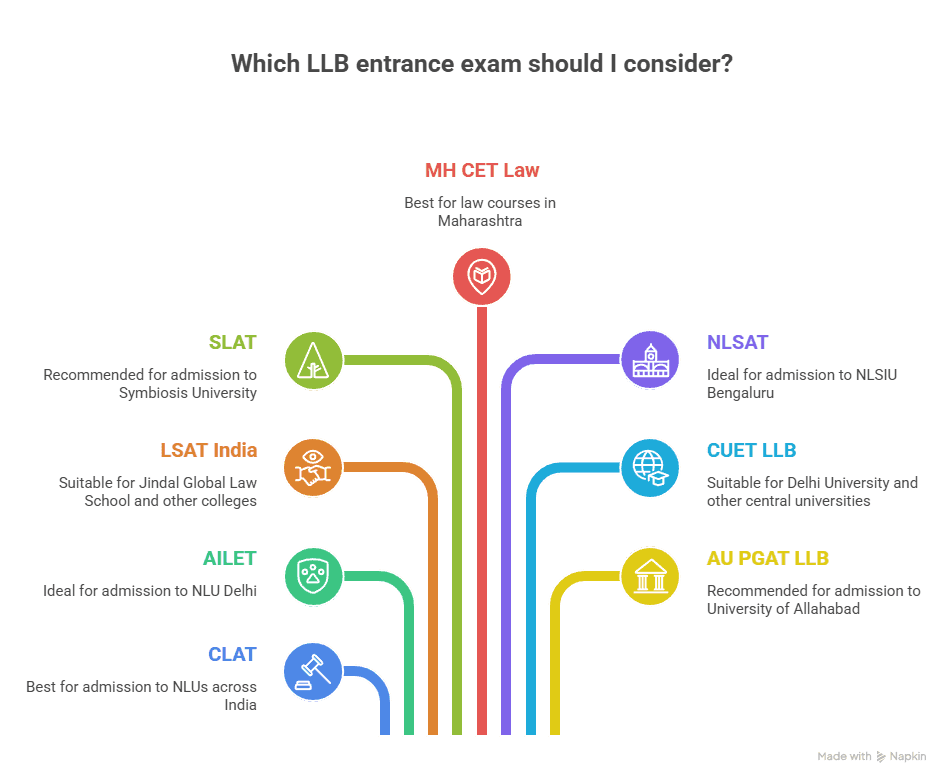
*Note that CLAT exams are a gateway for NLUs in India, which exclusively offer 5-year integrated LLB courses such as BA LLB. In this case, you would earn a 3-year LLB degree but have to invest two more years as part of graduation. You can still take this exam even if you have a bachelor's degree.
IGNOU degrees are approved by the UGC-DEB. Thus, they are considered valid for higher education in India for any course, including an LLB. However, the institutes may have exceptions for distance degree holders, as the eligibility and selection criteria vary from college to college. This is why students are advised to take any of their preferred LLB entrance exams for seamless admissions. You can also choose direct admissions to LLB courses, as well, provided that you satisfy the university-specific eligibility requirements.
No, Indira Gandhi National Open University (IGNOU) does not offer distance/online LLB courses due to the regulations of the Bar Council of India (BCI). BCI does not approve distance and online LLB courses.
A 5-year integrated LLB course is considered better for 12th passouts as it combines a 3-year bachelor's with a 3-year LLB, saving you one year of duration. However, for graduates, a 3-year LLB course is generally considered better, as taking up a 5-year integrated programme is going to cost you 2 more precious years.
Yes, you can do an LLB course at the age of 40 or even older, as the BCI or Bar Council of India has removed upper age limit restrictions for enrollment to LLB courses in India.
You can do an LLB course in private mode, ensuring that you attend classes on a daily basis in regular mode. External private mode, distance, or correspondence are not valid modes for an LLB course in India as per BCI regulations.
UPES College of Law, Dehradun
Amity Law College, Noida
Symbiosis Law College, Pune
Christ University, Bengaluru
NMIMS College of Law, Mumbai
ICFAI Law College, Hyderabad
Jindal Global Law College (JGLS), Sonipat
Our team of experts, or experienced individuals, will answer it over online meet. Book your slot now!
Book Free Online Counselling


Get Free Career Guidance