Explore Courses
Top University
Search anything
 Refer and Earn ₹ 5000
Did you know? According to Statista (2025), the online education market is expected to reach 279.30 billion dollars by 2029. With online education becoming the norm, the government of India has taken initiatives to make quality education accessible globally. With the statutory body, University Grants Commission, the government has begun to provide recognition to online and distance colleges across the nation. It aims to make online courses as credible and legitimate as regular courses.
With UGC approval for online institutions, the government ensures a quality online education check. However, did you ever wonder, “Do institutions stick to UGC guidelines?” And if yes, what are the essential UGC guidelines that every online education institute must adhere to? Consider this blog as your quick guide to UGC guidelines for online degrees and courses. Learn about the criteria that UGC mandates for standard quality online education. Let’s get started!
✅ Any course offered in law, allied sciences, engineering, or medical disciplines that require immersive training must not be offered through online mode.
✅ Online courses with disciplines in microbiology, psychology, biotechnology, etc., are prohibited by the UGC.
✅ An online degree programme must be approved by the UGC-DEB and align with the latest regulations laid by the UGC-DEB.
✅ You can verify the UGC-DEB approval through the official website of UGC-DEB: deb.ugc.ac.in.
✅ You can enrol in two full-time academic courses simultaneously (1 online + 1 in-person), provided that the timings of classes do not overlap.
UGC or University Grants Commission is an Indian statutory body. The commission is an initiative of the government of India. It is the central authority designated to ensure quality education in institutions across India. UGC approval is provided to those colleges and universities whose faculty, courses, examinations, and other educational requirements align with the specific standards or criteria issued by UGC / Government of India for quality education. Thus, UGC-recognised institutes:
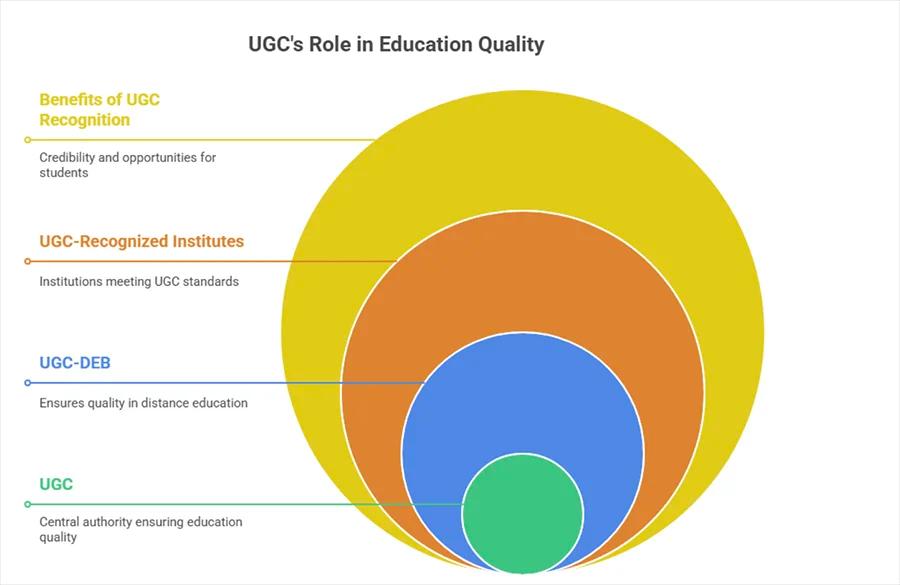
UGC approval was originally brought for regular courses. However, as the need and popularity of online education increased, the government of India also started to recognise online education institutes. UGC’s Distance Education Bureau, also known as UGC-DEB, ensures a quality check for online courses. It ensures that online courses provided by the colleges/universities are as credible and valuable as regular degree programmes. In India, only the UGC-recognised online degree courses shall be considered valid for higher education or jobs in private or public sectors.
According to the latest UGC guidelines released in August 2025, the UGC has terminated online healthcare courses. This is effective from August 2025. As per the new guidelines, courses in healthcare or allied sciences cannot be delivered through fully online or distance learning mode. The list of terminated online courses by the UGC is given below:
| Banned Course | Important Note |
|---|---|
| Psychology | Healthcare-related specialisation is now discontinued in ODL/online modes. |
| Microbiology | Fully banned under healthcare/allied disciplines in ODL/online mode |
| Food and Nutrition Science | Banned under the ODL/online category |
| Biotechnology | Included in the banned list under healthcare/allied disciplines |
| Clinical Nutrition and Dietetics | Specifically listed among the excluded programmes |
University Grants Commission has issued the guidelines for courses that are delivered through online mode across the nation. Under these guidelines, higher education institutes, whether central universities, state private universities, or deemed to be universities offering online courses, are covered. Here are several crucial UGC guidelines for online courses that every online institution must adhere to. Check out:
Here are the 4 essential factors you need to check for an online course:
Earning a degree without doing a background check of the institution? Sounds disappointing, right? Higher education institutes often showcase UGC approval on the home page of their websites. However, what if a forged website of a fake-named college is created with the UGC logo attached? It is easy to fall for scams like that. This is why it is advised to ensure the UGC recognition and verify it before enrolling. You can ensure the UGC recognition for a distance/online university on the official website of UGC-DEB. Here is how you can do it:
✒️
Click on the “Recognised HEIs for Online Programs”.
✒️
Go through the list thoroughly and cross-verify if the name of your chosen institution is listed there.
UGC provides recognition to online and distance learning institutes via the Distance Education Bureau (DEB). Indira Gandhi National Open University (IGNOU) is India's largest distance/online education institute, recognised by the UGC-DEB. Check out the top 10 distance/online institutions in India approved by the University Grants Commission:
| List of UGC Approved Universities for Online Courses | Location |
|---|---|
| Indira Gandhi National Open University (IGNOU) | Delhi |
| Amity University Online | Gautam Budh Nagar, Uttar Pradesh |
| U.P. Rajarshi Tandon Open University (UPRTOU) | Allahabad, Uttar Pradesh |
| Yashwant Rao Chavan Maharashtra Open University | Nasik, Maharashtra |
| Lovely Professional University Online | Phagwara, Punjab |
| ICFAI Foundation for Higher Education | Hyderabad, Telangana |
| Jain University Online | Bangalore, Karnataka |
| Chandigarh University Online | Mohali, Punjab |
| Uttarakhand Open University | Haldwani, Uttarakhand |
| Vardhman Mahaveer Open University | Kota, Rajasthan |
Before applying for an online degree programme in India, it is crucial to do a quality check. You should look for several mandatory disclosures to avoid confusion and have a seamless academic experience. It would help you select the right online degree courses, which are recognised, industry-aligned, and match your career goals. Here is the quick checklist to ensure the quality of the online course you wish to enrol in:
📝 UGC/DEB Approval: Don't just look for UGC-recognition on the university, but verify it through the UGC-DEB official portal. The approval is crucial for the recognition of your programme among employers or HEIs.
📝 Need for In-person Interaction & Lab Work: Understand if your programme requires lab work or face-to-face interaction to gain specific skills. If yes, make sure the university includes virtual labs and several on-campus/virtual interactive sessions.
📝 Course Compliance with UGC Online/ODL Norms: Make sure that your selected online/distance degree programme follows the guidelines laid by the UGC and DEB for quality curriculum.
📝 Syllabus Alignment with Regular One: Cross-check the syllabus of your chosen online course with the regular course at the same university. Make sure it follows the same credits, subjects, and evaluation pattern.
📝 Course Exit Options: As per UGC guidelines for online courses, the programmes should have multiple exit options. For example, if you quit the course after 1 year, you could leave with a certification or diploma. The scheme also allows you to enrol back in the course from where you left off in the next academic session.
📝 Status of Discipline Offered: Look out for the discipline or course you want to enroll is valid or banned. As per UGC guidelines, online courses in allied sciences and various medical disciplines, including psychology, are banned. Select a discipline or specialisation which is approved by the UGC-DEB to pursue in online/ODL mode.
The University Grants Commission, or UGC, functions under the Ministry of Education. Thus, guidelines issued by UGC adhere to the regulations decided by the government of India. Each institution offering regular, online, or distance courses must follow the UGC guidelines. They are issued to ensure the quality of the education provided to the students. Furthermore, online courses span a range of disciplines. However, courses like engineering, law, or medicine are strictly prohibited as they require practical training and physically immersive experience.
Yes, UGC provides recognition to online degree programmes for UGC-approved colleges and universities.
You can visit the official website of UGC DEB and explore the list of approved universities and colleges for online/distance education.
The degree earned from non-UGC-approved colleges or universities is considered unrecognised, non-valuable, and illegitimate by the authorities of India. It would not have any legal value among employers or higher education institutes for further studies.
Candidates enrolling in online and distance education courses must generate their DEB-ID first through the UGC DEB portal.
A UGC-approved course is offered by a UGC-recognised institution, ensuring that it meets the educational standards issued by the UGC & Government of India.
UGC's new guidelines are aimed at creating equity committees to ensure anti-discrimination for gender, caste, and disability across all higher education institutes in India.
From April 2025 onwards, students can now enrol in two full-time courses simultaneously. However, they must ensure that one course is done through physical (regular) mode and another could be online or distance courses, given that the timings and schedules of both courses must not overlap.
Our team of experts, or experienced individuals, will answer it over online meet. Book your slot now!
Book Free Online Counselling


Get Free Career Guidance