Explore Courses
Top University
Search anything
 Refer and Earn ₹ 5000
Learning Routes
Published on 13 November, 2025
Learning Routes Editorial Team
Reviewed and updated
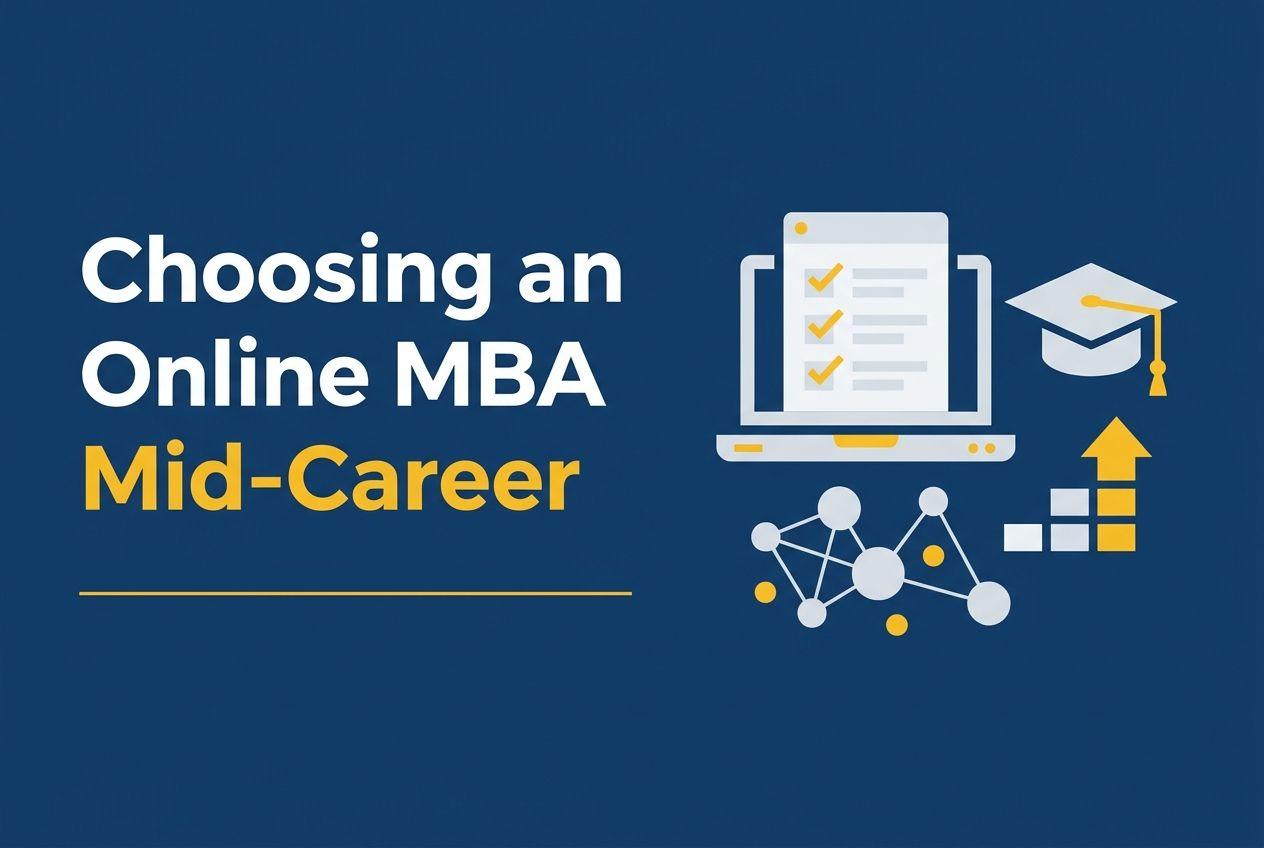
You’ve been doing the job well for over a decade. You know your function, you lead people, and you deliver results. But the director seat keeps going to someone else, often someone with three letters after their name. The credential gap is real, and you know it.
So you start looking into online MBAs. A couple of hours later, you’re drowning in sponsored content, conflicting rankings, and university websites that hide the true cost. Every programme claims to be "flexible", "rigorous", and “perfect for working professionals".
Here’s what most of that content gets wrong. The best online MBA for someone with your experience isn't necessarily the highest-ranked one. It's the programme deliberately built for where you are in your career right now. That means leadership-level peers, career leverage you can actually use, and a format that won’t force you to choose between your degree and your family by week eight.
This article gives you five specific features to look for, plus concrete ways to verify them before you commit to anything.
After a decade in the workforce, you're not looking for a career starter. You're looking for a ceiling-breaker. What you need the degree to do is strategic: build the credibility, business vocabulary, and peer network that gets you into director-level conversations. That’s very different from what a 26-year-old needs from the same degree. The degree from one of the best online MBA colleges in India will serve you best, as they are designed around applied learning, senior cohorts, and leadership frameworks. They shouldn't teach you what a P&L is from scratch.
Before you start comparing programmes, it’s important to make sure you’re looking at the right format.
If your goal is a promotion or a lateral leadership move in the next two to three years and you can’t take time off from work, an online MBA is usually the right path.
This is the feature most programmes market, and most applicants don't scrutinise enough. It’s also what separates a genuinely valuable degree from an expensive series of video lectures.
At your career stage, the quality of your network matters more than its size. You aren't just collecting connections. You're seeking peers you can call when you’re navigating a board presentation, a restructuring, or a career pivot. This requires a cohort of peers with comparable seniority, cross-industry exposure, and a real incentive to stay connected after graduation.
The signals to look for are the average years of experience in the cohort (10+ is a meaningful number), a diverse mix of industries, and whether alumni maintain active professional relationships, not just an email list.
Networking doesn't happen by accident in an online setting. It has to be designed into the programme’s structure. You should ask specifically about these things:
Don't just take a brochure's word for it. Here’s how to test a programme’s networking claims:
A strong online MBA should make your next career move faster, clearer, and more credible, whether that's an internal promotion, a lateral shift, or an industry switch.
Career services designed for new graduates won't help you. Look for programmes with offerings tailored to experienced professionals. This could include leadership coaching, executive communication workshops, internal mobility support, and career advisors who work in senior hiring. Programmes with dedicated tracks for professionals targeting VP or C-suite paths are a good sign that they understand your situation.
If you're using the MBA to move into a new industry, you need more than coursework. You need a programmes that offers:
You want a curriculum that's still relevant when you graduate. Specialisations in Business Analytics, Digital Strategy, and Sustainability/ESG are gaining traction with leadership hiring committees. Finance and Operations remain durable choices. Be cautious about overly niche specialisations unless they map directly to a specific role you're targeting.
For professionals with multinational career ambitions, programmes accreditation is a critical signal of quality. Accreditations like the AACSB (Association to Advance Collegiate Schools of Business) are globally recognised. They tell employers in different countries that your degree meets a high, consistent standard. If you plan to work for global companies or relocate, prioritising a programme with this level of international recognition can significantly improve your career mobility.
The gap between a strong online MBA and a weak one often lies in the learning design, not in the university's name on the certificate.
Fully asynchronous programmes offer maximum flexibility, but they sacrifice real-time debate and peer interaction. The strongest programmes often use a hybrid model. Core content is delivered asynchronously, with weekly or biweekly live virtual sessions for discussion and collaboration. Before enrolling, confirm the number of live sessions, their schedule, and the policy for missed classes.
Recorded lectures are just the beginning. A rigorous online MBA requires you to do something. Look for case study analysis, business simulations, applied capstone projects, and peer feedback on your work. For experienced learners, these are more valuable than exams because they mirror the complex, ambiguous problems you solve at work. They force you to apply theory and defend your decisions among peers.
Some on-campus advantages, like informal hallway conversations, don't translate perfectly to an online format. However, faculty quality, curriculum depth, and assessment rigor should be equivalent. If an online programmes is described as a "lite" version or uses different faculty (like a high number of adjuncts), that's a deal-breaker. Ask directly: "Is the online curriculum identical to the on-campus course, and is it taught by the same faculty?"
The learning platform is where you'll spend 10 to 15 hours a week. It needs to work. A good platform offers a stable learning management system (LMS), integrated tools for live video sessions, functional mobile access, and a clear support channel. It should also be accessible, with features like screen reader compatibility and captioned videos, demonstrating a commitment to inclusive design. Always ask for a demo before you enrol.
Platform friction can become a real dropout risk by week six, when you're behind on modules and group projects are starting. Red flags include student forums full of technical complaints, no mobile app, a help desk with limited hours, and collaboration tools that feel like an afterthought.
This last feature often determines whether you actually finish the degree. A great curriculum doesn't matter if the programme's pace and administrative burden break you by the second semester.
Most online MBAs advertise 15 to 20 hours of work per week. This is an average. During peak weeks with final projects and exams, it can spike to 25 or 30 hours. If you have regular work travel or a demanding job, that spike matters. Before enrolling, ask, "What does the heaviest week of the semester look like?" and "How are deadlines distributed?" Courses with front-loaded flexibility are easier to manage.
Look for academic advisors who respond in under 24 hours, documented policies for deferral or leave of absence, and pacing options that let you slow down during a busy period at work. Some programs even offer coaching on time management, recognising that integrating graduate school into a senior career is a skill in itself.
The application process alone can take 20 to 40 hours. It involves gathering transcripts, preparing for entrance exams (such as the GMAT, GRE, or CAT), verifying employment, writing statements of purpose, and securing letters of recommendation. Add in non-transparent fee structures, and the pre-enrolment phase becomes its own project. Platforms that support the full admission workflow, from registration to fee payment, can save you hours you don't have.
Tuition is only part of the cost. A better way to think about the ROI is to look at the total investment. Your real investment includes:
You can then set this total investment against the expected salary increase at the Director or VP level and a faster promotion timeline. Even a promotion that comes 6 to 12 months earlier can offset a significant amount of tuition.
Many experienced professionals qualify for cost-reducing options. Most accredited programmes offer merit-based scholarships, and your work history makes you a strong candidate. Ask the admissions office about scholarships early. For employer sponsorship, frame the MBA as a solution to a business problem, propose a commitment to stay with the company after graduation, and ask about the formal process for education assistance.
Use these five features as your scorecard: networking design, career leverage, learning design, platform quality, and life-compatible execution. Any programmes that is weak on two or more of these points probably isn't built for you, regardless of its ranking.
To counter the "easy online degree" stigma, strong courses use proctored exams, applied projects that can't be easily copied, peer reviews, and faculty-led evaluation. Ask directly: "How are assessments structured?" and "Are exams proctored?" Accreditation from bodies like AACSB or recognition under UGC sets a baseline, but asking about academic rigour will tell you more.
You now have a five-feature framework that cuts through the marketing copy. The next step is to apply it to a shortlist of courses.
An AI-based college finder lets you search for and compare accredited online MBA programmes side by side. You can filter by cost, duration, specialisation, and format, so you're working from facts, not just marketing brochures.
Once your shortlist is down to two or three courses, a free counselling session with an education advisor can help you pressure-test your choices. Does this programme's cohort really match your seniority? Will the career support move the needle for a Director-track candidate? Are there scholarships that change the ROI?
You've spent more than ten years making good professional decisions. This one deserves the same rigour. Start your comparison, ask the hard questions, and don't commit until you have clear answers.
Our team of experts, or experienced individuals, will answer it over online meet. Book your slot now!
Book Free Online CounsellingGet Free Career Guidance