Explore Courses
Top University
Search anything
 Refer and Earn ₹ 5000
Learning Routes
Published on 09 May, 2026
Learning Routes Editorial Team
Reviewed and updated
You've spent three evenings reading university websites, and somehow you're more confused than when you started. One program calls itself "online," another says "distance learning," and a third says "flexible hybrid." None of them explain what that actually means for your Tuesday nights or your annual leave.
Here's what those labels are covering up: the real differences lie in how learning gets delivered, when you need to show up, and how much support you'll actually receive. For a working professional, those three things determine whether you finish the program or quietly drop out by semester two. This article cuts through the marketing-speak and gives you a practical framework to choose the format that fits your life.
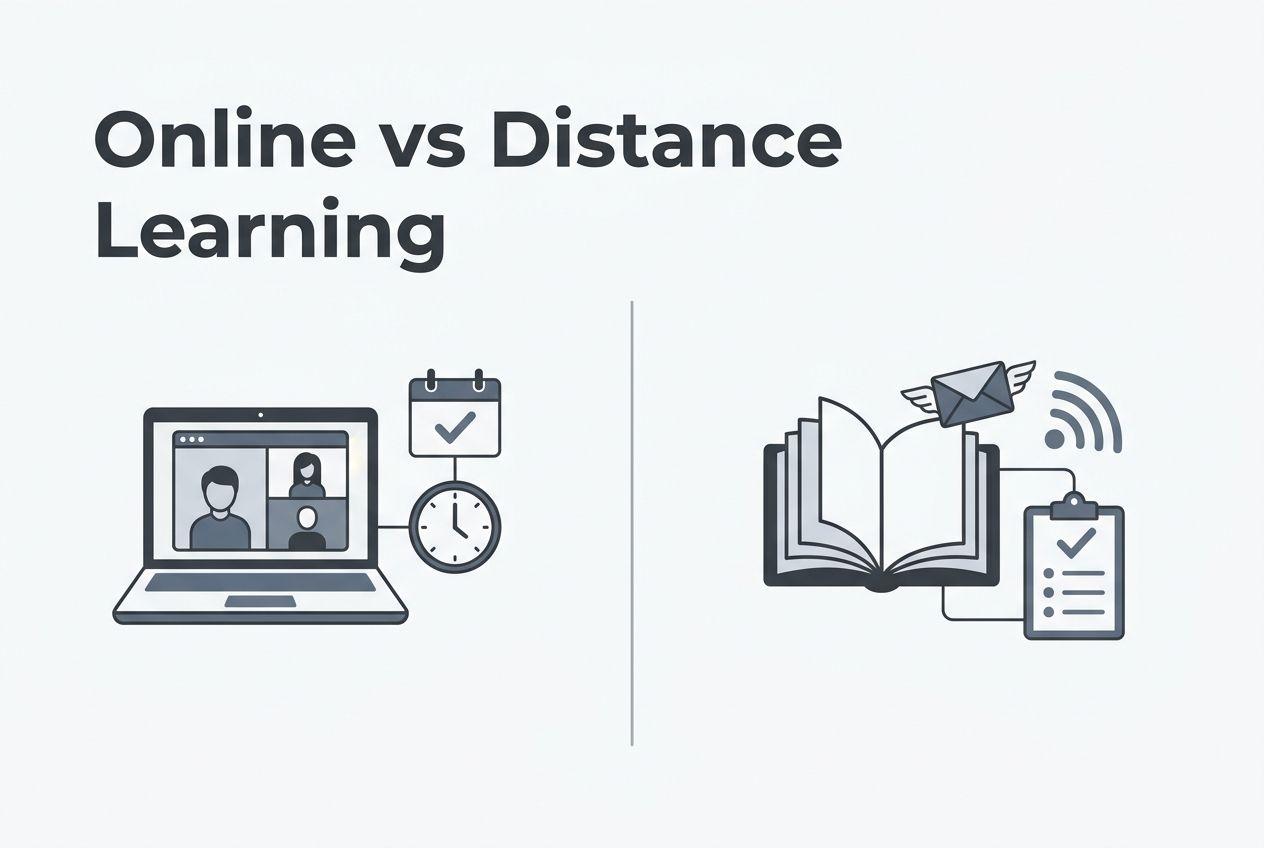
Distance education is the older, broader category. It refers to any structured learning where the student and institution are physically separated. Correspondence courses from the 1970s were distance education, as were programs delivered by post and radio. The defining feature is geographic flexibility, not the technology used to achieve it.
Online degrees are a subset of distance education that use internet-based technology as the primary delivery channel. This usually means a Learning Management System (LMS) like Moodle or Blackboard, video lectures, digital assignments, and live virtual classrooms. All online degrees are a form of distance education, but not all distance education is online.
The word "online" tells you the medium. It doesn't tell you whether you'll be expected to join a live session every Saturday morning or if you can watch recorded lectures at 11 p.m. That distinction, synchronous versus asynchronous, is far more important to your daily life than the label on the brochure.
Similarly, "distance" doesn't automatically mean you'll never have to travel. Some distance programs require you to visit a physical exam center for assessments. Before enrolling in anything, you need to know: How is content delivered? When must I be available? Where do I write my exams?
"Hybrid" or "blended" programs mix online learning with some mandatory on-campus sessions, like a weekend residency each semester. They try to offer the flexibility of remote study with the high-touch interaction of a traditional classroom.
For a working professional, the key question is whether the in-person components are truly mandatory. If you can’t commit to travel, a hybrid program may be impractical. Always clarify the policy for missing an on-campus session before you enroll.
In a synchronous online program, you attend live virtual classes at scheduled times, often weekend mornings or weekday evenings. Missing a session usually means missing the interaction, even if a recording is shared afterward. If your job involves travel, shift work, or irregular hours, a program with several mandatory live sessions per month will create friction fast.
In an asynchronous or self-paced format (common in many distance programs), content is pre-recorded. You watch lectures, complete readings, and submit assignments on your own schedule, within weekly or monthly deadlines. There's no "be here at 7 p.m." requirement. For someone managing unpredictable workloads, this is often the more sustainable model.
Most programs today sit somewhere between these two extremes. A good question to ask any university is: "What percentage of sessions are live and mandatory, and what's the re-watch policy if I miss one?"
In synchronous online programs, you can ask a faculty member a question in real time, participate in group discussions, and build a peer network through shared virtual experiences. This matters more than people expect, especially if you're switching roles and need mentors or references, not just a certificate.
In asynchronous or traditional distance formats, faculty interaction typically happens through email, discussion forums, or scheduled office hours. Response times vary widely. Some programs offer dedicated tutor support with quick response windows; others are essentially self-study with occasional check-ins. Neither is inherently better, but you need to know which you're signing up for.
Peer learning is also different. Asynchronous discussion forums can generate thoughtful responses, but they don't replicate the energy of a live group working through a case study together. If your career goal involves leadership or client-facing roles, that live interaction isn't a luxury. It's practice.
This is where many working professionals hit an unexpected wall. Assessment formats vary significantly and carry real scheduling consequences.
Online proctored exams use webcam monitoring software. You write from home but must be available during a specific window, sometimes on a weekday afternoon that doesn't fit a full-time job.
Physical exam centers require travel and advance booking. If your program uses offline exam centers, you may need to take leave on exam days, which can happen two or three times a year.
Project-based and assignment-driven programs assess you primarily through submissions, reports, and case studies, with no timed exams at all. These formats are often more manageable for working professionals but require consistent weekly effort rather than cramming for an exam.
Check the assessment structure before you apply, not after. Ask: Are exams synchronous? Where do I write them? Can I request a reschedule?
If you're staying in your field and need a credential to support an internal move, your priority is credibility and completion, in that order. A well-recognized distance or online program from an established university will serve you well, even if it's largely asynchronous.
Here, the reputation of the university matters more than live classroom hours. Your employer already knows your work; the degree just validates what they already see.
Switching roles is harder without proof of applied skills. In this case, program quality, interaction, and career support become more decisive. An online program with live case discussions, group projects, and an active alumni network will generally serve you better than a purely self-paced distance course.
When you're entering a new function, you don't just need the certificate. You need to demonstrate that you can think and communicate in that domain. Programs that make you defend ideas in real-time help you build that confidence.
For fields like data analytics, digital marketing, or financial modeling (where you need to demonstrate hands-on competency), check if the program includes simulations, tool-based assignments, or projects that use real software.
The best programs integrate tool-based learning into the curriculum, not just theory, and assess you on applied outputs. This is worth verifying directly. Ask the admissions team for a sample module or assessment brief. If they can't produce one, that tells you something.
Asynchronous formats are almost always the better fit. You need a program where missing a Tuesday evening session doesn't cascade into a week of catch-up. Look for programs with generous submission windows, recorded-everything policies, and mobile-friendly learning platforms.
Also ask what happens if you need a semester break or a deferred exam. Life happens. Programs that offer structured pause options are far easier to complete.
Accreditation is the single most important quality signal, and it's also the most commonly misrepresented. Here's what to actually verify:
An employer in another city or country will rely on these markers. A degree from an unrecognized program won't just be overlooked; it can actively raise questions about your judgment.
Beyond accreditation, look for:
Choose programs from institutions with name recognition in your industry or geography. Be ready to speak confidently about what you learned and how you applied it. The programs that reduce resume risk most effectively are those with verifiable accreditation, real alumni outcomes, and a curriculum you can articulate in an interview.
Building a reliable shortlist is key. Instead of juggling a dozen university websites, you can use Learning Routes’ Course and University Discovery pages to explore accredited options across categories like Online UG/PG, Diplomas, and Certifications. This helps you keep your research organized and compare fees, eligibility, and specializations in one place.
Most program marketing lists "student support" as a feature without explaining what it means. Before enrolling, ask specifically:
For working professionals, weak support is the quiet reason people don't finish. When you're studying at 10 p.m. after a full workday and you hit a concept you don't understand, a three-day email wait can derail an entire week of study.
If you're aiming for a role switch or a significant promotion, weigh career services seriously. Ask whether the program offers mock interviews, resume review, recruiter connections, or alumni networking access. Some online programs have active placement cells, while others list "career support" but only mean a jobs board.
For professionals who are already employed, placement may be less critical than alumni network access. These are peer connections you can tap for referrals, project collaborations, or even references down the line.
Tuition is the visible cost. Here's what often gets missed:
Some programs charge semester by semester, while others require full-year payment upfront. If budget is a constraint, look for programs that offer installment structures. Confirm this directly with the admissions office and ask what happens to fees if you need to defer or withdraw. Knowing the payment schedule before you apply gives you time to plan.
Your answers will point you toward a format. If you need fixed interaction and strong career support, a synchronous online program from a well-ranked institution is likely the better fit. If you need maximum schedule flexibility, an asynchronous program with project-based assessment is usually more sustainable.
Once you know your criteria, the worst thing you can do is contact five universities one by one and wait for callbacks. That approach wastes weeks and makes it hard to compare options clearly.
A better way is to use a tool like Learning Routes' AI-based College Finder to search across programs by type, specialisation, and university. This lets you compare the options that fit your needs in one view rather than across a dozen browser tabs.
The most common source of enrollment delay isn't the decision; it's the paperwork. Most programs require academic transcripts, identity verification, work experience letters, and fee payment within specific deadlines. Missing one document can push your enrollment to the next intake, which may be six months away.
For a smoother process, Learning Routes offers free counselling and admission support to help you confirm your program choice, prepare your documents, and navigate enrollment without having to figure it all out on your own. It's a faster path from decision to enrolled.
You now have a clear way to distinguish online degrees from distance education, a sense of which format fits your career goal, and a checklist to verify program quality before you apply.
The next step is building a shortlist you're actually confident in, not a list based on whoever called you back first.
Use Learning Routes to compare programs side by side, explore accredited options, and speak with a counsellor who can validate your shortlist and support your admission from start to finish. No pressure and no generic recommendations, just a faster, clearer path to a program that fits your life.
[Start your search or book free counselling on Learning Routes.]
Our team of experts, or experienced individuals, will answer it over online meet. Book your slot now!
Book Free Online CounsellingGet Free Career Guidance