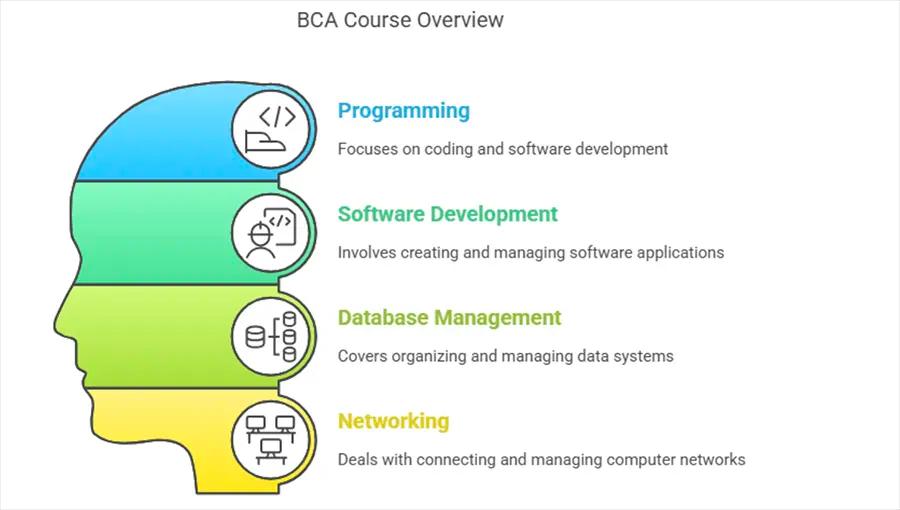
The Bachelor of Computer Applications (BCA) is a 3-year undergraduate degree programme covering approximately 35 to 40 subjects.
Generally, BCA subjects 1st year cover computer fundamentals, C programming, and mathematics.
BCA 2nd year syllabus includes data structures, Java/Python, DBMS, and operating systems.
3rd Year subjects cover software engineering, web development, computer networks, and electives such as AI, machine learning, cloud computing, and cybersecurity, ending in a final-year project.
After completing BCA, you may have strong concepts in computer applications and programming development. Read the blog further to learn more about the BCA subject details.
Download PDF:
Key Highlights of BCA Course Subjects 2026 in India
The full form of BCA is Bachelor of Computer Applications. It is a three-year undergraduate degree. This degree programme is inclined towards computer science, IT, and related fields. After you have completed 10+2 or an equivalent degree from a recognised board, you can pursue BCA. If you are planning to take this course, you must get an idea about the BCA 1st year syllabus and 2nd and 3rd year subjects. The table below shows a summary of the overall course.
Particulars
Information
Course
Bachelor of Computer Applications (BCA)
Duration
3 Years | 6 Semesters
Eligibility Criteria
10+2 from a recognised institute
Admission Process
Merit+Entrance Test (depending on the college)
Fee Range
INR 70,000 - INR 2,00,000
Subjects Covered
Hardware lab
Foundational maths
Financial Accounting
Software engineering
C++ Lab
Domain Lab
Top Career Opportunities
IT Analyst, Web Developer, Junior Analyst, Software Developer, Angular Developer
Average Salary
INR 5.0 LPA - INR 7.0 LPA
Types of Subjects in a BCA Syllabus 2026
The 3-year online Bachelor of Computer Applications consists of 6 semesters. It is designed for you to have a stronger grasp of computer applications. In each semester, you would cover core, specialised and practical lab subjects. Check out the types of BCA subjects 2026 that you would cover in every semester:
✅ Core Programming Subjects: The core subjects for a BCA program commencing in 2026 shall cover different programming languages, data structures, database management systems, different networks, and infrastructures.
✅ Specialisation Subjects: In this, you would cover different specialised elective subjects of advanced and emerging technologies. Some of the examples are cyber security, IoT, blockchain, data science, and more.
✅ Practical and Lab Subjects: The BCA syllabus 2026 shall also include lab subjects for subjects that require you to learn practical skills. Some of these subjects are operating system lab, digital electronics lab, C programming lab, and more.
✅ Capstone Project: In the BCA 3rd year, the curriculum shall include a project. It is a chance to showcase your practical and theoretical skills gained during the course. Moreover, you can use this to showcase your skills to employers and higher education institutes.
BCA Course 1st Year Semester-Wise Syllabus 2026
BCA subjects in the first year are divided into two semesters. In the BCA first semester syllabus, you get a chance to learn fundamentals of Mathematics, technical communication, web programming, and more. Check the list of all core BCA subjects with brief descriptions.
BCA 1st Semester Syllabus 2026
Semester 1
Topics Covered
Professional English
Communications, types of communication, business letters, reports, drafting of business letters, IT for communications
Foundational Mathematics
Sets and functions, calculus, vector calculus, divergence, integrals, limits and continuity, matrices, matrix operations
Digital Electronics
Number systems and codes, Boolean algebra, logic gates, combinational logic, flip-flops, and registers and counters
Introduction to Programming Using C
Computer and programming, C programming, control structures and arrays, functions and pointers, structures, unions and files, low-level programming and C preprocessor
Computer Architecture
Basic computer organisation and design, processor design and control unit, memory organisation, input output organisation, parallelism and pipelining, and recent trends
Digital Electronics Lab
Understanding the components of computer applications, operating systems, binary-to-gray code, binary ripple counter using JK FF, function table, and more.
C Programming Lab
Usage of operators and data types in C, writing programmes, and more.
BCA 2nd Semester Syllabus 2026
Semester 2
Topics Covered
Organisational Behaviour
Fundamentals of organisational behaviour, perception, attitude, values, motivation, personality, work stress, group behaviour, and conflict in organisation.
Advance Mathematics
Relations and functions, discrete mathematics, linear algebra, graph theory, differential equations, and 3D coordinate geometry.
Computer Applications
Computer fundamentals, Microsoft Office, financial accounting, and multimedia.
Operating Systems
Introduction and system structures, process management, process synchronisation, CPU scheduling, and virtual memory.
Data Structures
Introduction, searching and string, stacks and queues, linked lists, trees, sorting techniques and graphs.
Operating System Lab
Study commands, write a programme, demonstrate process synchronisation, basic operations, and threads.
The BCA second year includes semesters 3 and 4. The BCA syllabus 2nd year primarily covers subjects such as Python, operating systems, and Java programming. The BCA 2nd year subjects are different from the BCA 1st year syllabus. You can check the details of the subjects in the third and fourth semesters below.
BCA 3rd Semester Syllabus 2026
Semester 3
Topics Covered
Financial Accounting & Management
Introduction to financial accounting and management, basics of accounting, financial statement analysis, financial management, concepts and components of working capital.
Statistics
Introduction, concepts of central tendency and dispersion, probability, random variable, and index number.
Object-Oriented Programming using C++
Introduction to object-oriented programming, elements of C++ language, operators and manipulators, decision and control structures, arrays, pointers, and structures, functions, inheritance, virtual functions and polymorphism.
Database Management System
Introduction, DBMS architecture, data modelling using entity-relationship model, index structure for files, relational data model, database design, SQL, database administrator, and database recovery
C++ Programming Lab
Write C++ programs for different situations and outcomes
DBMS Lab
Introduction to SQL, data definition language, data manipulation language, filtering data using WHERE, SQL functions, sub-queries, and more.
Accounting Tool Lab
Creation of inventory groups and ledgers, creation of payroll records, displaying income statement, generating trial balance, purchase order and sales order processing, and more.
Introduction to the cyber world, hacking phases, email and countermeasures, securing social media, cryptography, privacy on the internet, and more.
Java Programming
Java fundamentals, data types, arrays and classes, inheritance, strings and exception handling, interfaces, Swing, and JAVAFX
Web Technology
Introduction to web design, HTML, CSS, JavaScript, Angular JS, Photo Editor, Web Publishing and Browsing.
Java Programming Lab
Learn to implement different processes through Java
Web Technology Lab
Create different HTML files for different situations and results.
BCA Course 3rd Year Semester-Wise Syllabus 2026
The BCA third year syllabus includes subjects such as big data, cloud and machine learning systems. You can check the details of subjects in the fifth and sixth semesters below.
BCA 5th Semester Syllabus 2026
Semester 5
Topics Covered
Python Programming
Introduction, Operators, Expressions, and Python Statements, Sequence Data Types, Functions, Python Modules, and Python Packages.
Computer Networks
Introduction, network access layer, network layer, transport layer, and application layer
Big Data Analytics
Introduction to big data and HADOOP, data collection, sampling, HADOOP, HADOOP eco system, Apache Spark, MongoDB, and PySpark.
Computer Graphics & Multimedia Application
Introduction, Graphic Technologies, Geometric Transformation, Representing Curves, and Multimedia.
Business Intelligence
Data integration, data modelling, enterprise reporting, data mining, and Power BI.
Introduction, cloud infrastructure, and virtualisation.
Python Programming Lab
Learn to write different Python programmes
BCA 6th Semester Syllabus 2026
Semester 6
Topics Covered
Artificial Intelligence
Fundamentals of AI, machine learning, deep learning, and computer vision.
Internet of Things
Introduction to IoT, sensors, actuators, IoT hardware platforms, IoT connectivity solutions, and cloud platforms for IoT.
Android App Developer
Introduction to Android, Android Studio, application development using Java and Kotlin.
Major Project
Choose a topic of your choice and demonstrate practical and theoretical skills.
Where Can I Download the Official BCA Syllabus 2026 PDF?
The BCA course subjects and syllabus 2026 pdf download can be done directly from whichever college you are planning to pursue the course. Today, BCA colleges in India ensure that you can get the complete information beforehand from the official website. In case you have any doubts, you can also reach out to the student support or college counsellors who shall guide you for the same.
BCA Syllabus 2026 Course Assessment
Your final BCA assessment is determined by the performance in both year-end and semester-end examinations. It also includes internal assessments. Check out the approximate breakdown of the weightage assigned to each paper:
✅ Internal assessments account for 25–50 marks for theory papers, whereas year- or semester-end exams account for 50–75 marks.
✅ Regarding Practical Papers: 40–50% of the marks come from internal evaluation, and another 50–60% come from year- or semester-end tests.
Object-Oriented Analysis and Design with Applications
Booch
Cost Accounting, Ashok Prakashna
Dr.G,B. Baligar
A Text Book of Mathematics for PUC I and II
B.G. Umarani and P.G. Umarani
C Programming; Oxford University Press
Byron Gotlfried
Data Structure Using C
A K Sharma
Fundamentals of Numerical Computation
G Alefeld and R Grigorieff
Digital Fundamentals”, Pearson Education Inc, New Delhi, 2003
Thomas L.Floyd
Principles of Management, Essentials of Management
Koontz and O’Donnel
BCA Course Admission Process 2026
Some colleges demand entrance examination scores such as the Symbiosis Entrance Test (SET) and Management Aptitude Test. In that case, you need to attempt the exam and present the exam score to the college to get shortlisted for further processing. Otherwise, the admission process is simple. You just need to visit the website of the respective college and fill out the application form in 3 simple steps.
✅ Fill the required details in the form
✅ Upload all the required documents such as Aadhar card, and 10th and 12th documents.
✅ Pay the application fees and submit the form
Conclusion
BCA syllabus is a culmination of IT, computer applications, and mathematical concepts. During these three years, you would gain practical skills needed to use in real-world situations in addition to theoretical knowledge. The BCA first-semester syllabus includes fundamental computer science and application training. Understanding these subjects will empower you to make effective decisions and solve challenging issues. So why wait? Join the BCA course now!
FAQs
Q1. What are the subjects included in the BCA syllabus for 2026?
BCA course comprises of subjects such as principles of management, organisational behaviour, Python programming, software engineering and business communication.
Q2. What are BCA subjects 1st year?
BCA first year includes subjects such as C Programming, Financial Accounting & Management, Digital Electronics & Computer Organisation, Organisational Behaviour, Mathematics- I & II, Principles of Management, Computer Laboratory and Practical Work of Office Automation.
Q3. Is BCA good for the future in 2026?
After completing BCA there are various job roles that you can explore, such as systems analyst, software developer, web developer, IT consultant, database administrator, network administrator, and more. Moreover, the average BCA salary is between 4 LPA and 8 LPA, depending on your skills, location, organisation, and experience.
Q4. Can I take BCA if I am weak in maths?
Yes, you can take BCA even if your maths is weak. Maths is required only in the first year of BCA. After that, the curriculum will not include advanced concepts; moreover, it will focus more on subjects related to your specialisations.
Q5. Is BCA 4 years now?
No, the average duration of the BCA course is 3 years. However, some colleges offer integrated BCA-MCA specialisations.
Every query is necessary.
Our team of experts, or experienced individuals, will answer it over online meet. Book your slot now!
With a Master’s degree in Journalism & Mass Communication and over six years of hands-on experience across journalism, PR, and content creation, Manavta Kaundinya brings both academic rigour and industry insight to her writing. At LR, she works on blogs, emailers, social platforms, editorial updates, educational campaigns and outreach initiatives. She is an enthusiastic person eager to help learners make informed choices aligning with their goals.
Isha Jain holds a Bachelor's degree in Literature along with a Diploma in Digital Marketing, bringing a strong foundation in communication and content creation. With over 7 years of hands-on experience in the education domain, she has crafted impactful content across various formats - ranging from educational blogs and news articles to video scripts, newsletters, and learner-focused campaigns.
As the editorial lead at Learning Routes, Isha plays a key role in shaping content that empowers students and working professionals to make confident choices about online courses and career-building certifications. Her deep understanding of the online education space is reflected in her writing, which aims to simplify complex decisions and provide real-world clarity to learners.
Beyond her professional role, Isha has also written extensively on lifestyle and digital learning trends. She is passionate about guiding students and loves engaging in conversations around career development on platforms like LinkedIn, Quora, and Reddit. Whether it's recommending the right upskilling path or demystifying online education, she has helped countless learners take confident steps toward their goals.
In her spare time, you’ll find Isha reading, traveling, or playing sports to stay active and inspired.

 Refer and Earn ₹ 5000