
Explore Courses
Top University

Komal
Published on 26 February, 2026
Learning Routes Editorial Team
Reviewed and updated

Struggling to climb a career ladder? An MBA could be your way to get a six-figure salary. MBA (Master of Business Administration) is a two-year postgraduate degree that accelerates your career growth in the management sector. The MBA course pedagogy combines theoretical concepts and practical training. The course is divided into four semesters. The degree offers various specialisations, including financial management, HR management, marketing management, and strategic management. If you are also planning to pursue an MBA degree but are in a dilemma, this blog is for you. We have started from point zero in this blog and explained everything about an MBA. So, let’s get started.
MBA full form is Master of Business Administration. It prepares you for managerial and leadership roles in the business world. It also includes relevant industry exposure and enhances your skills through real-time projects. The degree offers a great way to expand your industry network and ascend the corporate ladder. Owing to the prestige of this programme, it has a rigorous admission process. But have you ever wondered where it all started? When did MBA courses and management education become a popular choice for a huge population of students? Here’s a brief account of the history of MBA degrees in India.
The story of management education started long ago. During the 1950s, XLRI, FMS and the Indian Institute of Social Welfare and Business Management were the forerunners in management education. After liberalisation in the 1990s, management education became extremely popular. Gradually, several premier institutions emerged, focusing on technical and management education.
From the first B-school in India to more than 20 IIMs today, MBA programmes in India have expanded considerably. From scepticism to the experiential-based MBA courses of the current times, India’s MBA journey has been remarkable. So much so that an MBA has become one of the most commonly chosen postgraduate degrees today; as the country continues to achieve academic excellence, MBA programmes remain at the forefront. Therefore, the future holds immense opportunities for aspiring MBA students and institutions.
Highlights: Explore What a Top MBA Curriculum Looks Like

Broadly, there are three modes of pursuing MBA courses: online, distance, and regular. In regular mode, you get two options, i.e., full-time and part-time. Details of the same are given below. Let’s explore each mode of an MBA.
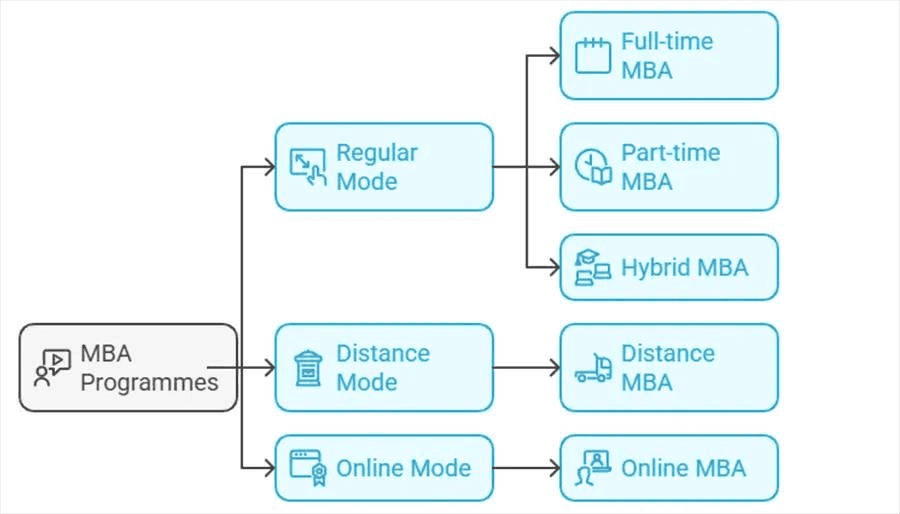
✅ Full-time MBA: It is the traditional way of pursuing any degree. In this mode, you must This spacing issue exisattend your classes every day at the university campus. Face-to-face interaction is a must in this mode of learning. Top MBA colleges in India include IIMs, FMS, MDI and XLRI.
✅ Part-Time MBA: The format of a part-time MBA is less rigid compared to a full-time programme. You would attend in-person classes, but they are usually held in the evenings or at weekends. So, you could continue with your commitments and responsibilities on the sidelines.
✅ Distance MBA: The flexibility factor is loosened here. In this mode, you do not need to visit the university campus. The study material shall be delivered to you by post or email, and you can study at your own pace. However, the exams are conducted offline at the designated examination centres, usually in the nearby region. Furthermore, for most distance MBA colleges in India, the exams are conducted online so you can take them from home.
✅ Online MBA: It is the most flexible mode of learning, where you can attend either live sessions or recorded lectures. Degrees received from top online MBA colleges in India are equivalent to those of a full-time offline course. So you could quickly pursue your job and simultaneously complete your master’s degree.
✅ Hybrid MBA: Since no one wants to give up the benefit of online learning and miss out on the on-campus experience, a hybrid MBA was introduced. It is a blended mode of learning where you have to visit the campus for a few modules, while the majority is done online.
Every college follows different eligibility criteria, and it may vary for online and distance modes as well. Let’s take a look at the common eligibility parameters that you must fulfil.
✅ You must have completed your bachelor’s degree from a UGC/AICTE/AIU-approved university in any stream.
✅ The minimum marks in your undergraduate degree must be 50%. However, it may vary depending on the institution. The reserved category students get 5% relaxation in the minimum mark criteria.
✅ Must have qualified for one of the MBA entrance exams. However, many online MBA courses do not require entrance test scores.
✅ There is no upper age limit to pursue an MBA in India. However, some entrance exams may follow age restrictions.
Are you planning to enrol in an MBA course? The admission process for MBA degrees can generally be completed online. However, the MBA admissions process varies institution by institution. Let’s have a look at the general steps for MBA admission.
✅ Prepare a list of prospective colleges of choice and see if they have your desired specialisation.
✅ Understand the eligibility and admission procedure for every college/university you apply to.
✅ Prepare for the MBA entrance exam accepted by your desired college, and appear for that exam.
*Please note that the entrance exam is mainly required for regular MBA and not for online or distance MBA courses. After appearing for an entrance exam, you would also be required to apply separately for admission to the respective colleges. The steps to apply for MBA admissions in colleges are as follows:
✅ Visit the official website. Fill out the college application form.
✅ Upload all the necessary documents along with the entrance exam score.
✅ If shortlisted, prepare for the next round of the selection process, which may include group discussion and personal interviews.
✅ Receive the confirmation letter and pay the programme fee to book your seat.
The curriculum varies across MBA courses because different specialisations are offered. Moreover, every college has a unique curriculum. The general MBA syllabus is divided into four semesters. The last two semesters offer in-depth details regarding the specialisation you choose. Here, we have compiled a general syllabus for the MBA course. Let’s quickly explore this:
As we see in the table, an MBA degree's curriculum includes a specialisation in the third or the fourth semester. Some of the common MBA specialisations offered in an MBA are finance, business, marketing, supply chains, human resources, entrepreneurship, IT, healthcare, etc. Depending on one's academic interests, a student may choose from any of these specialisations and gain advanced knowledge and skills in that particular domain. All of the specialisations offer plenty of professional opportunities upon completion of an MBA degree. Make sure that you choose a specialisation that aligns with your academic interests and professional aspirations.
We have discussed before that one needs to appear for MBA entrance exams for admission. Whether it is GMAT/GRE/CAT/MAT/XAT, you need to clear the cut-off. Top-ranked MBA institutions have the highest MBA admissions cut-off. Here are some tips to start preparing for various management entrance exams. These tips help you prepare for the exam smartly and effectively.
IIM, or the Indian Institute of Management, is regarded as the top-ranked MBA institution in India and globally. Apart from IIMs, there are various MBA colleges offering full-time MBA courses. Let’s have a look at the top 5 MBA colleges with great placement records, student support and services and high ROI.
Online MBAs are highly popular, especially among working professionals. They can easily manage their studies without taking a break from work. They are also beneficial for students who are not interested in full-time MBA courses. Online MBA courses are valid and on par with regular management programmes.
Almost everyone else is pursuing an MBA or planning to do so. What’s the craze of an MBA course? It’s the outcome and benefits you get after completing this course. So, are you also planning to take advantage of an MBA course? Let’s explore the top benefits of an MBA at a glance.
As the business world evolves, the MBA course has to take a global approach to a more holistic education. It is because of the growing and changing demands of businesses and students that online MBAs are also on the rise. It has further increased student participation in this field. Ultimately, an MBA is a ticket to more significant opportunities and higher salaries.
Enrolling in an MBA could open your doors to various senior-level career prospects. With this excellent degree, you could reach C-suite executive roles. Furthermore, its diversified specialisations allow you to choose your expertise in your desired career goals. In short, pursuing an MBA could be your road to a successful, long-term, and stable career.
Yes, an MBA course is a 2-year postgraduate degree programme.
An MBA course at a top university in India would benefit you more. MBA programmes of IIMs, XLRI, Amity University, Manipal University, and Symbiosis Institute of Management Studies are considered the best.
Depending on the study mode, specialisation and college you choose, the MBA course fee differs. It usually ranges between INR 30,000 and INR 30+ lakh.
Securing a high salary package after an MBA relies on your skills, experiences, and other factors. Apart from this, the industry in which you work also matters. For instance, as per today’s market trend, business analytics, finance, IT, etc., are booming sectors; therefore, the salary potential in this field would be high.
MBA courses do not require any work experience unless specified by a university. MBA admissions is open to graduates and working professionals.
Our team of experts, or experienced individuals, will answer it over online meet. Book your slot now!
Book Free Online Counselling

Get Free Career Guidance