Explore Courses
Top University
Search anything
 Refer and Earn ₹ 5000
Anti Paper Leak Bill 2026 is an amendment bill, proposing changes to the Public Examinations (Prevention of Unfair Means) Act, 2024. The Bill was passed in Lok Sabha on July 29, 2026 and in Rajya Sabha on July 30, 2026. Now, it awaits the President’s assent before being notified in the Official Gazette and enacted into law. Furthermore, the Bill 2026 proposes various changes to the Act 2024. It aims to strengthen the legal framework against exam fraud in India, such as paper leaks, organised cheating, impersonation, etc.
This blog takes a deep dive into the Anti Paper Leak Bill, 2026. It covers crucial details like punishments, financial penalties, and fresh proposals. Scrolling ahead, you shall also discover the differences between the Public Examinations Act 2024 and the Public Examinations Amendment Bill 2026.
✅ Anti Paper Leak Bill 2026 is officially known as the Public Examinations (Prevention of Unfair Means) Amendment Bill, 2026.
✅ The objective of the Bill 2026 is to discourage organised crimes, exam fraud, and paper leak cases.
✅ The Bill proposes higher penalties of up to 10 crore for offenders.
✅ The minimum imprisonment for offenders has increased to five years from three years, while the maximum remains ten years.
✅ The Constitution of Fast-track Courts, Special Task Forces (STFs), & Special Public Prosecutors has been proposed in the Bill 2026.
The Anti Paper Leak Bill 2026 is an amendment to the Public Examinations (Prevention of Unfair Means) Act, 2024. It is officially referred to as the Public Examinations (Prevention of Unfair Means) Amendment Bill 2026. It aims to strengthen the framework introduced in 2024 to prevent paper leaks, organised cheating, impersonation, and other unfair means that take place during public examinations across nations.
The bill focuses on stopping exam fraud by ensuring quick investigations, higher exam security, and greater accountability. Its objective is to maintain fairness and credibility in recruitment and entrance examinations in India.
Also Read: Who is the Current Education Minister of India?
The Anti Paper Leak Bill 2026 was introduced in the Lok Sabha in July 2026 to make public examinations more secure and transparent. The bill was introduced following the CJP-led protest for the NEET paper leaks case in 2026. It is basically an amendment to the Public Examinations (Prevention of Unfair Means) Act, 2024, for stricter punishments for such offences, speedy investigations, and higher accountability.
Here is why the recurring paper leaks became a reason for student protests to demand a bill amendment:
✅ Delayed and cancelled exams led to postponed admissions and job recruitments of students.
✅ Loss of public trust in the recruitment process, raising concerns about fairness and merit.
✅ Extra financial burden, as candidates may need to travel and prepare again for re-examinations.
✅ Stress and disappointment for those whose genuine hard work is affected by unfair practices.
The Anti Paper Leak Bill 2026 reinforces the existing framework of the Public Examinations Act, 2024. It introduces stricter penalties and quicker judicial processes to ensure fairness in the exams. Also, addresses the need for better accountability and amplified exam security. You may take a look at the crucial features of the Public Examinations (Prevention of Unfair Means) Amendment Bill 2026:
Harsher Punishments for Those Involved in Such Offences: Encourages strict punishment in the existing bill, including longer imprisonment and higher penalties for individuals and organised groups involved in examination malpractice or fraud.
Fast-track Courts to Speed Up the Judicial Processes: Special courts shall be established to ensure speedy trials and investigation of public exam malpractice cases at the judicial level. It helps avoid longer delays in court hearings, ensuring timely justice is served.
Higher Digital Security to Maintain the Integrity of Exams: The Anti Paper Leak Bill 2026 fosters stronger digital security measures for online public examinations. Its objective is to protect exam systems and question papers from various types of cyberattacks, unauthorised access, and data breaches.
Institutional Accountability: Holds examination authorities and private service providers directly liable if they fail to maintain fairness and integrity in exams.
Stricter Deterrents to Curb Exam Malpractices: Stronger measures and strict protocols should be followed to lower or completely prevent cases like paper leaks, organised cheating, impersonation, and other unfair practices.
Proposed amendments to the Public Examinations (Prevention of Unfair Means) Act, 2024 aim to strengthen the overall existing framework. It focuses on discouraging organised exam crimes, frauds, and serious issues like repetitive paper leaks. Amplifying the penalties and duration of imprisonment are the core measures of the Anti Paper Leak Bill 2026, emphasising stricter rules and regulations to prevent exam frauds. Check out the punishment and penalties proposed under the Anti Paper Leak Bill Lok Sabha 2026:
As per the existing law, the minimum imprisonment duration was 3 years for individuals found guilty of exam fraud and paper leaks. It has been significantly extended to 5 years and can rise up to 10 years at maximum.
Whereas the financial penalties for the same can go up to INR 50 lakhs from INR 10 lakhs. The ultimate objective of the government in introducing this system is to create stronger deterrence to enhance the public examination system.
The proposed amendment also outlines strict punishments for agencies involved in the conducting of examinations, managing exam centres, and organisations providing logistics and technology support for the same.
Such service providers could face up to 4 years of debarment from conducting exams, up to an INR 1 crore penalty, and recovery of exam costs, according to the Public Examinations (Prevention of Unfair Means) Act 2024.
As per proposed changes, the financial penalty has been maximised to INR 5 crore, in continuation with recovery of exam costs. Additionally, the period for debarment has been extended to 8 years.
The new Anti Paper Leak Bill 2026 enforces stricter laws for organised paper leak crimes. Under the new proposal, the minimum jail term for organised crimes related to exam frauds would be seven years, which was five years earlier, while the maximum would still be ten years. The penalty has been significantly raised from INR 1 crore to INR 10 crore.
The Union Government has taken a stance on senior management as well. Executives at senior levels, directors, and other individuals in charge of service providers can also face a minimum imprisonment of 5 years, up from 3 years. The maximum jail sentence will remain the same, up to 10 years.
The amount of fine has also been increased to INR 5 crore from INR 1 crore. Moreover, the objective of implementing these changes is to enhance accountability for higher authorities involved at various levels in the conduct of public examinations.
This is one of the major amendments proposed in the new bill. Under this proposal, special fast-track courts shall be established for cases related to exam fraud, paper leaks, and exam malpractices. States and union territories are required to designate these courts that would conduct day-to-day hearings with minimum adjournments.
It also states that the trial should be completed in a maximum of 3 months from the filing of the chargesheet. Pending exam fraud cases shall also be transferred to these courts in order to speed up the trial and resolve the chargesheets at the earliest.
The move can be seen as a response to widespread criticism that trials and investigations take years to conclude in the major exam controversies.
Delayed investigations undermine the public trust and student confidence in the examination system. The existing law has provisions for investigation authorities. However, it specifies no deadlines to finish the investigation on exam fraud.
Under the proposed amendments, fixed timelines of two months have been allotted to investigation authorities. This shall extend to central investigation agencies, state police agencies, and any other special task forces commissioned for such cases.
Currently, cases related to exam controversies can be transferred to the central investigating agencies. With this new amendment being introduced, the Centre shall now have the authority to constitute Special Task Forces (STFs) for such cases. This new change shall allow these forces to investigate complicated and large-scale paper leak and exam fraud cases independently.
The new bill further proposes that all States and Union Territories appoint Special Public Prosecutors to handle the exam fraud & paper leak cases in fast-track courts. It also introduces a dedicated appeal system, under which such appeals will be heard directly by the High Courts. Moreover, the appeals should be decided by a two-judge bench within three months, wherever possible.
The Public Examinations (Prevention of Unfair Means) Act, 2024 has provisions for the recovery of cost for re-conducting examinations from those involved in exam fraud cases. It also states that properties would be attached in order to compensate for the losses caused by the exam fraud.
The new Anti Paper Leak Bill 2026 retains these provisions, ensuring that offenders bear the financial consequences for their actions alongside stricter penalties.
The Public Examinations (Prevention of Unfair Means) Amendment Bill, 2026 covers a range of major public exams conducted across India for recruitment and academic selection purposes. Primarily, the law applies to all the central public or national-level examinations held under the central government. Here are several major exams that would be covered in the new bill:
📝 Union Public Service Commission (UPSC) Exams
📝 Staff Selection Commission (SSC) Exams
📝 Exams conducted by the National Testing Agency (NTA): JEE, NEET, CUET, etc.
📝 Railway Recruitment Board (RRB) Exams
📝 Institute of Banking Personnel Selection (IBPS) Exams
The proposed amendments for the Anti Paper Leak Bill 2026 aim to build a more trusted framework for public examinations in India. By addressing senior management authorities and enforcing stricter punishments and higher penalties, the move is to discourage individuals and large networks of people from engaging in examination malpractices in India.
The Bill further encourages enhanced security protocols, special fast-track courts, special forces for independent investigation, and direct appeals in high courts. Its objective is to ensure timely legal action and hold offenders financially accountable. Restore public trust and protect the hard work of genuine candidates.
The Public Examinations (Prevention of Unfair Means) Amendment Bill, 2026 states multiple changes and improvements to existing laws. It aims to reinforce the existing examination system across the nation. It is advantageous for students who put their genuine efforts into exam preparation and get discouraged due to exam fraud. Let us explore the benefits of the Anti Paper Leak Bill 2026:
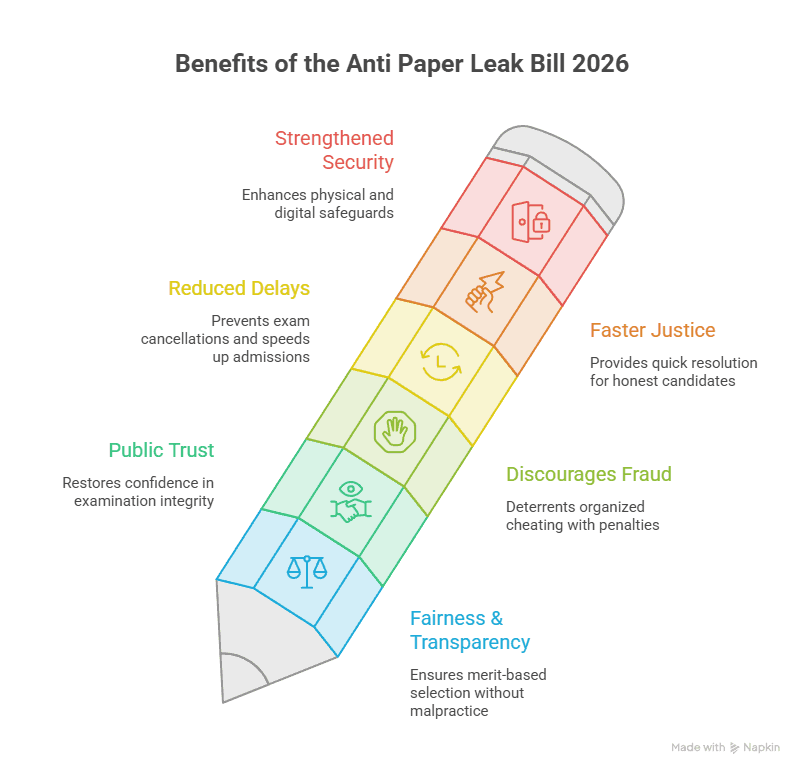
The Bill enables a fair examination process by reducing incidents like paper leaks and organised cheating. It helps ensure that students are shortlisted based on merit without any malpractices.
The motive behind enforcing stricter laws, harsher punishments, and faster legal proceedings is to restore the confidence of students in the public examinations’ credibility and integrity.
Tougher punishments and higher financial penalties are expected to deter organised groups involved in paper leaks, impersonation, and other unfair examination practices.
Preventing recurring paper leaks can help avoid cancellation of exams. Ensuring quick court conclusions against chargesheets related to exams fosters reduced delays in counselling processes, admissions, and recruitments.
Proposed fast-track courts and time-bound legal proceedings encourage the quick resolution of paper leak and other exam fraud cases. This can help protect the interests of genuine aspirants across the nation.
The Bill encourages examination authorities to adopt powerful security measures. And enhance the digital safeguards to prevent exams from leaks, data breaches, and other cyber frauds.
The Public Examinations (Prevention of Unfair Means) Act, 2024 was the first legislation in India that was introduced to prevent unfair practices in public examinations. Considering the repetitive paper leaks and organised crimes, the government has faced the necessity to make amendments to the 2024 Act.
As a result, the Anti Paper Leak Bill 2026 is introduced as an amending bill to strengthen the laws in the existing 2024 Act. It has mainly emphasised fast-track courts for exam cases, independent investigation forces, higher penalties, and increased imprisonment for offenders in such cases. Here are the key differences between the Act, 2024 and the Amendment Bill, 2026:
Anti Paper Leak Bill 2026 or the Public Examinations (Prevention of Unfair Means) Amendment Bill, 2026 is an amending bill. The main motive behind introducing this bill is to create a stronger examination system so that students who genuinely put their efforts into exam preparation can get timely justice. It targets different kinds of offenders who can be involved in exam fraud cases, such as the directors of managing exam centres, service providers, and exam conducting agencies. Moreover, the Bill 2026 shall reduce delayed admissions and recruitments for aspirants.
The Anti-Paper Leak Bill 2026 was passed in Lok Sabha and Rajya Sabha in July 2026. It still needs to be presented to the President of India before being passed as a law.
Public Examinations (Prevention of Unfair Means) Amendment Bill, 2026 is an amending bill to the Public Examinations (Prevention of Unfair Means) Act, 2024 that proposes harsher punishments and higher penalties for offenders in paper leak and exam fraud cases. It also introduces fast-track courts, fixed deadlines for investigations, and special task forces (STFs) to deliver timely justice in exam malpractices.
As per the new Amendment Bill 2026 (Anti Paper Leak Bill 2026), the proposed punishment for paper leak in India is:
✅ Up to INR 10 crore of fine
✅ Up to 10 years of imprisonment
✅ Recovery of exam costs
✅ Property attachment from offenders
Paper leak cases often lead to immediate exam cancellations, thorough investigations, and extreme financial penalties for those involved in such cases.
1. Introduction of the Bill (First Reading)
2. Discussion and Review (Second Reading)
3. Voting and Passage (Third Reading)
4. Approval by the Other House (Lok Sabha/Rajya Sabha)
5. President's Assent
6. Publication in the Official Gazette (Becomes an Act)
Our team of experts, or experienced individuals, will answer it over online meet. Book your slot now!
Book Free Online Counselling


Get Free Career Guidance