Explore Courses
Top University
Search anything
 Refer and Earn ₹ 5000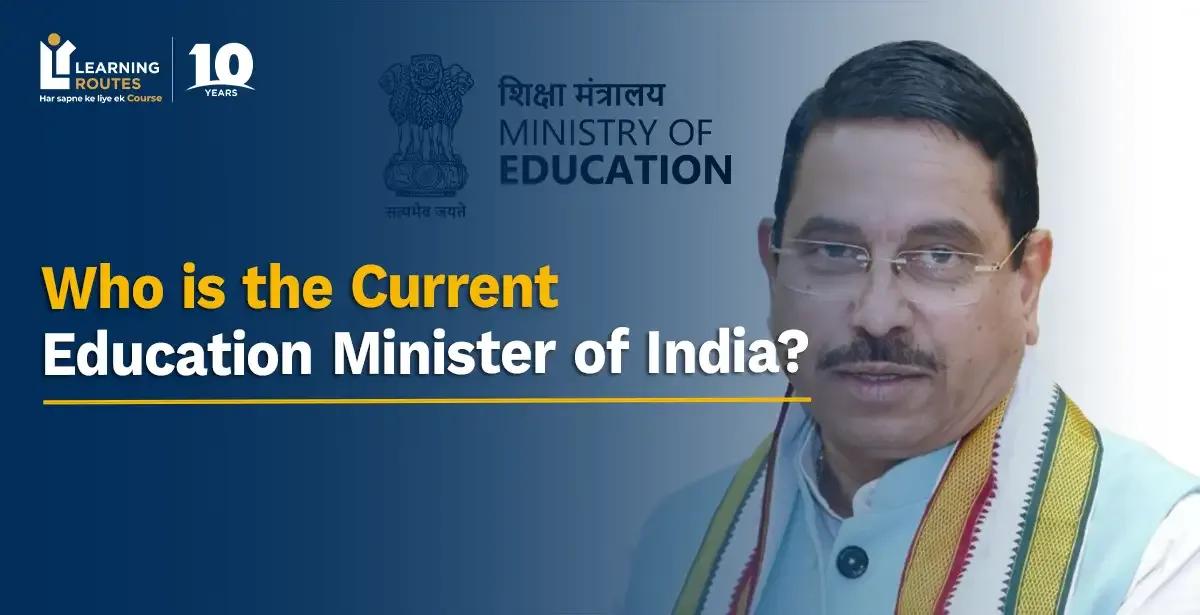
“Education is the one thing no one can take away from you” – Elin Nordegren
Our Indian Constitution gives the right to education to every citizen of the country, making it a fundamental right. So yes, no one can take it away from you. According to the law, the state must provide free and quality education to all children aged 6 to 14 years. Educational infrastructure is the pillar of a country’s socioeconomic development. In the nation-building journey, the Ministry of Education (MoE), Government of India, aims to cultivate strong minds with the light of education. And the education minister heads the MoE, a cabinet minister belonging to the ruling political party.
The union education minister plays a critical role in planning and overseeing the population’s educational needs as the representative head. The President of India elects the education minister on the suggestion of the Prime Minister. Every 5 years, the education minister is changed as per the results of the Lok Sabha elections. Now, you must be wondering who currently holds the position of education minister in India. Currently, Hon’ble Cabinet Minister Pralhad Joshi is the Education Minister of India. Joshi was appointed as the new education minister of India on July 25, 2026, after the resignation of the previous education minister, Shri Dharmendra Pradhan. He formally took charge of the role on July 26, 2026.
In this blog, we have taken a deeper look into the life and achievements of the Hon’ble Minister. Moreover, it shall also cover his work to make education accessible and convenient for all.
Born on November 27, 1962, Shri Pralhad Joshi hails from Bijapur in Karnataka. He belongs to the family of Venkatesh Joshi, who was an employee in the Indian Railways. Joshi has graduated from Shri Kadasiddeshwar Arts College in Hubballi. Being an industrialist after completing his college, Joshi led a movement to hoist the Indian flag at Idgah Maidan in Hubballi, Karnataka.
Subsequently, he also participated in the “Save Kashmir Movement” between 1992 and 1994 and became well known for his patriotism. In 2004, Joshi was elected for the first time as the Member of Parliament (MP) from the Dharwad constituency after defeating Congress candidate B.S. Patil. He secured three consecutive wins from that constituency in later years.
Moreover, he is an active member of Rashtriya Swayamsevak Sangh (RSS). Currently, he represents the Dharwad seat in the Lok Sabha as a Member of Parliament. In addition to this, he is also the Minister of Consumer Affairs, Food and Public Distribution & the Minister of New and Renewable Energy for the Government of India.
The Education Minister of India is responsible for carrying out the functions of the Ministry of Education, Government of India. They are in charge of enhancing the education system of India. Furthermore, the MoE ensures the quality and accessibility of education at various academic levels, from primary to higher education. The key responsibilities of the education ministers of India include:
✅ Implementing and overseeing the guidelines of the National Education Policy at multiple academic levels.
✅ Providing support to disadvantaged groups, including women, need-based, and minorities.
✅ Ensuring that education quality is maintained at all learning levels across the nation, especially in backward areas that lack many facilities.
✅ Imparting scholarships, loan subsidies, and economic help to learners, coming from weaker sections.
✅ Working with foreign institutes, government regulatory bodies, and UNESCO to empower international cooperation.
Pralhad Joshi formally assumed the office as the 10th Education Minister of India on July 26, 2026. However, he did not secure the charge for the role by separate elections. Instead, he was appointed by the Honourable Prime Minister of India, Shri Narendra Modi, after the nationwide student protest of CJP (Cockroach Janta Party), led by Abhijeet Dipke. The protest took place over the growing public concern for exam-related controversies, mainly paper leaks.
After President Droupadi Murmu accepted Dharmendra Pradhan's resignation, the Prime Minister entrusted the Education Ministry to Pralhad Joshi. A senior BJP leader, who is a five-time MP from Dharwad and an experienced Union Cabinet minister. Joshi has been chosen for the role because of his long administrative experience and leadership in managing several key ministries under the Union Cabinet.
Shri Dharmendra Pradhan, during his tenure (2021-2026), has taken various steps to upgrade the education system of India. Various schemes, platforms, and policies have been made, ensuring quality education for everyone. Let’s take a look at the schemes/programmes launched by the preceding education minister for the upliftment of society as a whole that are still valid, regardless of the resignation:
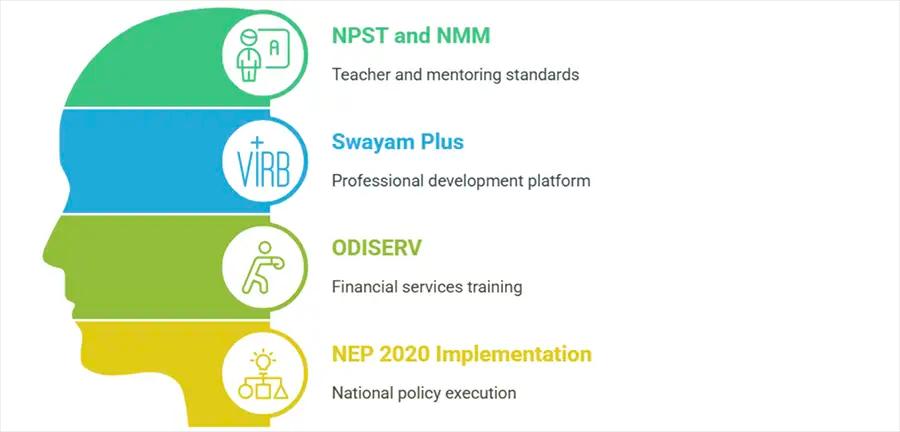
In March 2024, Shri Dharmendra Pradhan launched various school and teacher education initiatives. He launched the National Professional Standards for Teachers (NPST) and National Mission for Mentoring (NMM) programmes. He also launched printed books on NMM and NPST, guidelines and videos of SCERTs/DIETs, a video of Vidya Samiksha Kendra, 200 TV channels, and 52 primers in the Indian language. (DIETs represent 613 District Institutes of Education and Training.)
Also Read: How Online Learning Changing School Education in India?
In February 2024, the Union Education Minister launched the new SWAYAM Plus platform. The platform offers professional development and employability-focused programmes for working professionals and higher education students.
The minister launched the project ODISERV in the Sambalpur area. It aims to train young graduates for employment opportunities in the financial services area. This 100-hour training programme would equip you with skills essential for banking, finance, and insurance. Under the project ODISERV, over 1100 students have already been trained, and some have also received job offers.
The Hon’ble minister is key in implementing the National Education Policy, 2020. From implementation to awareness, Mr. Dharmendra Pradhan has been committed to creating a skilled and workforce-ready India.
Also Read: Online Education Revolution: Initiatives Taken by the Indian Government
The Ministry of Education was created on 26th September 1985 by the 174th amendment to the Government of India Rules, 1961. Earlier, it was known as the Ministry of Human Resource Development (MHRD). However, the Union Cabinet changed the name on July 29 to the Ministry of Education to clearly define the ministry’s focus. The Ministry of Education has two sub-departments that cater to different grades of the Indian education system. Both these departments have distinct roles and functions.
Ever since independence, India has witnessed the reforms brought by many education ministers. Over 30 individuals have served as cabinet education ministers in India since independence in 1947. Maulana Abul Kalam Azad was the first education minister of India, who served in this position from 1947 to 1958 (a tenure of 11 years). Here is the list of education ministers who have assumed the role of Union Education Minister since independence:
| Name of the Minister | Tenure |
|---|---|
| Maulana Abul Kalam Azad | 1947 to 1958 |
| K.L. Shrimali | 1958 to 1963 |
| Humayun Kabir | September 1963 to November 1963 |
| M.C. Chagla | 1963 to 1966 |
| Fakhruddin Ali Ahmed | 1966 to 1967 |
| Triguna Sen | 1967 to 1969 |
| V.K.R.V. Rao | 1969 to 1971 |
| Siddhartha Shankar Ray | 1971 to 1972 |
| S. Nurul Hasan | 1972 to 1977 |
| Pratap Chandra Chunder | 1977 to 1979 |
| Karan Singh | 1979 to 1980 |
| B. Shankaranand | January 1980 to October 1980 |
| Shankarrao Chavan | October 1980 to August 1981 |
| Sheila Kaul | 1981 to 1984 |
| K.C. Pant | December 1984 to September 1985 |
| P.V. Narasimha Rao | 1985 to 1988 |
| P. Shiv Shankar | 1988 to 1989 |
| V.P. Singh | December 1989 to November 1990 |
| Raj Mangal Pande | November 1990 to June 1991 |
| Arjun Singh | 1991 to 1994 |
| P.V. Narasimha Rao (twice) | December 1994 to February 1995 |
| Madhavrao Scindia | February 1995 to January 1996 |
| P. V. Narasimha Rao | January 1996 to May 1996 |
| Atal Bihari Vajpayee | May 1996 to June 1996 |
| S. R. Bommai | 1996 to 1998 |
| Murli Manohar Joshi | 1998 to 2009 |
| Arjun Singh | 2004 to 2009 |
| Kapil Sibal | 2009 to 2012 |
| M. M. Pallam Raju | 2012 to 2014 |
| Smriti Irani | 2014 to 2016 |
| Prakash Javadekar | 2016 to 2019 |
| Ramesh Pokhriyal | 2019 to 2021 |
| Dharmendra Pradhan | 2021 to 2026 |
| Pralhad Joshi | 2026 to Present |
Union Minister Pralhad Joshi assumed office as the education minister of India for the first term, bringing over two decades of parliamentary and administrative experience with him. Having previously handled multiple cabinet roles, Joshi now takes on the responsibility to lead the education sector of India. As a freshly appointed education minister, he is expected to strengthen the NEP 2020, improve the quality of education from schooling to higher academic levels, and make necessary reforms to prevent issues like paper leaks in India. His leadership shall play a crucial role in shaping India's education system. Supporting the country's vision of building a skilled and developed nation under the goal of Viksit Bharat.
Shri Pralhad Joshi has been appointed as the new Education Minister of India after the resignation of Shri Dharmendra Pradhan in July 2026.
Maulana Abul Kalam Azad was the first education minister of India after independence in 1947. He served in this position for a tenure from 1947 to 1958 in the cabinet of Jawaharlal Nehru.
The five important pillars of the National Education Policy (NEP) 2020 are Accessibility, Affordability, Accountability, Equity, and Quality. These pillars ensure high-quality, inclusive, accessible, and affordable education for everyone in India, from preschool to higher education levels.
Savitri Bai Phule is widely recognised as the mother of modern education in India. She is also known as the first female teacher of India who encouraged women's education and social reform in the 19th century in India.
Lord Macaulay is known to have begun the English-medium education in India in the 19th century to ensure that the educated class could manage the administrative work efficiently during British rule.
5+3+3+4 represents the new educational development stages, in which:
5 means 5 years of foundational education: preschool to class 2nd.
3 represents 3 years of preparatory education from class 3rd to class 5th.
The next 3 refers to the middle education range between class 6th and class 8th.
Finally, 4 reflects 4 years of secondary education between class 9th and class 12th.
Our team of experts, or experienced individuals, will answer it over online meet. Book your slot now!
Book Free Online Counselling

Get Free Career Guidance