
Explore Courses
Top University
Search anything
 Refer and Earn ₹ 5000
Want to hold a doctorate in business, but confused between PhD vs DBA? Both are doctorate degrees, include research, and can help you advance your career. Then, what's the dilemma? It is a matter of choosing between theoretical findings and applied research. A PhD can help you build a career in research and academia. But a DBA can unlock opportunities to senior executive roles in business and is globally recognised. So, which one should you choose? Down to career outcomes, curriculum, and your goals, the decision should be based on your requirements. This blog is a comprehensive guide to PhD vs DBA programmes. Learn the PhD vs DBA full form, differences, compare multiple factors, and know which one is ideal for you.
The full form of a PhD course is the Doctor of Philosophy. Despite its name in philosophy, the degree is awarded in a wide range of disciplines and subjects. A PhD is considered the highest level of qualification that you can earn after completing a master's in a relevant discipline. This is basically a research-oriented programme that focuses on the development of new theories, allowing you to contribute your original findings to a field of study. Pursuing a PhD is generally ideal for:
✅ Students wishing to pursue a career in academia & research
✅ Candidates want to assume positions of professors or researchers in higher education institutes
✅ Anyone planning to publish scholarly papers
A DBA or Doctorate of Business Administration is the highest qualification in academic business management and administration. The course is introduced as a follow-up to a Master of Business Administration (MBA). However, it is generally provided to senior executives for leadership roles and C-suite positions to acknowledge an extensive and applied understanding of the latest business trends to solve real-world problems at business organisations or workplaces. Here is who should enrol in a DBA programme:
✅ Working professionals to acquire higher-level positions
✅ Senior managers and entrepreneurs
✅ Business consultants, associates, and leaders
PhD courses focus on academic research and creating new theories on your own, which further contribute to the existing field of study. However, DBA emphasises applied research in the areas of business and management, solving corporate issues on a larger scale. PhD is a more theory-centric while DBA is an applied-research oriented programme. You may explore the difference between a PhD vs DBA in business programme:
Yes, a Doctor of Business Administration (DBA) is considered an equivalent course to a Doctor of Philosophy (PhD) as both are doctoral programmes. However, in India, the University Grants Commission (UGC) only recognises PhD courses as doctorate programmes for academics and research curriculum.
Therefore, legally, a DBA may not hold the same value as a PhD programme in India. But both courses allow you to use “Dr.” as a prefix in your name. However, at a global level, a DBA is more valuable for working professionals, senior business executives, and leaders in corporate than a PhD course.
Yes, a DBA is similar to a PhD in business course in terms of research-based pedagogy and a doctorate degree, but it varies by objectives. The curriculum of a PhD helps you pave your way to academia and research, while a DBA unlocks the career ladders to top-level roles in corporate, such as general manager, CEO, department head, etc. A PhD course aims to make you a master's at a conceptual level, while a DBA allows you to apply your researched findings to solve real-world challenges in the workplace.
Both PhD and DBA courses are valuable for different purposes. While they have a few similarities, the objectives and curricula of both programmes are notably different. We shall compare the crucial factors of both PhD and DBA courses that make them distinct from each other to learn about the differences in detail. Let us explore:
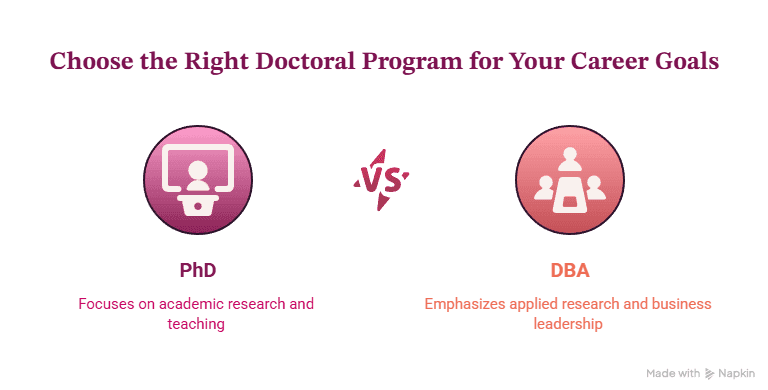
A PhD programme focuses on academic research. It allows you to develop new theories or contribute to existing theories with fresh perspectives. Fill out the loopholes and gaps in the existing theories. The research work of a PhD programme is thesis-oriented.
On the other hand, the research of a DBA programme is focused on applied theories that can be used to solve real-world issues. As a DBA student, you contribute to advancing business theories by combining your research with issues at workplaces. It encourages case studies, applied knowledge, and fresh perspectives that can effectively be used to tackle dynamic business challenges.
A PhD programme is widely acknowledged as a full-time course, and is rarely part-time. It requires the undivided attention of learners, thoroughly involved in the coursework. The duration of a PhD is generally 4-6 years, with initial years focusing on comprehensive theory-based knowledge. In the later years, the focus gradually shifts to dissertation and thesis research to contribute new insights to a field of study. It is generally difficult to manage a PhD programme alongside a full-time job, family affairs, and other commitments for working professionals.
In contrast, a DBA course does not require cohesive attention, making it ideal for busy professionals. The course is generally delivered through a fully online or blended mode of learning. It allows you to accommodate and balance your work and family obligations while being involved in learning and research at your pace. This learning approach of a DBA course makes it a wise choice for future business enthusiasts who can commit to research work and provide valuable and vast contexts compared to traditional PhD in business courses.
PhD programmes include a thorough research curriculum. These are ideal for those who want to build their careers in academia and research or wish to publish their thesis in a desired field. It helps you acquire positions for professors at higher education institutes in India in a particular field.
DBA courses, however, are more beneficial for professionals planning to get promoted to senior-level, leadership, and top-management positions. Being a DBA student, you will be doing research specifically relevant to business domains. This research can further be applied practically to solve real-world business problems. Educate learners, publish in academic theories, and share as guest lecturers.
A PhD is a doctoral programme that follows a structured curriculum. In a PhD in business, you engage in a learning phase for the first few years and then focus on research, dissertation, and thesis. The curriculum revolves around the core principles of management, business theories in societal change, and new findings on market trends.
DBA courses, alternatively, consist of conceptual understanding along with applied research methods. It focuses more on the development of skills, professional growth, decision-making skills, and leadership responsibilities. You need to use your findings to solve existing issues at the workplace, leading to applied practical knowledge.
In a PhD programme, learners are generally postgraduate students who want to contribute to original facts or existing theories as academic scholars. The main focus of PhD students is conducting research and teaching at the college and university levels as professors. As a PhD graduate, no matter what your designation is, you would be highly recognised as an academic research scholar worldwide. Furthermore, professors with PhDs often contribute small theories to publishing books or write a book as an author throughout their careers.
Conversely, the path of DBA graduates is not limited to academia and research only, as it is a business-focused programme. In this course, graduates are already working professionals with several years of experience in the industry. The course helps business practitioners to upgrade their relevant skills, perspective, and knowledge through applied research, conducted to manage and solve business problems at an organisational or larger level. After obtaining a DBA degree, professionals can expand their opportunities as consultants, business research specialists, or simply acquire senior roles in an organisation.
A PhD pursued from an institution in India is generally valuable for roles in academia and research within the borders. However, foreign PhD courses may attract better funding and positions at top-tier institutions for research globally. Therefore, the scope of a PhD course is limited to academia, especially in India.
On the other hand, an online DBA holds recognition globally by employers as well as educational institutions. Even most of the best DBA courses are provided by international institutes or in collaboration with top universities globally. The programme focuses more on building global perspectives and being able to acquire roles overseas.
PhD courses are mostly based on fellowship and research. Graduates are typically provided with all the tuition costs of an institution, along with a stipend for research work. In exchange, PhD scholars work as lab supervisors, junior fellowship research or teaching assistants, while learning.
DBA, alternatively, lets you bear all the expenses on your own. You have to pay all the costs relevant to acquiring a degree, such as tuition costs, research work, dissertation, etc. However, with DBA courses, professionals are free to pursue their continued income while being engaged in the programme. Depending on the institute, both PhD and DBA allow you to apply for financial aid to help weaker sections.
A PhD course, as per UGC guidelines, is only valid when done through the full-time and in-person mode of learning. A fully online or distance PhD is not valid in India. Thus, it offers no flexibility to learners as long as the theoretical learning takes place. You may receive a bit of flexibility to research at your pace within the duration of the programme.
Unlike PhDs, the Doctor of Business Administration is a programme for working professionals and senior executives, serving in an organisation or consultancy firm. Therefore, the programme is offered in a fully online mode or hybrid, allowing you to learn at your pace. However, you need to manage and adjust your time accordingly, as per your requirements, to focus on research and projects.
Pursuing a PhD programme is ideal for those who want to see themselves as a professor, published author, or researcher in the education sector. In some cases, experienced professors with a PhD may become departmental heads and lead the team.
DBA, on the other hand, has a remarkable significance for leadership positions in the corporate world. It is considered a better and a valuable fit for aspiring corporate professionals, seeking senior executive roles and C-suite positions like CEO, CFO, COO, in their own or other organisations.
A DBA degree typically offers better salary packages than a PhD. DBA graduates are working professionals who already have 3-5+ years of industry experience. Additionally, many professionals work for senior executive, top-management, and C-suite roles that often pay high salaries, ranging between INR 30 LPA and INR 70 LPA, depending on position, company, and working experience. On the other hand, PhD grads are mostly freshers and aim to work in academia and research. Depending on their working sector, private or government, the salary packages for PhD grads in India range from INR 7 LPA to INR 25 LPA.
DBA courses are precisely designed for working professionals in the corporate. Thus, it can offer you a better curriculum and business-oriented learning approaches than a PhD programme. Here is why a DBA is more valuable for professionals than a PhD programme:
DBA courses are mostly online, and some of them are hybrid. Therefore, you can manage your learning schedule with your working hours and other commitments accordingly.
Unlike a PhD degree, DBA programmes are offered within 3-6 years. Some universities may also have fast-track or accelerated DBAs with 1-3 years of duration, allowing you to wrap up your learning earlier.
DBA courses are conferred to working or senior professionals. Therefore, the expertise, new insights, and applied knowledge you gain through research work help you promote to higher-level roles or obtain better salary packages.
The coursework of a DBA degree is focused on the areas of business and its impacts on global markets. On the contrary to PhD courses, DBAs have a more business-oriented approach in their curriculum, preparing you to thrive in business domains, rather than academia only.
Most DBA courses are designed for senior executives with 10-15+ years of work experience. With its advanced and research-based holistic knowledge about workplaces, it can serve as a gateway to C-suite roles.
Both DBA and PhD in business allow you to earn a doctoral-level qualification. Either way, you will be able to showcase your research skills. However, both courses will be beneficial for different requirements. If you are a business enthusiast, but wish to contribute to research and findings in business through published journals, or become a professor for business and management students, a PhD in business should be suitable. But if you are looking to climb the career ladder in corporate for senior-level or top-level management roles, a DBA is more valuable at the national and global level.
Between a PhD or DBA, a DBA is generally better than a PhD for working professionals who want to expand their opportunities in the business domain. A PhD is more suitable for academic-oriented careers.
Yes, academically, a DBA is equivalent to a PhD programme as both are doctorate degrees, the highest level of qualifications in their respective domain.
Yes, a Doctor of Business Administration or DBA is higher than a master's, as it is a follow-up and doctoral-level programme for those with master's degrees.
Yes, professionals who have a DBA degree can use “Dr.” as a prefix in their names, like a PhD programme.
DBA is a more professional programme that emphasises applied research in business, while a PhD in business is ideal for academia.
Our team of experts, or experienced individuals, will answer it over online meet. Book your slot now!
Book Free Online Counselling


Get Free Career Guidance