Explore Courses
Top University
Search anything
 Refer and Earn ₹ 5000
“Does an online MCA offer the same value as a regular MCA?”
“Will I miss out on the on-campus experience if I opt for an MCA online?” These are some of the most common concerns while opting for an online MCA. However, both courses are two sides of the same coin. One offers you flexibility to learn at your pace, while the other is more focused on an immersive experience. Choosing between an online MCA and a regular MCA often becomes challenging when concerns take over your mind. However, to know which course aligns with your requirements the best, it is better to compare the courses’ features. You can easily choose between an online MCA and a regular MCA by considering your learning preferences. An online MCA course leads in terms of flexibility, cost-effectiveness, and self-paced learning.
However, regular MCA is generally a follow-up for those seeking frequent interaction, in-person networking opportunities, and access to massive placement drives. This blog compares the key factors of an online MCA vs a regular MCA. Learn differences in recognition, pricing, interaction, pedagogy, mode of learning, etc. Explore how an online MCA differs from a regular MCA. Discover which one is the right choice for your future career goals.
An online MCA course follows a well-rounded curriculum of two years. It consists of four semesters of six months each. You gain an in-depth understanding of programming languages, software development, mobile app development, and data structures, among others. Additionally, the course includes a capstone project in the last semester, helping you develop hands-on skills. Furthermore, the coursework for an online MCA is delivered via online synchronous and asynchronous lectures. You can interact with faculty through live lectures, generally scheduled on weekends. Or learn whenever you like through recorded videos, e-books, and PDFs.
A regular MCA is offered through the conventional mode of learning. This programme has a duration of two years, spanning four semesters. It requires you to visit the college premises regularly to attend lectures in person. Moreover, a regular MCA is also referred to as a traditional MCA and an offline MCA. This course facilitates face-to-face interaction with faculty, peers, and guests. Additionally, it also includes project work, which you have to complete in person. Practical training is also provided in person, making it easier for you to resolve your doubts in real time.
Well, the concise answer is no in most cases. The curriculum of an online MCA and a regular MCA is similar in various aspects. As per the guidelines of UGC for online courses, an institution should maintain equivalent academic standards in an online MCA curriculum as in its regular MCA to make it worthwhile for learners. Therefore, the core areas remain the same in an online MCA curriculum, such as focus on coding languages, databases, algorithms, computer applications, and more. Thereby, the project work is also included in the last semester of an online MCA for a hands-on learning experience. However, while the core subjects remain the same, you may find differences in some subjects that depend on your chosen specialisation during the course. Continue reading to learn more about this in detail.
Both online MCA and regular MCA have their benefits and limitations, which may influence your entire learning experience. An online MCA will offer you flexibility in learning time and location, but a traditional MCA encourages more face-to-face interaction. However, both courses are designed to meet the needs of students with different requirements. An online MCA helps those who have commitments and cannot relocate, but want to hone skills while working. However, if you are a fresher and want to learn and develop skills in person, then a traditional or regular MCA is better. It emphasises learning in the real-time moment with peers and mentors. Take a look at the differences between an online MCA and a regular MCA course:
Here, we have compared several factors that make an online MCA and a regular MCA different. Both courses have their benefits and some challenges. To understand these, let us explore the factors listed below in detail:
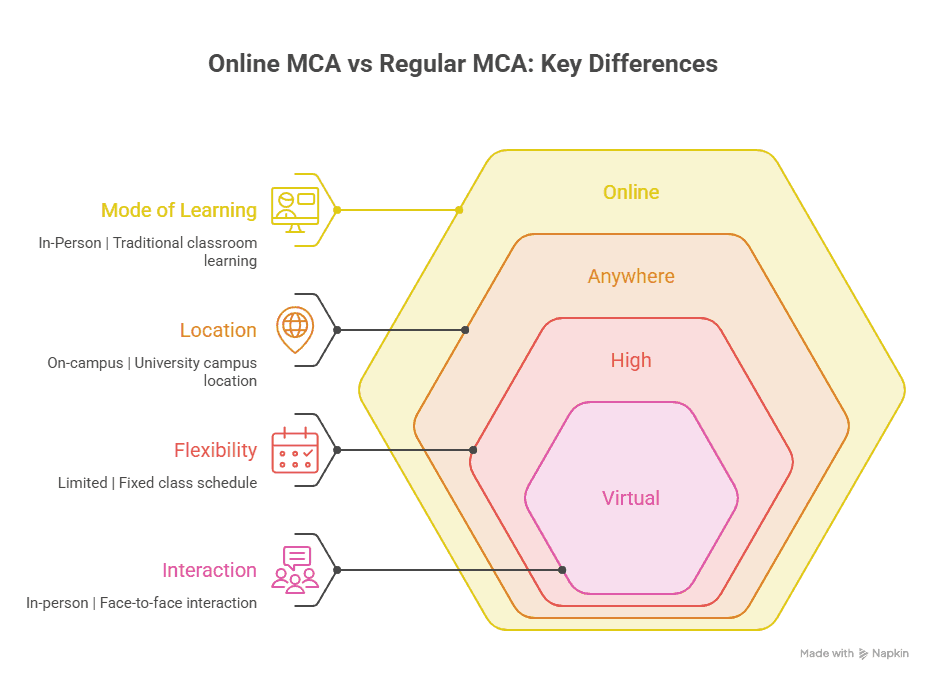
An online MCA course is delivered through an online and virtual mode of learning. It involves online synchronous and asynchronous lectures, which are conducted virtually. On the other hand, a regular MCA imparts knowledge offline through the conventional mode of education. You learn in the traditional classroom set-up, where the lectures take place in face-to-face mode.
Learn at your pace by enrolling in an online MCA course. The programme eliminates locational restrictions and allows you to enhance your qualifications from anywhere, anytime. It fosters self-paced learning as it includes recorded lectures, e-books, and PDFs. Alternatively, an offline MCA offers you no flexibility, basically. The idea of convenient learning is limited to classroom lectures, which require mandatory physical attendance on campus.
As per UGC guidelines, online MCA courses should follow the standard syllabus, programme structure, and examinations as of regular MCA programmes. Therefore, the curriculum and syllabus of an online MCA are the same at their core. They share various core subjects and electives for industry relevance. However, the pedagogy for the courses is what makes them distinct from each other. Take a look at the online MCA vs regular MCA pedagogy:
✅ Virtual & live interactive lectures with faculty, generally scheduled on weekends.
✅ Recorded video lectures for anytime learning.
✅ Study material in e-books and PDF format, which can be accessed on any device with internet.
✅ Guest sessions with industry leaders are conducted virtually.
✅ Classroom-based learning.
✅ Lectures in face-to-face mode, generally scheduled for weekdays.
✅ Immersive learning experience with faculty and peers.
✅ In-person seminars in collaboration with industry leaders.
There are two types of interactions in education. In-person and virtual. An online Master of Computer Applications facilitates virtual interactions with faculty and peers. However, some online universities like Online Manipal, CU Online, and Amity Online organise immersive events for learners to meet and greet with faculty, leaders, and peers in-person.
Regular MCA courses, conversely, promote daily in-person meetings with mentors and your classmates. It enhances your learning experience and keeps your mood in check, especially when you feel distracted from studying or in class. It depends on your requirements whether you need regular immersion or virtual and timely interaction opportunities to upgrade your qualifications.
Enrolling in an online MCA course costs far less than a traditional MCA programme. Firstly, the average fee structure for online MCA courses in India ranges from INR 50,800 to INR 2,75,000. However, a regular MCA costs between INR 1,50,000 and INR 6,00,000 or even higher, depending on your chosen university. Besides, pursuing an online MCA allows you to save on commute charges, hostel expenses, and rental costs, making an online MCA course cost-effective and budget-friendly. It makes learning possible and accessible for those with average household incomes or financial problems.
Both online MCA and regular MCA courses promote networking events for learners. In an online MCA, you can connect with your peers and faculty virtually through live sessions, webinars, and video conferences. Furthermore, several colleges organise networking events on-campus for their online learners, lasting from a few days to a week. But you can expand your network faster in an offline MCA as you get opportunities to meet and interact with your peers, faculty, and industry leaders frequently.
Both an online MCA and a regular MCA require approvals from UGC to be recognised and valid in India. As per UGC guidelines for online courses, an online MCA entitled by the UGC will hold equal value as a regular MCA degree in India. It would be valid for higher education, competitive exams, and jobs in the government and private sectors. However, regular MCA degrees generally hold more value among employers than an online MCA due to active in-person participation and an immersive learning curriculum.
A Master of Computer Applications (MCA) is a technical course. It requires you to gain practical knowledge on programming languages, databases, and algorithms through mini to major projects. However, with instructions from mentors, whether in-person or virtual, you can develop these skills on your own.
Moreover, both online and offline MCA courses focus on hands-on learning experience as it is a core to becoming a professional in the IT or software development field. The only difference here would be in terms of interaction and immersive learning. If you are a self-disciplined and dedicated person, even an online MCA could help you gain similar skills, as it follows the same curriculum as a regular MCA.
Looking at the demand for online MCA courses, colleges nowadays are trying to make the course more immersive, active, and efficient, similar to a regular MCA course. Therefore, both online MCA and offline MCA courses offer placement opportunities. An online MCA course generally fosters a virtual placement process where you connect with employers through online job platforms.
However, in a regular MCA, placement opportunities are offered in-person, allowing you to interview with recruiters face-to-face. Generally, most online MCA courses provide placement assistance instead of organising virtual drives with employers. But, this is a case that depends and varies by each individual college and university. Whereas, regular MCA from top colleges facilitate both placement assistance and placement drives.
You should select an MCA that suits your career goals, financial conditions, and learning requirements. If you want an immersive learning experience, hands-on curriculum, everyday interaction with your peers and faculty, an offline MCA or regular MCA is an ideal choice. However, opting for an online MCA would be in favour if you do not want to relocate, have a tight budget, or cannot attend every day classes due to family or work commitments. Here are the factors you may consider to make the right decision:
📝 Consider your flexibility requirements
📝 Evaluate your budget
📝 Look for specialisations to choose your major
📝 Placement opportunities and career support services
📝 Validity of degree for jobs or further education
📝 Analyse your learning style & interaction preferences
📝 Career goals and requirements for immersive learning experiences
Both an online MCA and an offline MCA are good choices depending on your requirements. Freshers often look for immersive learning where they can meet with peers and faculty to gain insights and skills in person. For this, a regular MCA is a wise choice. However, professionals, homemakers, managers, or those preparing for competitive exams but need a backup plan or simply cannot relocate, can pursue an online MCA course due to its flexibility. It is advised to make a note of your requirements and preferences for career outcomes, and then compare factors accordingly. Choose a course that fits your major preferences for learning.
An online MCA is good for working professionals who cannot commit time to on-campus learning. Regular MCA is an ideal choice for freshers seeking high in-person immersion and assured placement opportunities after completing the course, which may vary by university.
An online MCA ensures flexibility of location and self-paced learning, allowing you to upskill without physical on-campus attendance. Offline MCA courses have fixed learning schedules that require in-person classroom attendance.
Yes, an online MCA degree approved by the UGC is valid for jobs and further qualifications in higher education institutes across India.
Yes, an online MCA degree recognised by the UGC has equivalent recognition to a regular MCA programme.
Yes, if your online MCA degree is approved by the UGC, you can apply for government jobs without hesitation.
Our team of experts, or experienced individuals, will answer it over online meet. Book your slot now!
Book Free Online Counselling


Get Free Career Guidance