Explore Courses
Top University
Search anything
 Refer and Earn ₹ 5000
Narayani
Published on 20 December, 2025

Learning Routes Editorial Team
Reviewed and updated
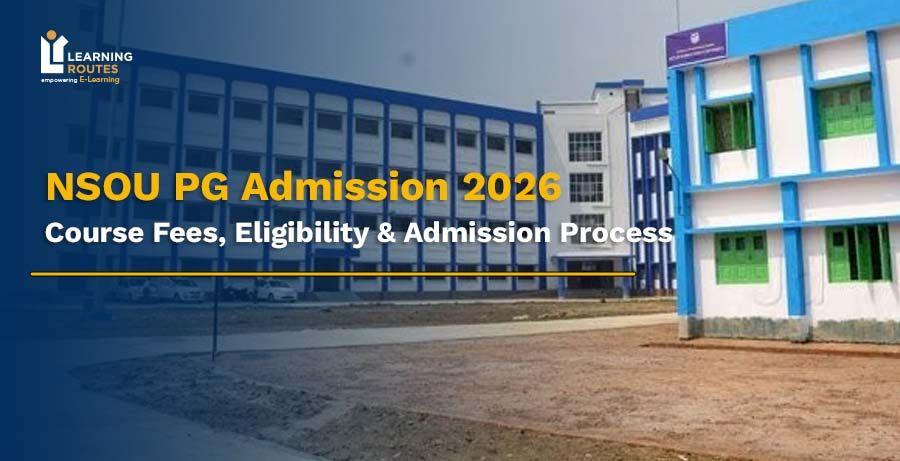
Netaji Subhas Open University is one of the well-established open universities in India. It is known for its state-of-the-art multi-disciplinary distance learning programmes. Located in Kolkata, NSOU has its origins in the state of West Bengal, India. If you are an undergraduate and seeking to upskill with distance postgraduate programmes, the blog is exclusively designed for you. It lifts the curtain on NSOU PG admission details. Enrolling in NSOU distance PG courses allows you to learn without relocation & earn without worrying about study schedules. Discover the step-by-step NSOU PG admission process in this blog. Discover NSOU courses fee structure, eligibility criteria, and other vital details.
Netaji Subhas Open University, commonly known as NSOU, is a distance learning institution. The university caters to the multi-disciplinary programmes in an open and distance education mode. It is accredited with NAAC grade A. NSOU generally opens admissions for PG courses in the months of June & July. The last date of NSOU PG admissions usually extends till the months of November & December. It is advised to apply at the earliest to secure your seat conveniently. Keep reading to uncover the crucial aspects of NSOU PG admissions: fee structure and eligibility criteria.
NSOU master's degree programmes are widely recognised and accepted. The university is graded by the National Assessment and Accreditation Council (NAAC). Additionally, it has many prestigious recognitions that make NSOU PG admission courses valid and legitimate. You may take a look:
✅ NAAC A Grade
✅ Recognised by UGC
✅ UGC-DEB Approved
✅ AICTE Approval
✅ RCI Recognised
Netaji Subhas Open University admission generally begins in the month of July. The university begins the admission process for its July session every year at the same time. The last date is generally extended and is subject to change. Here are the tentative NSOU PG admission dates for the July session 2026. Check out:
Netaji Subhas Open University offers post-graduate courses across many disciplines. NSOU courses are approved by the UGC-DEB, AICTE, and RCI, making the NSOU PG courses widely recognised. Here is one of the most essential parts of NSOU PG admission. Check out the NSOU PG courses fee structure before moving a step ahead:
NSOU PG Courses
Also Read: Top 10 Universities for Distance Education in India
Another crucial aspect of NSOU PG admissions is the eligibility criteria. Every distance learning course at NSOU follows some general eligibility provisions. You can only apply to a particular NSOU PG course if you ensure to satisfy these course's eligibility requirements. Here we have listed the minimum eligibility criteria for each NSOU distance PG course. You may explore:
NSOU PG Admission Eligibility Criteria
*Note that the eligibility criteria slightly vary for CBCS and Non-CBCS.
The NSOU PG admission process is the same for different courses. The only aspect you need to ensure is the eligibility criteria. Now that you have explored the eligibility requirements for each NSOU PG course, you may move ahead with the admission process. Here are the quick steps to apply for NSOU PG courses:
✅ Visit the official website of the Netaji Subhas Open University.
✅ Navigate to the “Admissions” and apply for your desired course.
✅ Fill out the application form with the required academic and personal information.
✅ Upload the scanned copies of essential documents in the form.
✅ Pay the registration fees via online payment modes.
✅ Submit the form and wait for confirmation by the university.
✅ Upon document verification, you would receive a notification from NSOU for fee payment.
✅ Pay the course fees online to get your admission done.
You need to submit the soft copies of several essential documents. These documents need to be submitted along with the application form by the time of the registration process. NSOU has a list of required documents for admission to its distance PG courses. Here is the list of crucial NSOU PG admission documents:
✅ Government-issued identification card (Aadhar Card, Voter ID, etc.)
✅ Certificate/Marksheet of 10th class
✅ Certificate/Marksheet of 12th class
✅ Graduation Marksheet/Degree
✅ Passport-size coloured photograph
✅ E-signature
*Additional documents may include a driving licence, a passport, and additional degrees/certificates if available.
NSOU PG admission lasts till the month of November and December. The last date for application to NSOU distance courses is subject to modification as per the vacant seats for a particular course. Additionally, NSOU PG courses fee structure is quite affordable, and eligibility requirements are generic. To ensure a smooth admission process for NSOU distance PG courses, you need to stay up-to-date with university notifications. Once the application forms are out, connect with university counsellors and proceed with the registration process. Explore the fees and eligibility criteria, gather all the necessary documents in advance, and apply at the earliest to secure your seat.
The last date for NSOU PG admission is subject to change. However, the form submission link generally closes by the month of November or December, every year. You can visit the official website of the Netaji Subhas Open University to learn about the accurate dates and details.
The duration of postgraduate distance learning courses at NSOU is 2 years for distance MA, MSc, MBA, MSW, and MCom courses. However, distance MLISc (Master of Library and Information Sciences) courses at NSOU follow a duration of one year only.
Indira Gandhi National Open University is a central government open university in India, whose distance learning courses are recognised globally. On the other hand, Netaji Subhas Open University is a State open university, which was established and funded by the government of West Bengal. Therefore, the recognition of NSOU open and distance learning courses may be limited within the nation’s borders.
Yes, Netaji Subhas Open University distance education degrees are valid for government jobs and higher education across other institutions as they are approved by the UGC, UGC-DEB, and AICTE.
The only disadvantage of an open university is the lack of campus immersion. However, open university courses are designed by keeping in mind the needs of working professionals and students who cannot relocate to continue their higher studies. Therefore, the preferences for disadvantages vary by individuals’ academic needs.
Our team of experts, or experienced individuals, will answer it over online meet. Book your slot now!
Book Free Online Counselling
Get Free Career Guidance