
Explore Courses
Top University
Search anything
 Refer and Earn ₹ 5000
In the world of corporate, having a master's often feels sufficient. However, after spending several years in the same industry, there comes a point when earning a supreme-level credential becomes a necessity, not an option. In the business landscape, that credential could be a Doctor of Business Administration (DBA) for many professionals. A DBA is the highest level of qualification one can earn in business administration. A DBA course is worth it for professionals seeking to promote to executive-level roles, build influence in the corporate sector, and contribute research findings to business fields.
It emphasises applied research and dissertations, preparing senior professionals to take charge of leadership and executive roles. The programme is globally valued for the best ROIs, salary hikes, and career growth. This blog is a quick guide to “Is a DBA Worth It?”. Learn about the programme cost, salary prospects, benefits, and the potential returns on investment. Dive in to explore in detail!
A Doctor of Business Administration is a professional doctorate degree programme, mostly offered through online or hybrid learning modes. It is a specially curated programme for working professionals who are determined to solve business challenges at workplaces through research. Furthermore, a DBA course typically lasts three to six years, depending on the institution.
It is a professional and research-based programme that combines conceptual understanding, research, and a dissertation. Moreover, while a DBA is an equivalent course to a PhD, it focuses on strategic thinking, leadership, and applied research, rather than being academic only.
A DBA is a professional programme for working executives. It is worth it for professionals in many ways, such as career advancement, career switch, flexibility, and more. Here are some of the top factors that make a DBA degree worth it for professionals at senior or executive levels:
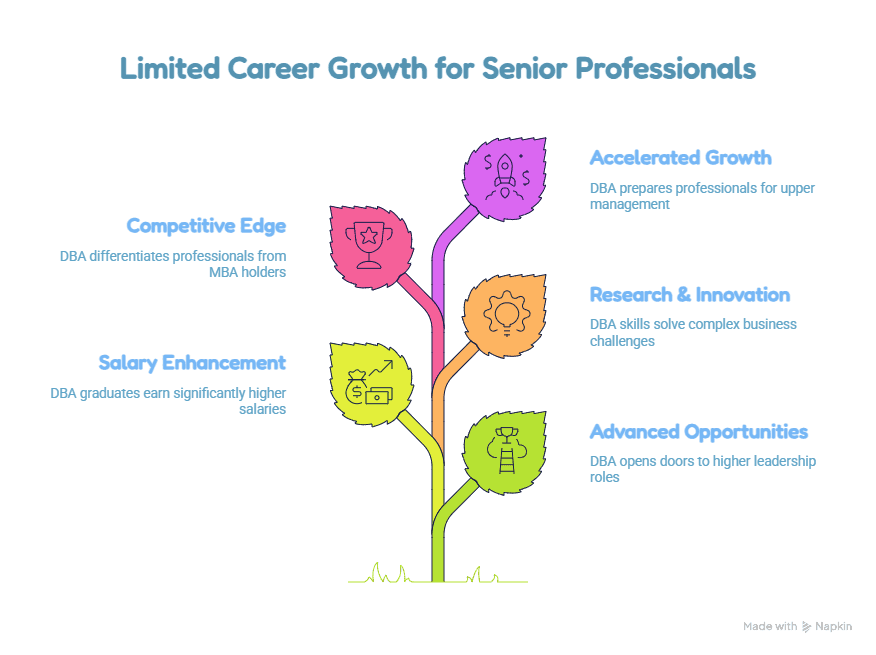
DBA graduates can explore upper-level leadership roles in corporations, such as Consultant, Chief Executive Officer (CEO), Chief Operating Officer (COO), and Executive Director (ED). You can also consider jobs in academia and research, including professor, research publisher, etc.
Various industry reports state that professionals with a doctoral degree significantly earn higher than those with a master's degree. DBA graduates are already senior professionals with decent salary paychecks. Besides, multinational companies hire DBA professionals. Having a DBA degree can make you eligible for executive-level roles in a corporation, whose salary is often higher, ranging between INR 40 LPA and INR 70 LPA.
DBA courses follow research-based learning. Professionals with a DBA degree contribute to solving complex business challenges strategically and contribute to the corporate sector based on their individual research. This makes a DBA degree valuable for entrepreneurship, consulting, and executive positions.
Having a DBA degree makes you stand out among professionals with an MBA or equivalent qualification. It indicates your research-based, authentic knowledge for business and decision-making. A DBA provides you with a competitive advantage in organisations for leadership and senior positions, making you an asset to employers.
The objective of a DBA programme is to help senior professionals prepare and escalate for roles in upper management levels. It helps those professionals whose career feels stationary after reaching a certain position in the corporate world.
You May Also Read:
In India, a Doctor of Business Administration is currently limitedly available across higher education institutes. IIM Sambalpur and SP Jain School are among the top institutions in India, offering an online DBA programme. The cost of the IIM Sambalpur DBA is approximately INR 25,39,315. Whereas, SP Jain online DBA fees are INR 25,01,800.
International universities, however, such as Rushford Business School, Texas State University, London School of Management and Technology, offer top-class DBA courses, costing from INR 12 lakhs to INR 35 lakhs, on average. Therefore, on a brief note, the average cost of DBA courses ranges from INR 12-35 lakhs. However, some institutes also offer expensive DBA courses with fees ranging between INR 50-70+ lakhs.
DBA graduates often earn higher than those with a master's level of qualifications. However, salary prospects are generally different for every individual. It depends and varies by job roles, positions, company type, location, and more. However, as DBA professionals are considered to work for senior and executive-level positions, the salary potential is often high. Here are the average salary prospects for DBA graduates, based on the job roles and experience:
The career impact of a DBA course depends on your work experience as well. The promotions, salary hikes, or transition to high-level roles professionals may seek significantly depend on their work experience. Thus, DBA graduates with 5-10 years of work experience can earn between INR 8.6 LPA and INR 29 LPA, on average. Here are the job roles that mid-career professionals may consider after earning a DBA degree:
Source: AmbitionBox
Professionals with a DBA who have served in the corporate industry for more than 10-15 years often qualify for executive-level positions. The average salary for positions also depends on your prior work experience and the job roles you have handled so far. In India, DBA professionals with 10-15+ years of work experience can earn from INR 16 LPA to INR 65 LPA. You may explore the potential opportunities for senior executives with a DBA degree:
Source: AmbitionBox
ROI stands for return on investment. A DBA programme is worth the cost, typically due to its returns on investment. It is one of the major benefits of the course that makes a DBA degree worth it. Moreover, the ROI of a DBA course can be calculated depending on the average salary potential and the average cost of the programme. Here is a quick ROI analysis for a Doctor of Business Administration degree:
ROI = (Total Profits / Investment) x 100
Now, depending on the above data, we could have two case scenarios:
Therefore, depending on the salary outlook and average cost of the course, a DBA can offer an ROI of 300% to 473% within 3 years. Thus, you can rest assured, as even with average, lowest salary packages, you may still be able to get your 100% returns on a DBA course.
*Note: We have calculated an estimated ROI based on the salary prospects and average programme cost discussed above.
DBA return on investment varies for every individual. Apart from work experience, there are several other factors that contribute to enhancing ROI for DBA graduates. Here are several measures that you can take to maximise DBA RoI:
Businesses focus on outcomes more than academic excellence. Research on concepts that can target real-world workplace challenges or improve organisational performance.
Instead of theory, let your facts speak. Build presentations, display findings, and share models and insights based on your profound research. Organisations value professionals who turn research into strategic decisions and measurable business outcomes.
Participate actively in executive discussions. Publish insights from your research, share new ideas, and speak facts. The more you become visible to the world, the lasting impression you are likely to leave.
DBA houses professionals, leaders, executives, and entrepreneurs from all over the world. Leverage this network to build cross-cultural as well as cross-functional insights. Collaborations lead to opportunities, and opportunities result in growth.
A real leader never stops learning. A DBA doesn't make you supreme. Keep investing your precision and passion into exploring leadership psychology, achieving organisational growth, and contributing to solving workplace issues.
Yes, investing in a Doctor of Business Administration could be beneficial for senior professionals in long-term scope. The programme allows you to perform individual applied research to solve complex issues in workplaces. This can also be considered a significant contribution to the field of business administration.
Moreover, it makes you ready to assume senior-level positions for leadership, consultancy, and director roles. DBA graduates also earn more than professionals with MBA or other master's degrees. It also unlocks opportunities to work abroad. Therefore, it can be said that a DBA programme is a good investment for career growth in the corporate sector.
DBA is not just another degree added to your resume. For seasoned professionals, it is an opportunity to fast-track their careers and broaden their insights. It is an investment made to chase the returns in long-term career growth. Based on the cost of a DBA and corresponding salary outlook, the programme is highly worth it in terms of ROI and career growth.
Additionally, it unlocks doors to various dream job roles and high-salaried paychecks. DBA graduates are also highly valued in the global market, creating opportunities abroad. Thus, in a nutshell, yes, a DBA degree is worth it for working professionals seeking career growth opportunities, handsome paychecks, and top-level business roles in corporate.
A Doctor of Business Administration or DBA is a worthwhile degree programme. It offers senior professionals an opportunity to grow in their careers with completely fresh and research-oriented insights. The doctorate degree is highly worth it for experienced professionals in terms of ROI, increased earning potential, and career growth opportunities. However, the salary hike, expanded career options, and returns on investment are not the same for everyone. This also depends on your prior work experience, responsibilities you have managed in business, performance in your DBA programme, etc.
DBA graduates can consider leadership and C-suite positions for various roles, including Chief Operating Officer (COO), Chief Marketing Officer (CMO), Executive Director (ED), Management Consultant, Vice President/Chairman, etc. Interested candidates can join academia for University Professor, Business Research Projects, and Published Author, among others.
You can explore promotions, salary hikes, and career switch opportunities in sectors like consultancy, advisor, leadership, academia, non-profit organisations and government after completing a DBA degree programme.
A doctoral degree in business administration can unlock career growth opportunities for you in corporate and academia. Doctorate degrees in business administration, like DBA, are considered the best options to advance to senior-level positions. A PhD in business, on the other hand, is considered more suitable for higher-level roles in academia and research.
Yes, a DBA is the highest level of qualification in business administration, often a follow-up programme to an MBA. As this is a doctoral-level degree, it offers better career growth opportunities and salary growth potential than those who hold an MBA degree only.
Both DBA and PhD are highly respected in their targeted domains. Professionals with DBA qualifications hold more value among employers in the corporate sector due to their applied research-based knowledge. In contrast, a PhD is more worthwhile for academic and research sectors where the focus is theory-based.
Our team of experts, or experienced individuals, will answer it over online meet. Book your slot now!
Book Free Online Counselling


Get Free Career Guidance