
Explore Courses
Top University
Search anything
 Refer and Earn ₹ 5000
Have you ever wondered if climbing the corporate ladder is enough? Or do you want to use your dedication to redesign the ladder itself? This is where the difference becomes visible between a DBA (Doctor of Business Administration) and an MBA (Master's of Business Administration).
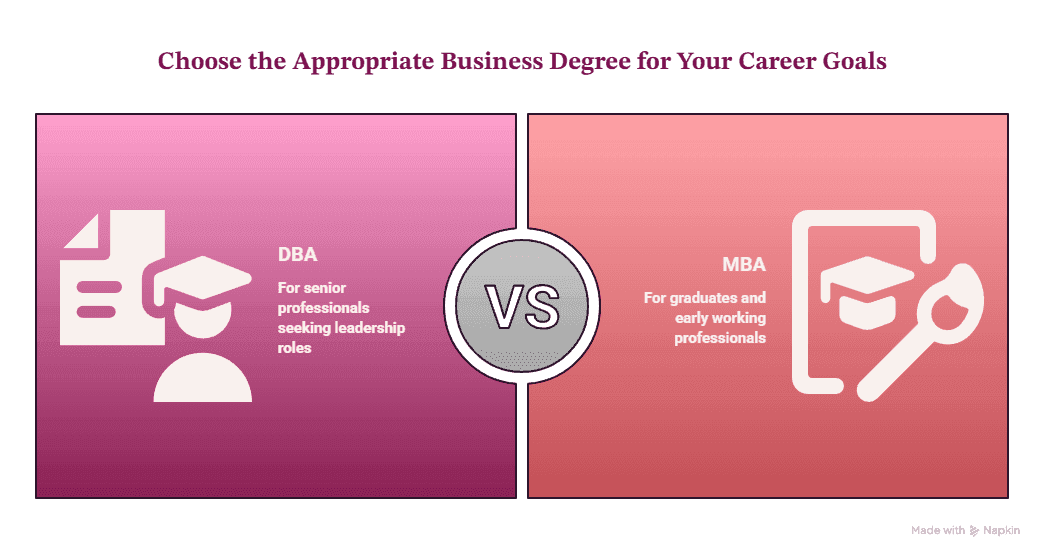
Both are degree programmes. However, an MBA is a master's level degree that helps you secure jobs and advance gradually. DBA, on the other hand, is a doctoral-level degree that helps mid-level working professionals advance into senior, leadership, and C-suite positions, allowing you to redevelop, reinforce, or maintain the overall business infrastructure effectively. This blog discusses the major differences between DBA vs MBA. Dive in to learn about key differences and compare major factors such as cost, eligibility, salary, objective, etc. Understand which course, among DBA and MBA, is right for you!
A DBA stands for Doctor of Business Administration. This is a doctoral degree programme that generally lasts for 3 to 5 years. It is a PhD equivalent course that focuses on business-oriented research and a dissertation that can be further applied to solve real-world corporate challenges. A DBA is mostly delivered through the online and blended mode of learning to suit the schedules of working professionals. Furthermore, the programme requires you to have at least 3-5+ years of experience. However, top institutions often demand 10+ years of work experience to enrol in the course.
✅ Leaders and managers seeking to upgrade their positions.
✅ Senior executives want to explore broader areas in business and management.
✅ Working professionals with 10-15 years of work experience looking to step into C-suite roles.
The full form of an MBA is Master of Business Administration. It is a master's degree programme in business and management that has a duration of two years. The postgraduate degree emphasises the areas of finance, marketing, operations, logistics, supply chain, etc. You can pursue this course in a single or dual specialisation. Moreover, the programme is accessible in regular, part-time, online, distance, and hybrid learning modes. It is ideal for graduates and early working professionals who wish to enhance their knowledge and qualifications.
✅ Fresh graduates seeking to upgrade their qualifications.
✅ Professionals with 0-3 years of work experience wanting to upskill and grow.
✅ Young professionals who wish to switch careers into a new domain.
DBA and MBA are two different courses in a similar field. DBA is a higher level of qualification as compared to an MBA course. You can pursue an MBA after completing a bachelor's degree. DBA, on the other hand, requires you to hold a master's plus several years of work experience in a relevant domain. Here are the key differences between a Doctor of Business Administration and a Master of Business Administration programme:
An MBA is a postgraduate degree that requires you to hold a bachelor's degree for admission. DBA, however, is a doctoral-level programme exclusively for professionals with mid-career to senior-level work experience. Both DBA and MBA differ by programme length, focus area, curriculum, fees, etc. Let us explore and compare such factors that make a DBA and an MBA notably different:
A Doctor of Business Administration typically lasts three years. Some institutes grant an extendable duration of five to six years to complete the programme. There are also fast-track DBA courses available that may be completed within 2 years, allowing you to accelerate your learning.
Master of Business Administration, on the other hand, has a duration of two years only. Some institutes may provide you with the flexibility to complete an MBA in up to 4 years, but only in online/distance learning mode. Flexible MBA courses, which are online, distance, or hybrid, often allow you to learn at your pace.
DBA courses are known to have an advanced, extensive curriculum inclusive of theory, research, project, and dissertation. These courses aim to help mid-career professionals gain original insights through individual research and solve real-world business problems. While the theory is prime in the initial years, research and dissertation are the primary focuses of the course.
The focus of an MBA programme remains intact on core knowledge and practical skills. It emphasises the areas of marketing, finance, operations, logistics, and human resources, among others. The two-year curriculum includes core subjects, elective courses, and capstone projects by the end of the final year. It is considered more ideal for freshers who wish to gain deeper insights into the different areas of management.
DBA courses in India are currently limited and are mostly offered by international universities or in collaboration with them. The average cost for a DBA course ranges between INR 12 lakhs and INR 25 lakhs. Some of the top international universities, such as the University of Missouri - St. Louis, University of South Florida, and West Virginia University, offer a DBA that costs up to INR 70 lakhs to INR 1 crore for senior professionals with 10+ years of work experience.
An MBA, on the contrary, costs far less than a DBA programme. The average cost of a regular full-time MBA in India ranges between INR 3 lakhs and INR 15 lakhs. Through top institutions like NMIMS, IIMs, XLRI Jamshedpur, and Symbiosis has MBA courses of up to INR 30+ lakhs. If you opt for flexible MBA courses, the fee structure would be much lower, ranging from INR 1 lakh to INR 3.5 lakhs.
A Doctor of Business Administration is exclusively tailored for working executives. Senior professionals who wish to advance to top-management roles or the highest level of positions in their organisation can pursue this course. It opens your doors to multiple pathways across various business domains, such as:
📝 Chief Executive Officer (CEO)
📝 Management Consultant
📝 General Manager (GM)
📝 Executive Director (ED)
📝 Department Head
Conversely, an MBA aims to help graduates get placed for entry-level roles. It also helps you gradually advance to higher roles and managerial positions. Young professionals with 0-1 years of experience can consider an MBA to escalate to upper-level roles like team lead or team manager. With an MBA, you could consider various job opportunities like:
📝 Financial Analyst
📝 HR Manager
📝 Sales Executive
📝 Marketing Manager
📝 Business Consultant
According to the US BLS (2025), median usual weekly earnings for doctoral degree holders are USD 2,278. Whereas those who have a master's degree earn an average of USD 1,840, nearly 23.8% lower than those with doctoral degrees.
Doctor of Business Administration is a PhD equivalent doctorate degree. It helps you explore the executive-level roles in business whose paychecks are much more than those of managerial positions. In India, the average salary for roles like general manager, CEO, and management consultant varies from INR 27.5 LPA to INR 50 LPA and beyond, depending on work experience, company, location, and role.
Moving on, MBA graduates in India qualify for junior to managerial positions in finance, marketing, operations, HRM, etc. Depending on your work experience and job position in an organisation, you can earn between INR 4.4 LPA and INR 12+ LPA. Thus, salary prospects for DBA graduates are notably higher than those of MBA degree holders.
Most DBA courses require you to have at least 5-10 years of work experience. Some DBAs may enrol candidates with 3-5+ years of experience as well. To enrol in a DBA programme, you should have:
📝 A passed master's degree, MBA or other relevant discipline.
📝 5-10+ years of work experience at senior-level positions.
📝 No entrance exam is generally conducted.
On the other hand, an MBA course is open to graduates for admission. This is a master's level degree that does not require any mandatory work experience. Though the eligibility criteria may slightly vary by the institutions, here are the general eligibility requirements for admissions to an MBA programme:
📝 Bachelor's degree in any discipline with at least 50% marks.
📝 No work experience is mandatory.
📝 Some institutes may require you to qualify for an entrance exam.
Most of the best DBA courses are provided by foreign universities in the US and Europe. There is no entrance exam conducted for admissions. However, DBA admissions are provided based on the Statement of Purpose, Letter of Recommendation, and interviews. These requirements may slightly differ by university.
MBA admissions are mostly done depending on the fulfilment of eligibility requirements for a particular university. Top MBA institutes in India and abroad require you to qualify for exams like CAT, MAT, GMAT, etc. Some institutes may also conduct interviews to shortlist candidates.
Both DBA and MBA are two very different courses. One is a doctoral-level degree while the other is a master's degree programme. Therefore, the curriculum, objective, cost, job opportunities, and salary prospects of both courses vary significantly as well. Now, as for choosing, only working professionals with several years of work experience can enrol in a DBA programme. Thus, if you are a graduate, an MBA programme would be more suitable for you. DBA, on the other hand, ideal for professionals with 5-10+ years of experience, who also hold a master's degree, seeking to promote to executive roles.
DBA vs MBA, both courses target a different section of learners. While an MBA programme focuses on graduates acquiring advanced knowledge of business and management, a DBA degree targets working professionals who have handled responsibilities at managerial or senior levels. An MBA course is more theory-oriented, whereas a DBA programme emphasises applied research to solve business challenges at workplaces. Selecting between the two courses is simple, as the eligibility criteria significantly vary.
A Doctor of Business Administration is a doctorate-level degree, while an MBA is a master's degree programme. An MBA course is ideal for fresh graduates stepping into the corporate world to build a successful career, while a DBA is designed for already successful professionals who have served in the corporate world for five to more than ten years, and now wish to acquire positions at higher-level roles such as general manager, director, consultant, vice president, etc.
Yes, a DBA course is extremely worth it after completing an MBA, for those who want to expand their career opportunities in corporate, leadership, and consulting.
Yes, you can enrol in a DBA programme with any relevant master's degree, apart from an MBA. You just need to fulfil the work experience and admission requirements for your desired university or institution.
Professionals who have 5-10+ years of work experience and have a master's degree can apply for a DBA degree.
Yes, a Doctor of Business Administration or DBA course is highly accepted in the corporate or business sector of India, where you can be a suitable candidate for senior, executive, leadership, or C-suite roles.
Our team of experts, or experienced individuals, will answer it over online meet. Book your slot now!
Book Free Online Counselling


Get Free Career Guidance