
Explore Courses
Top University
Search anything
 Refer and Earn ₹ 5000
Narayani
Published on 07 January, 2026

Learning Routes Editorial Team
Reviewed and updated

Cost and Management Accountant (CMA) and (Chartered Accountant) CA are the two terms which sound different but are often used interchangeably. Both are similar designations, earned through different routes of admission. While ICMAI (Institute of Cost Accountants of India) is the institution that conducts the CMA exam, CA aspirants require membership from ICAI (Institute of Chartered Accountants of India).
Moreover, CMA & CA both careers require you to qualify 3-tier exams: foundation, intermediate, and final (advanced). A minimum training of 3-years in a similar discipline is also mandatory to be eligible for memberships from ICMAI or ICAI. Consider this blog as your quick guide to CMA vs CA. It uncovers the CMA vs CA difference, eligibility criteria, selection process, and many more details. Dive in & explore the career scope and job opportunities for each programme.
CMA full form is Cost and Management Accountant. A CMA is a certified professional in the field of finance and operations management. Being a cost accountant, you are responsible for a variety of roles such as budgeting & forecasting, internal & management audits, financial analysis, taxation, inventory valuation, etc. ICMAI (Institute of Cost Accountants of India) provides certification to eligible CMAs who have qualified the three-level exam, along with the compulsory tenure of articleship. Check out the roles and responsibilities of a CMA India:
✅ Prepare and provide accounting reports on a monthly or quarterly basis to management.
✅ Suggests new financial policies and practices to enhance the cash flow of an organisation.
✅ Decides the standard costs for products and services depending on associated expenses.
✅ Review and manage the balance sheets and general ledger to ensure compliance and accuracy as per the company's norms.
The full form of CA is Chartered Accountant, who is a finance expert tasked with different financial and accounting jobs. A chartered accountant is a qualified professional who manages financial auditing, taxation, accounts & consulting, and reporting. To become a certified CA, you are required to subscribe to the membership from the Institute of Chartered Accountants of India (ICAI). Candidates must pass a three-level exam and complete mandatory training of 3-years under the supervision of a licensed CA. Here is a glimpse of the roles & responsibilities of a Chartered Accountant:
✅ Perform auditing of the financial records for clients to ensure accuracy & record keeping.
✅ Involved in financial planning and analysis to help clients make informed decisions for equity, investments, and debt financing.
✅ Manages financial risks by monitoring financial activities and coming up with plans to prevent losses.
✅ Provides guidance to firms or clients on multiple aspects of finances, such as budgeting, investments, taxes, cost management, etc.
Cost Accountants and Chartered Accountants share similar responsibilities, which may vary in some cases. However, the pathway to becoming a CMA or CA is distinct in many ways. Here are the CMA vs CA difference for explicit & quick understanding:
Particulars |
You May Also Read:
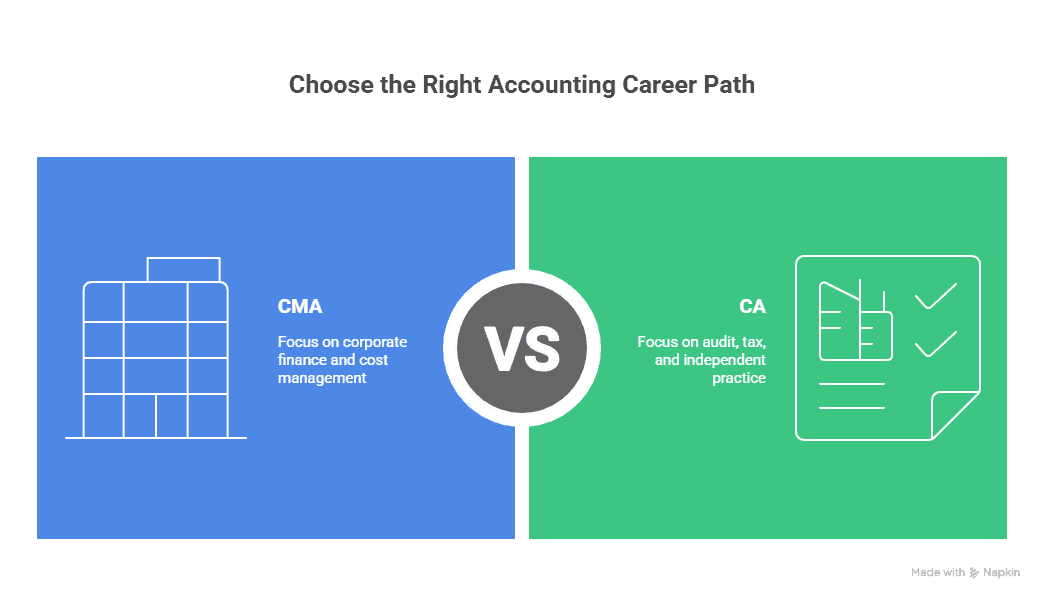
There are many aspects of a CMA vs CA that you may wish to explore. We have compared some of the crucial and primary features of the CA vs CMA that would provide you with comprehensive knowledge of CMA and CA roles, exams, pathways, and career scope. Let us explore:
The pathway to CMA includes three exams. Candidates get 120 minutes (2 hours) to write the first level or foundational exam. The CMA intermediate and final level exam has a duration of 180 minutes (3 hours).
Duration of CA also depends on exam levels. The CA foundation exam comprises 4 papers: accounting, business laws, quantitative aptitude, and business economics. The first two papers take 3 hours, while the remaining two need to be solved in 2 hours each. CA intermediate and final exams generally last 3 hours. Sometimes the last paper of the final exam lasts for another hour.
Both the Indian CMA and CA exams follow a similar admission route. The qualification process requires you to clear a three-level exam and complete the mandatory articleship of nearly three years. However, the eligibility criteria slightly differ based on the course domains. Check out the eligibility differences for CMA and CA:
✅ You become eligible for CA Level 1 after passing the 10th or equivalent examination.
✅ You can take the CMA intermediate directly after graduation without qualifying for the foundation. However, anyone who has not graduated must qualify foundation exam.
✅ To appear for the CMA final level exam, you must have qualified intermediate level and completed a training period of 15 months.
✅ Level 1 exam requires passed 10+2 from a recognised board and registration with ICAI BoS (Board of Studies).
✅ CA Level 2: Candidates with a 10+2 qualification need to pass the CA Foundation.
✅ Graduates can have direct entry to appear for CA Intermediate.
✅ Additionally, commerce graduates require 55% aggregate, while 60% marks is the minimum eligibility for non-commerce grads.
✅ CA Level 3: Passed CA intermediate level with completed articleship of at least 2.5 years.
The CMA vs CA selection process is quite similar. You need to qualify for the 3-tier exam levels and complete the compulsory tenure of practical training (differs for CMA and CA) under the supervision of a licensed CMA/CA to receive the respective memberships from ICMAI and ICAI.
CMA and CA both shared some roles and responsibilities. Therefore, the areas of study are mostly the same. While the CA exam syllabus follows a more comprehensive structure of detailed knowledge, the CMA exam has a shallower syllabus. Check out the overview:
Cost and Management Accountants can create possibilities across multiple-national companies and top domestic firms in India. However, Chartered Accountants generally have a wider scope as major recruiters include the world's largest professional services network of Big 4. Check out some of the top recruiters of CMA vs CA to know your career scope across industries:
Some of the responsibilities of a Cost and Management Accountant and a Chartered Accountant are similar. However, CAs generally have a wider scope of job roles as compared to CMAs. Additionally, the roles of CMAs are more corporate-oriented, whereas being a Chartered Accountant allows you to begin your independent practice from local to advanced levels. Here are the potential job sectors for the CMA vs CA difference, ensuring a wider career scope:
Job Sectors for CMA: Corporate finance & accounting, manufacturing, business advisory, government and PSU, consulting, banking, research & academia.
Job Sectors for CA: Audit and assurance, direct and indirect taxation, accounting, financial reporting, investment and corporate finance, entrepreneurship, banking, insurance and capital markets, government and regulatory bodies.
Explore the top job opportunities for CMAs and CAs across the industries discussed above:
Salaries for Cost and Management Accountants (CMA) and Chartered Accountants (CA) depend on numerous factors. It varies by your roles, companies, and work experience. According to AmbitionBox, a CA salary in India with fresher experience can range between INR 6-7 LPA in top companies like KPMG, PwC, etc. In-hand salary may vary from INR 60,000 to INR 70,000 per month. A CA with 3-year experience can expect an average salary of INR 8.7 LPA, while the highest salary can go up to INR 15-20 LPA, or beyond for 9-10+ years of experienced Chartered Accountants.
CMAs, on the other hand, may expect a fresher salary package varying from INR 5.5-6.2 LPA. After 3 years of work experience, CMAs may earn between INR 81,000 and INR 82,000 per month. The highest salary for CMAs often ranges between INR 9-12 LPA and beyond, depending on work experience, company, and location.
Both CMA and CA are exam-based certifications. You need to prepare for exams by yourself through online and self-paced learning or by joining CMA/CA-specific coaching. Therefore, the application process for both programmes is mostly the same. Here it goes:
✅ Visit the official website of ICMAI/ICAI and register for the foundation exam.
✅ Appear for the exam, qualify, and register for the CMA/CA intermediate level.
✅ Take the intermediate exam and qualify for it.
✅ Enrol for training under the supervision of la icensed CMA/CA for the required period of time and complete it.
✅ Register for CMA/CA finals, take the exam, and qualify.
✅ Apply for ICMAI/ICAI memberships and appear for convocation to receive certification.
Both CMA and CA programmes can provide you with a future-proof career scope and many job opportunities across sectors. However, the CMA vs CA difference is not about choosing the better one, but the right one. CMA and CA are both the top programmes offering you respective jobs and positions with a decent salary hierarchy. Making the better choice depends on your career aspirations and areas of interest.
Choosing CMA is ideal for those seeking corporate exposure across accounting and business advisory. CA is a more suitable option for individuals with career goals in taxation, auditing, accounts, or banking sectors. Moreover, if you want to begin your start-up or wish to begin an independent practice in accountancy with higher success rates, CA is a better choice.
The CMA vs CA difference lies across various aspects such as syllabus, difficulty of exam, job roles, career scope, salary, etc. Though it is advised to choose a role depending on your career goals and interests. Duration and time are also crucial factors to consider. Qualifying CMA could be easier than CA due to the shallowness of the CMA curriculum. As CA has more in-depth requirements of syllabus, the competition for the same is also fierce. However, with the right planning and dedication, you can excel in both exams. Last but not least, CA stands out more than CMA due to its higher prestige and demand among Big 4-like global firms. However, CMA can also create similar opportunities for you, but in different sectors of cost and accounting.
CMA could either be a Cost and Management Accountant or a Certified Management Accountant. Cost and Management Accountants can earn more than CAs; however, it generally depends on their working experience and company, while CAs often have a higher scope of salary in India. Certified Management Accountant, on the other hand, is a global certification and profile, offered by an institute of US. Therefore, as compared to the US CMA, the scope of the CA salary in India could be shallow.
No, CMA and CA are two distinct positions. They have different areas of jobs to handle, so none of these works under anyone. CAs can most often be self-employed, also working as an entrepreneur to themselves.
The Cost and Management Accountants (CMA) course duration depends on the time of exam qualification. However, by considering eligibility after graduation, you would at least need 3-4 years to qualify for the 3-tier exam, along with the training period.
A chartered accountant salary in India varies by company and work experience. Freshers with 0-year experience as certified CAs can secure INR 6-8 LPA jobs across top firms like PwC, KPMG, or EY. The salary prospects increase with work experience and can go upto INR 15-20 LPA or higher in future.
Yes, the Chartered Accountancy exam is known to be one of the toughest exams in the finance domain in India. Candidates usually need 4-5 years to clear the exam, including a training period of 2.5-3 years.
Our team of experts, or experienced individuals, will answer it over online meet. Book your slot now!
Book Free Online Counselling
Get Free Career Guidance