Explore Courses
Top University
Search anything
 Refer and Earn ₹ 5000
Delhi University admission is a dream come true for many in India. However, to get enrolled in DU successfully, you must be aware of the reservation policies at DU. The university follows the Central Government policies, offering reservations to SC, ST, OBC-NCL, and EWS. If you are applying through the reservation quota, you must thoroughly understand the total reserved seats, eligibility, and documents. However, which reservation policy could you claim for your admissions at DU? This blog will provide a comprehensive overview of reservation policies at DU. You could choose the ideal policy that fits your position based on your category.
The British started the reservation policies in India. Back then, the caste system in India was prevalent. Most backward communities were prohibited from participating in government programmes. Britishers made some reservations for different categories so they could access government public programmes.
However, reservation based on the caste system was first proposed by William Hunter and Jyotirao Phule in 1882. Due to various backward castes, Dr. B. R. Ambedkar carried forward this legacy and incorporated it into the Indian Constitution.
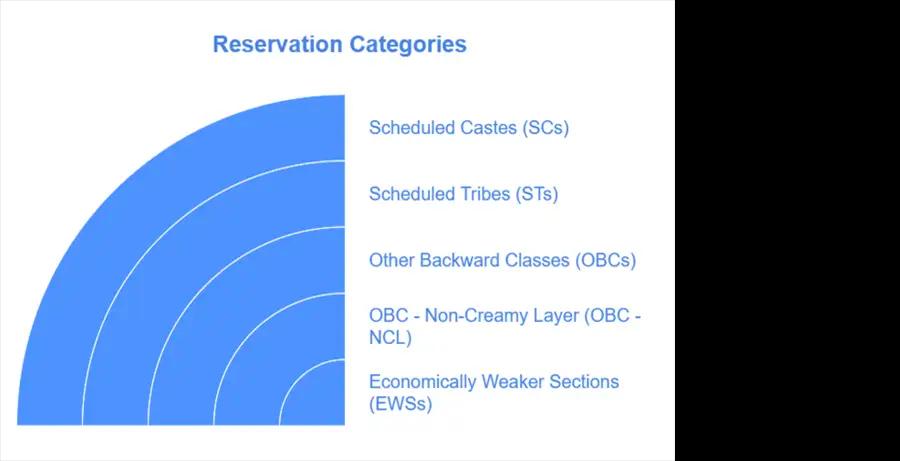
“Aap chronology samajhiye.” Under these reservation policies, the people were divided into several categories, including:
Scheduled Castes (SCs)
Scheduled Tribes (STs)
Other Backward Classes: Non-Creamy Layer (OBC – NCL)
Economically Weaker Sections (EWSs)
Also Read: Delhi University (SOL) – Courses, Fees & Admission
Often known as DU, the University of Delhi offers various courses in different disciplines. However, admission is made through the entrance exams and counselling processes. Therefore, every affiliated college has its cut-offs. You must secure certain cut-offs to enter your desired DU College.
However, you could get some relief in cut-offs based on your category under the reservation policies at DU. Each college affiliated with DU follows these reservation policies. The reservation quota is divided into the following categories:
SC/ST
OBC-NCL
EWS
DU follows certain guidelines from the Indian government regarding the reservation policy. Let’s explore these common guidelines, irrespective of certain categories:
To secure any reservation benefit, you must submit a certificate issued by government authorities.
You must have your caste certificate showcasing these:
Name
Caste/Tribe
The category you belong to (OBC-NCL, SC, or ST)
Suitable government of India schedule, under which the certificate is issued.
All submitted documents must be updated per current government policy norms.
You could upload the application slip if you don’t have an updated certificate at registration time.
You need to fulfil other essential requirements if you seek admission under PwBD, CW, or other categories.
You would not be counted under the reserved quota if you were admitted through the merit list.
All colleges must fill all reservation seats for reserved candidates.
Also read: Is Going for Distance Education at Delhi University a Good Idea?
DU has some specific reservation policies for SC and ST candidates. Most of these policies are based on the central government reservation policies. Here are the reservation policies at DU for SC and ST candidates:
22.5% of total seats at DU are reserved for candidates belonging to SC and ST categories.
Colleges could interchange 15% of SC and 7.5% of ST seats if required.
The admission process at DU is based on entrance exams.
Therefore, SC/ST candidates must appear for the respective exam for their course.
A separate merit and general list for SC and ST candidates would be prepared.
Different colleges have different cut-off requirements. Being an SC or ST candidate:
You would be provided with 5% relaxation in the original cut-offs.
The relaxation cut-offs will be increased if seats remain vacant after 5% relaxation.
The seats reserved for SC/ST candidates must only be filled by them.
If seats can’t be filled, the seats are interchangeable between SC and ST.
If seats still remain vacant after interchanging, they will be left as they are.
As per the government of India, 27% of seats are reserved for the OBC-NCL categories. Under this category, NCL refers to “Non-Creamy Layer.” It’s a sub-classification of the OBC category. OBC candidates with low family incomes, which are below a certain limit, fall under this category. DU offers reservation policies at DU. However, the relaxation differs for both. Here are some essential reservation policies at DU for OBC-NCL that you must consider before moving ahead:
Your caste certificate must showcase whether you belong to the non-creamy layer.
Candidates of the OBC-NCL category must ensure that their cast falls in the Central List of OBCs notified by the Ministry of Social Justice and Empowerment.
The non-creamy layer certificate must be up-to-date based on the latest financial year.
Usually, the University of Delhi reserves 10% of seats for economically weaker sections. However, this reservation could change based on the academic situation every year. It is often decided after an official notification from DU is issued. Each college reserves 10% of the seats for EWS candidates. However, the eligibility criteria for these candidates could vary depending on the notifications at DU.
To be eligible for the reservation, you must have a recently issued EWS certificate.
Also Read: New Education Policy 2020: Purpose, Features, Key Changes, Implementation, Challenges
Here is a short snapshot for you, so the next time you apply at the DU admission portal, you can keep this handy.
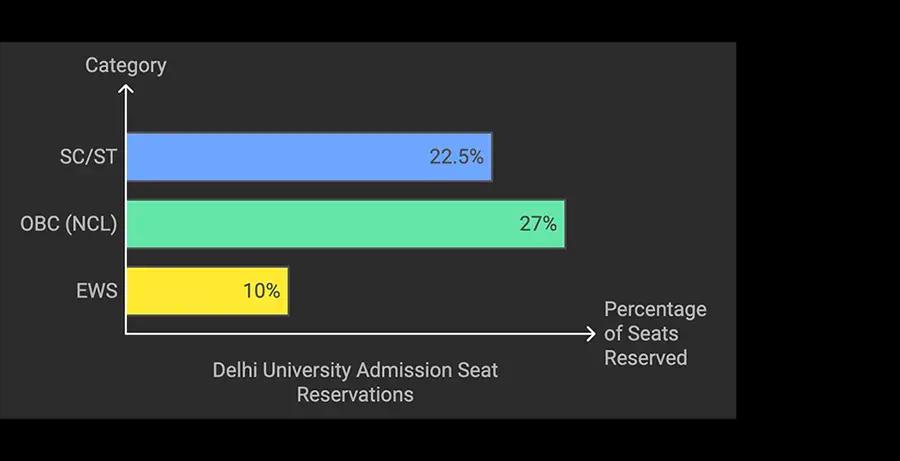
Being one of the top universities in India, Delhi University adheres to the guidelines of the central government. It follows all the reservation guidelines mentioned by the government. The colleges affiliated with DU ensure that all the reservation and relaxation requirements are fulfilled as per DU notifications. The cut-offs for different colleges vary.
However, they provide the same relaxation percentage as per the DU guidelines. If you belong to any of these categories mentioned above, you must ensure that your certificates are valid and updated. Furthermore, you wouldn’t be considered under the reservation quota if you got admission through the merit list.
The reservation policies at the University of Delhi are designed keeping in mind the learners from all over the country, and not just from Delhi. The university reserves some percentage of seats for the students from reserved categories SC, ST, OBC-NCL, and EWS.
27% reservation of seats is done for the students who belong to the OBC-Non-Creamy Layer. The university follows the Central Government policies for offering reservations to SC, ST, OBC (NCL), and EWS
Yes, the Delhi University reserves 10% seats for the Economically Weaker Section (EWS). This reservation is uniformly applied across its UG and PG programmes in all the DU colleges.
Our team of experts, or experienced individuals, will answer it over online meet. Book your slot now!
Book Free Online Counselling

Get Free Career Guidance