Explore Courses
Top University
Search anything
 Refer and Earn ₹ 5000
PhD stands for Doctor of Philosophy. It is considered the highest level of qualification that students can acquire in any discipline, academically. In India, pursuing a PhD requires you to fulfil various eligibility requirements. To pursue a PhD in India, you should have a master's degree with a minimum of 55% marks. Alternatively, you can apply with a 4-year bachelor's degree with at least 75% marks. Additionally, you should have qualified for UGC NET, GATE, CSIR NET, or university-specific entrance exams, followed by an interview.
This blog covers the PhD eligibility for admissions in India. It also lists PhD eligibility criteria for some of the top institutions in India. Dive in to learn about the age limit criteria, score requirements, entrance exams, PhD admission process, documents required, etc., in detail.
Eligibility for PhD admission in India includes academic qualifications, score requirements, and entrance exams. Candidates are required to have a master's degree with at least 55% marks (50% for reserved categories) in general. Additionally, applicants should qualify in any national-level PhD exam or a university-specific exam to apply for admission. Take a glance at the basic PhD eligibility criteria in India:
You May Also Read:
Pursuing a PhD course in India requires you to hold a master's degree in a relevant subject or discipline, followed by a bachelor's degree. Both 3-year and 4-year bachelor's degrees are acceptable for a PhD in India. Candidates with a 4-year bachelor’s degree can directly apply for a PhD without a master's degree. Moreover, some universities specifically require a master's in philosophy for PhD admissions. Some of the popular master's level qualifications for a PhD course in India may include:
📝 Master of Arts (MA)
📝 Master of Science (MSc)
📝 Master of Business Administration (MBA)
📝 Master of Computer Applications (MCA)
📝 Master's of Pharmacy (MPharm)
📝 Master's of Technology (MTech)
📝 Master's of Commerce (MCom)
📝 Master's of Laws (LLM)
Candidates typically need a total of 55% marks in a master's degree to apply for a PhD in India. 5% score relaxation is provided to applicants belonging to the reserved categories, such as SC, ST, OBC, EWS, or PwD, as per UGC guidelines. Furthermore, UGC allows students who have a bachelor's degree of four years to apply for a PhD without the need for master's qualifications, provided that they have a score equivalent to 75% marks in graduation. It is advisable to check the eligibility criteria of each college as it may vary.
As per UGC guidelines for PhD eligibility age, there is no particular upper age limit criterion for PhD admissions at most universities and institutions. However, fellowship programmes like Junior Research Fellowship (JRF) have age restrictions that may range from 28 to 35 years. If you are applying for Assistant Professor via UGC NET, there is no upper age limit criterion.
Yes, PhD admissions in India typically require you to take the entrance exam. Generally, national-level qualifying exams like UGC NET, CSIR NET, or GATE are accepted exams for admissions to a PhD course in India. However, universities conduct separate examinations for those who do not have a qualifying PhD exam. Here are some of the common exams for PhD eligibility in India:
Yes, according to updated rules and regulations of UGC, candidates with a 4-year bachelor's degree can directly apply for PhD admissions and appear for PhD qualifying tests like UGC NET. However, you should have an aggregate of 75% marks in order to apply for PhD admissions. Additionally, having a master's degree is not mandatory for those applying through a four-year undergraduate degree for PhD admissions.
Many government and private institutions in India require you to clear the national-level entrance exams such as UGC NET, GATE, or CSIR NET to be eligible for PhD admissions. Some universities conduct their own entrance exam for those who have not passed any such examinations. Explore the detailed eligibility for some of the popular institutions in India providing a PhD course:
IIT Delhi PhD admissions are conducted by the Department of Humanities and Social Sciences at IITD. PhD eligibility requirements at IIT Delhi require you to fulfil several academic, score, and entrance exam requirements. Here are the eligibility criteria for PhD admission at IIT Delhi:
📝 You should have a master's degree such as MA, MSc, or equivalent with an aggregate of 60% marks.
📝 Candidates belonging to SC/ST categories get 5% relaxation in the aggregate scores in postgraduate qualifications.
📝 Candidates with a BTech can apply directly without a master's degree.
📝 You should have qualified a national-level PhD exam such as UGC NET or GATE to pursue a full-time PhD at IIT Delhi.
Jawaharlal Nehru University (JNU) accepts all three categories of exams for PhD admissions. Depending on the PhD course and subject you are applying for, you need to take the qualifying entrance exam. Check out the general eligibility criteria for PhD admission JNU:
📝 You should have a 3-year bachelor's + 2-year master's degree or a 4-year bachelor's + 1-year master's degree.
📝 The minimum marks to apply for PhD admissions at JNU are 55% or an equivalent grade.
📝 Individuals applying with a 4-year bachelor's degree should have at least 75% marks or an equivalent grade.
📝 Candidates who have completed an MPhil with at least 55% marks can also apply.
📝 5% score relaxation is provided to the reserved category candidates as per UGC guidelines.
📝 Depending on your chosen course, you need valid scores of PhD entrance exams: UGC NET, JRF, or GATE.
📝 You should meet the subject relevance requirement as specified by the concerned centre/school of JNU.
PhD admissions at Amity University take place based on academic and shortlisting requirements. You need to have a master's degree along with scores of the qualifying PhD examination to be eligible for Amity’s PhD programme. Take a look at the crucial eligibility criteria for PhD admission Amity University:
📝 Master's degree with a minimum of 55% marks from a recognised institution.
📝 4-year bachelor's degree with at least 75% marks from a recognised institution.
📝 5% score relaxation shall be provided to reserved category students of SC, ST, PwD, EWS, and OBC NCL.
📝 You need to qualify any one of the All India national-level competitive exams for PhD, such as UGC NET, CSIR NET, DBT JRF, GATE, etc.
📝 Candidates who have not qualified any of the national-level entrance exams are required to take Amity's PhD Entrance Test (Amity's PET).
Yes, you can apply for PhD admissions with a distance master's degree in India, provided that the issuing institute is approved by the UGC (University Grants Commission) or DEB (Distance Education Bureau). However, you still need to meet the score and shortlisting eligibility for PhD admission. Ensure that you have earned 55% to 60% marks in your PG degree. Additionally, you have to qualify the national-level or university-specific entrance exam for admission to most institutes.
Candidates who belong to the reserved categories can apply for PhD admissions with a master's degree with a minimum of 50% marks. Those who are applying through a 4-year bachelor's degree need to have at least 70% marks in graduation. In simple words, reserved category candidates in India receive a 5% score relaxation in the standard aggregate marks, as per the guidelines of the UGC, Government of India.
The relaxation generally applies to SC, ST, OBC Non-Creamy Layer (NCL), EWS, and PwD categories. Apart from this, there is also reservation of seats across institutes as per the Indian government guidelines for reserved categories that may vary by universities and colleges.
Enrollment in a Doctor of Philosophy (PhD) course in India generally requires your personal, academic, and professional documents. However, the exact documents vary by universities and colleges. Here are the commonly required documents for PhD admissions that you should gather before applying for the programme:
✅ Photo ID proof (Aadhaar Card, Voter ID, etc.)
✅ Marksheet of 10th class
✅ Marksheet of 12th class
✅ Marksheets of bachelor's degree
✅ Marksheets of master's degree
✅ UG degree/certificate
✅ PG degree/certificate
✅ Scorecard of qualifying entrance exam (UGC NET, GATE, etc.)
✅ Category certificate (if applicable)
✅ Passport-size coloured photographs
✅ Migration or transfer certificate (if required)
✅ NOC - No Objection Certificate (may be required for some working professionals)
PhD courses in India follow a rigorous admission process. You need to choose your specialisation or subject, ensure eligibility, take entrance exams, and then apply for admission. Here are the steps to apply for a PhD in India:
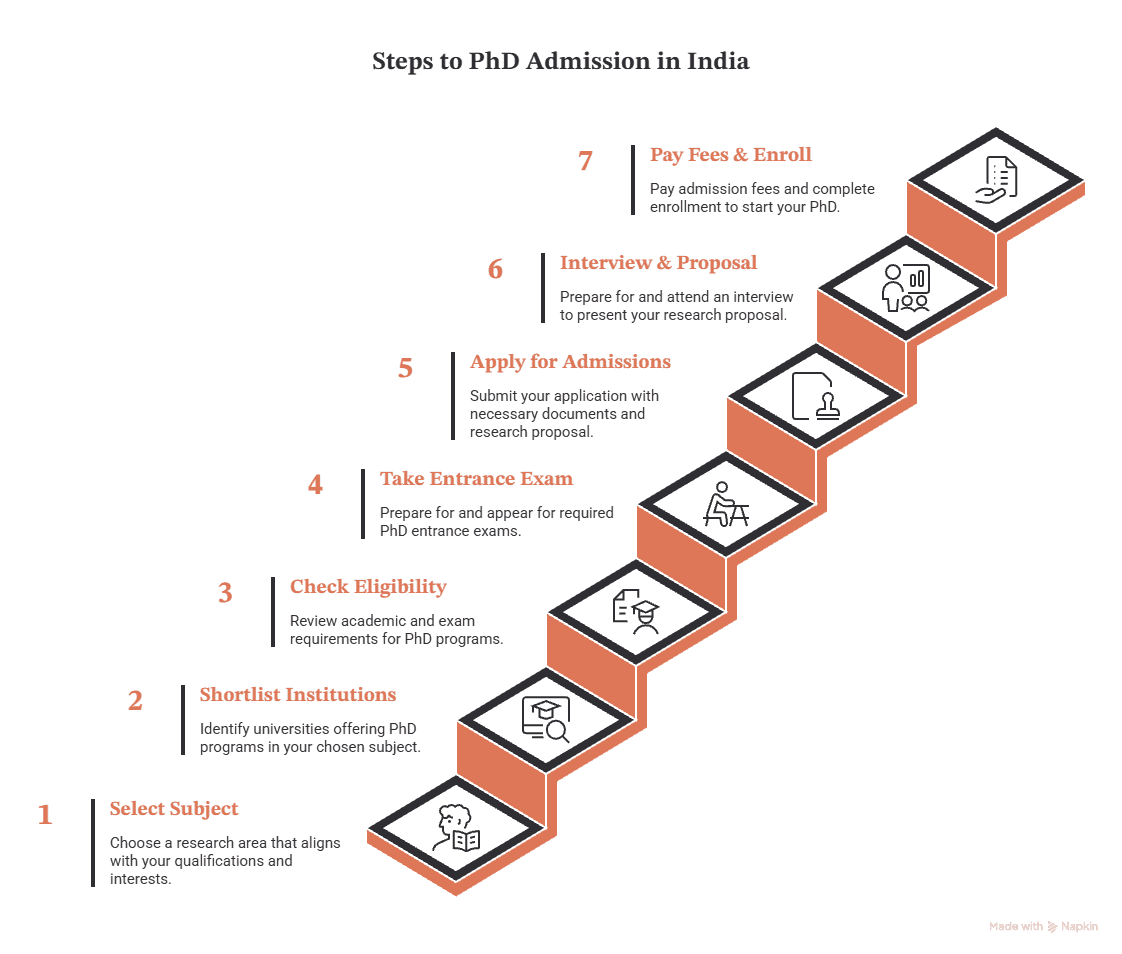
Choose an area of research that matches your academic qualifications and interests. You can look for unanswered questions, findings with research gaps, etc., that you can add value to with your findings. Opting for a particular subject and research area helps you explore the right institutions.
Once you know about your PhD requirements, look for recognised universities or institutions that offer a PhD in your desired subject. You can compare faculty, infrastructure, research areas, and admission requirements to select the suitable institutes.
After shortlisting several institutions, check the eligibility criteria for PhD programmes. Look for academic qualifications, score requirements, accepted entrance exams, and the shortlisting process.
The next and most important step is to appear for the required PhD entrance exams, such as UGC NET, GATE, CSIR NET, etc. Make sure to visit the official portals of these exams to know about the deadlines, application form opening dates, and exam dates.
After the result declaration, applications for institutions open. You have to keep essential documents ready, along with exam scorecards and research proposals.
After the application form is submitted successfully, you would be notified regarding the interview dates. You have to keep your research proposal ready in many cases. Authorities generally test your knowledge of the subject and research clarity.
Candidates who have been selected during the interview are provided with an offer letter. You have to pay the admission fees within the given deadlines and complete the document verification process. You can start your PhD from the notified date.
Yes, pursuing a Doctor of Philosophy (PhD) is completely possible without having NET exam scores. As per UGC, NET is only one way to enrol in a PhD course in India and is not a mandatory requirement for PhD admissions. There are various alternative methods to pursue a PhD without NET in India. Check out ways to apply for a PhD without UGC NET:
✅ University Entrance Exams: Many central, state, and private universities conduct their separate exams for admission to their doctoral programmes.
✅ GATE Scores: You can take the GATE exam if you wish to pursue a PhD in engineering or technical disciplines.
✅ Sponsored or Part-Time Courses: Working professionals who have relevant industry experience can apply for part-time PhD or sponsored PhD courses without NET scores.
✅ Direct Admissions: Candidates who are working as research assistants or project staff on funded projects at top institutions can consider the direct admission route available at several universities.
*Note: There may be some specific requirements for PhD admissions without NET scores, depending on a particular institution and its regulations.
The typical PhD eligibility requirements require you to have a master's degree in a relevant discipline or subject. You also have to meet the score requirements, depending on your degree. Besides this, you should have entrance exam scores of UGC NET, GATE, CSIR NET, or university-specific exams for doctoral degrees in India. Moreover, there are direct admission routes available for PhD at several institutions. However, there may be several specific requirements, such as the need for work or research experience. Ensure the exact PhD admission eligibility criteria by visiting the official websites of your shortlisted institutions.
You should have at least 55% marks in a master's degree or 75% marks if you are applying through a 4-year bachelor's degree to apply for PhD courses across government universities in India. IITs may require 55% to 60% marks in the qualifying degrees.
You typically need a master's degree in a relevant discipline in order to apply for a PhD course in India. If you have a four-year bachelor's degree with 75% marks, having a master's degree is not mandatory for admission.
Yes, you can apply for a PhD in India without a master's degree, provided that you have a 4-year bachelor's degree from a recognised institution with a minimum of 75% marks. PhD courses in some foreign countries may allow you to apply with bachelor's qualifications followed by university-specific eligibility requirements.
A two-year PhD is not common in India and is also not approved by the UGC; therefore, it typically takes at least four years to complete a PhD in India.
Doctor of Philosophy, or PhD, is a doctoral degree, which is considered the highest level of qualification academically.
Our team of experts, or experienced individuals, will answer it over online meet. Book your slot now!
Book Free Online Counselling


Get Free Career Guidance