Summarize this blog post with:
Did you know that the incidents of cyberattacks in India might reach 17 trillion by 2047? Nearly 1 billion emails were hacked in a single year, affecting 1 out of 5 internet users. These alarming numbers indicate a need for cybersecurity professionals and experts. More and more government and private organisations are on the lookout for professionals in ethical hacking, data protection, digital forensics, and more.
With cyber threats on the rise, a career in cybersecurity is at its peak. A cybersecurity certification provides you with practical training and hands-on skills. Such certification would enhance your resume and prepare you with job-ready skills that are in demand; as a result, cybersecurity jobs are also on the rise. This blog discusses jobs after cybersecurity certification. Additionally, we shall also provide the job role, salary range, and top skills necessary for the job.
List of Top 8 Jobs After Cybersecurity Certification
Cybersecurity is one of the most sought-after careers by tech professionals. Moreover, with the increasing number of cyberattacks, there is a shortage of skilled and experienced cyber professionals. As a cybersecurity professional, your key role is to protect data and prevent threats. Here are the 8 job roles that you can pursue after a cybersecurity certification:
| Job Roles | Pay Scale (in INR) |
|---|
| Cybersecurity Analyst | INR 4.0 LPA – INR 8.0 LPA |
| Security Architect | INR 16.0 LPA – INR 30.0 LPA |
| Cloud Security Engineer | INR 6.0 LPA – INR 15.0 LPA |
| Network Security Engineer | INR 4.0 LPA – INR 10.0 LPA |
| Ethical Hacker | INR 3.6 LPA – INR 12.0 LPA |
| Computer Forensics Analyst | INR 4.0 LPA – INR 16.0 LPA |
| Chief Information Security Officer | INR 27.0 LPA – INR 97.5 LPA |
| Cybersecurity Consultant | INR 6.0 LPA – INR 13.2 LPA |
*Source: Glassdoor
Also read: Top Cyber Security Certifications to Boost Your Career in 2025
1. Cybersecurity Analyst
This is an entry-level job role. As a cybersecurity analyst, you are responsible for protecting your company’s network, hardware, and software from any cyber threat. You must protect your company’s private data from spills, leaks, or theft. In this role, you are responsible for monitoring the network traffic, investigating issues, fixing bugs and maintaining firewalls. Moreover, you must perform regular risk assessments to detect any threats.
Essential Skills:
-
✔️
Understanding of programming languages like JavaScript, C++, Java, and Python
-
✔️
Your ability to detect threats and intrusions
-
✔️
Networking and network security
-
✔️
Data security
-
✔️
Data management and storage
Salary Range:
| Job Role | Pay Scale (in INR) |
|---|
| Cybersecurity Analyst | INR 4.0 LPA – INR 8.0 LPA |
*Please note that the salary varies depending on the organisation, location, experience, and more.
2. Security Architect
As the name suggests, security architects are responsible for the security of their organisation. Cybersecurity job descriptions include designing systems and policies to prevent any such threats. You are responsible for understanding, designing, and building a company’s security system. Furthermore, you are required to keep the organisation safe from any digital threats. In this role, you must ensure compliance with rules and regulations, perform regular threat analysis, and oversee effective strategies. Furthermore, you are required to estimate a budget for new software and hardware.
Essential Skills:
-
✔️
Learn best practices for cloud security
-
✔️
Understanding of network security
-
✔️
Software development and DevSecOps
-
✔️
Identity and access management
-
✔️
Learn Linux, Windows, and Mac operating systems
Salary Range:
| Job Role | Pay Scale (in INR) |
|---|
| Security Architect | INR 16.0 LPA – INR 30.0 LPA |
*Note: Salary varies depending on the organisation, location, experience, and more.
3. Cloud Security Engineer
A cloud security engineer manages and ensures the security of cloud-based systems and data. Data has led to an increase in cloud infrastructure and cloud networks. However, the surge in demand also requires maintenance, testing, planning, and more. In this role, you would help analyse security risks. As a cloud security engineer, you shall design, improve, and monitor the system to manage and minimise risks. Additionally, you must ensure compliance and documentation.
Essential Skills:
-
✔️
Learn cloud platforms like Amazon Web Services
-
✔️
Master programming languages like Java, Python, Ruby, and C++
-
✔️
Analytical thinking is necessary for threat recognition and minimising
-
✔️
Ensure data protection
-
✔️
Incident response during threats
Salary Range:
| Job Role | Pay Scale (in INR) |
|---|
| Cloud Security Engineer | INR 6.0 LPA – INR 15.0 LPA |
Note: salary varies depending on the organisation, location, experience, and more.
4. Network Security Engineer
As the name suggests, a network security engineer is responsible for designing and maintaining the security of an organisation. It is your job to prevent any kind of data theft and unauthorised access. With more companies relying on online channels for operation, ensuring data protection from hackers is much more important now. The role includes designing, implementing, maintaining, and troubleshooting a network security system. Additionally, you must locate and fix bugs in the code.
Essential Skills:
-
✔️
Programming and networking skills
-
✔️
Ability to build authentication systems
-
✔️
Application of firewalls, VPNs, and routers
-
✔️
Understanding of cyber laws and other rules and regulations
-
✔️
Experience in testing, identifying, and addressing issues
Salary Range:
| Job Role | Pay Scale (in INR) |
|---|
| Network Security Engineer | INR 4.0 LPA – INR 10.0 LPA |
Note: salary varies depending on the organisation, location, experience, and more.
5. Ethical Hacker
A certified ethical hacker is employed to find and fix security vulnerabilities. Typically, individuals, the government and private organisations appoint ethical hackers. For this role, you have the knowledge and tools of a hacker, but you lawfully use them. The purpose is to safeguard a security system from future threats and cyberattacks.
Essential Skills:
-
✔️
Risk management approach and practices
-
✔️
Proficiency in programming languages like Python, Java, C++, and Ruby
-
✔️
Understanding of protocols, architectures, and issues
-
✔️
Penetration testing and security analysis tools
-
✔️
Web applications, databases, and associated security issues
Salary Range:
| Job Role | Pay Scale (in INR) |
|---|
| Ethical Hacker | INR 3.6 LPA – INR 12.0 LPA |
Note: Please note that the salary varies depending on the organisation, location, experience, and more.
6. Computer Forensics Analyst
This is a mid-level role. You must have specialised in gathering and analysing data related to cyberattacks and illegal online activity. In this role, you use advanced data retrieval and analysis skills to solve cases. The US Bureau of Labour Statistics shows a 15% rise in IT-related job roles, which includes forensic computer analysts, between 2021-2031. Some of the soft skills you must have are collaborative and effective communication skills and attention to detail.
Essential Skills:
-
✔️
Advanced knowledge of digital storage methods
-
✔️
Understanding of operating systems and programming
-
✔️
Hacking and malware techniques
-
✔️
Ability to ethically retrieve and recover data
-
✔️
Understanding of the law
Salary Range:
| Job Role | Pay Scale (in INR) |
|---|
| Computer Forensics Analyst | INR 4.0 LPA – INR 16.0 LPA |
Note: Salary varies depending on the organisation, location, experience, and more.
7. Chief Information Security Officer
In this role, you are required to manage the information security of the organisation. You must protect the IT infrastructure and make sure that your team understands their roles. Moreover, as a leader, you must ensure complete compliance and security. This is a senior-level executive role that includes designing, developing, implementing, and enforcing strict security policies. Additionally, your team would also look forward to guidance and support.
Essential Skills:
-
✔️
Ability to effectively manage business and security risks
-
✔️
Strong understanding of Linux, virtualisation, and networking concepts
-
✔️
Understanding of data privacy regulations
-
✔️
Experience with SDLC and DevSecOps
-
✔️
Strategic planning and vision
Salary Range:
| Job Role | Pay Scale (in INR) |
|---|
| Chief Information Security Officer | INR 27.0 LPA – INR 97.5 LPA |
* Please note that the salary varies depending on the organisation, location, experience, and more.
8. Cybersecurity Consultant
A cybersecurity consultant’s role is to protect their client’s data from any kind of cyber attack. In this job, you must identify the issue, evaluate the problem, and find viable solutions. The aim is to design protection layers for the clients so that there is no scope for data theft, hacking, and more. As technology advances, there is a surge in the demand for cybersecurity professionals. The role includes system protection, vulnerability testing, security checks, and performing reports.
Essential Skills:
-
✔️
In-depth understanding of ethical standards
-
✔️
Knowledge of potential threats such as social engineering, phishing, and network access
-
✔️
Proficient usage of programming languages
-
✔️
Knowledge of encryption techniques
-
✔️
Risk mitigation and penetration testing
Salary Range:
| Job Role | Pay Scale (in INR) |
|---|
| Cybersecurity Consultant | INR 6.0 LPA – INR 13.2 LPA |
* Note: The salary varies depending on the organisation, location, experience, and more.
Also read: 7 Best Free Cybersecurity Courses & Certificates
Top Companies Hiring Cybersecurity Professionals
As the online presence of companies increases, the demand for cybersecurity professionals shall rise across sectors. Data is everywhere, and all organisations around the globe are trying to protect themselves from any kind of cybercrime. Here is a list of companies where you can kickstart your cybersecurity career:
| Companies Hiring | Companies Hiring |
|---|
| Meta | Capgemini |
| Google | Deloitte |
| Amazon | Microsoft |
| PwC | KPMG |
| IBM | Accenture |
| Cisco | EY |
Essential Soft Skills for a Cybersecurity Professional
Until now, you must have understood the crucial cybersecurity skills. However, it is the combination of technical and soft skills that helps your career advance. For a successful professional journey, you must have these skills. Take a look at the 5 soft skills a cybersecurity professional should possess:
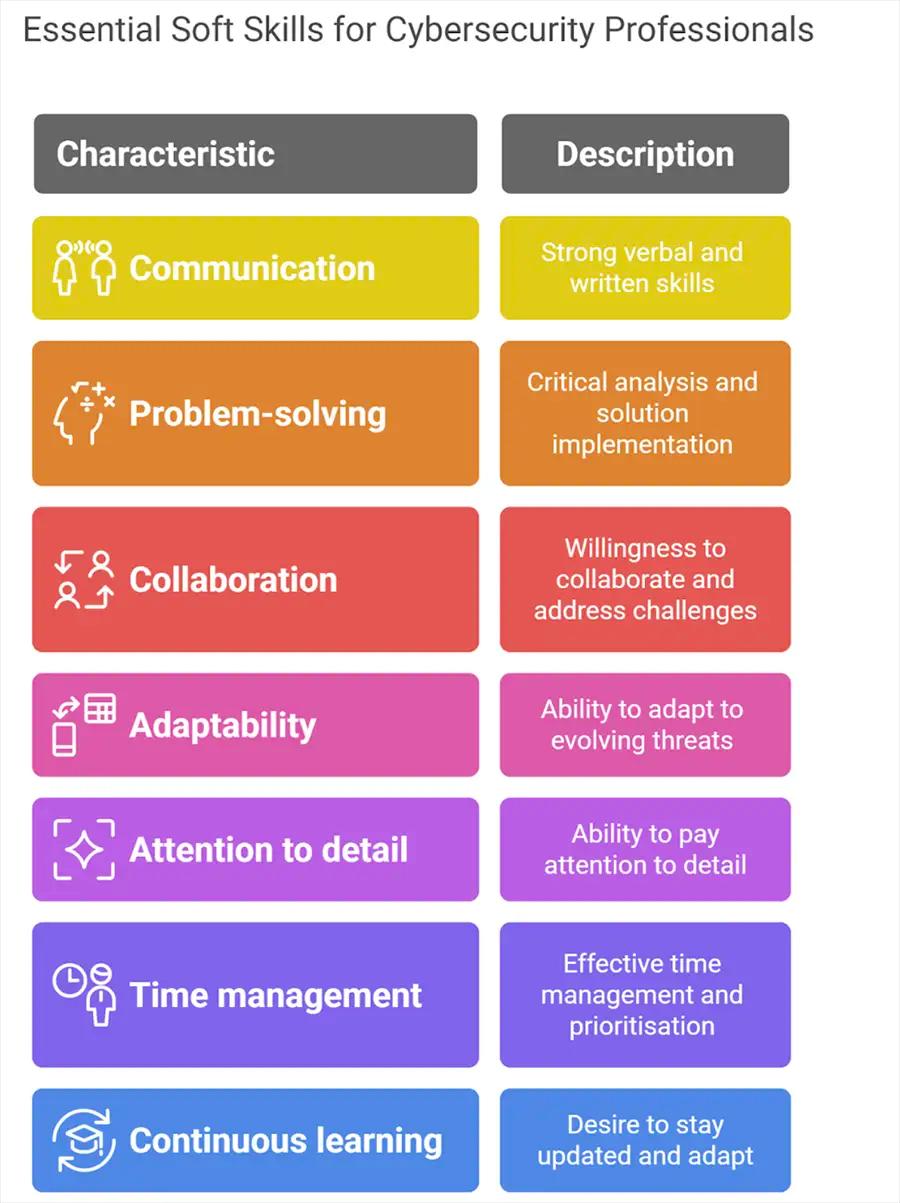
-
✅
Strong verbal and written communication skills.
-
✅
The ability to critically analyse and solve a problem.
-
✅
Willingness to collaborate and address security challenges.
-
✅
Ability to adapt to evolving cybersecurity threats and technologies.
-
✅
Must have the ability to pay attention to detail.
-
✅
Effective time management and prioritisation skills.
-
✅
A desire to stay updated and adapt to the changing cybersecurity trends.
Conclusion: A Final Sign Off
A cybersecurity certification is a great way to future-proof your career. In a world where we hear of cyber scams and dangers around every corner, this profession has become important. This has led to an increase in demand for trained and experienced professionals. Remember, a cybersecurity certification opens a gateway to a broad range of career opportunities. Keeping this in mind, we have shared 8 different career roles that you can explore after the certification. From IT industries to healthcare management companies, cybersecurity is part of each industry. Some of the job roles discussed above are cybersecurity analyst, chief information security officer, network security engineer, and more.
FAQs
1. What jobs can I get after cybersecurity?
There is a broad range of career opportunities available after cybersecurity. Here is a list of roles that you can look out for:
2. What to do after you get your cybersecurity certification?
After you get your cybersecurity certificate, you can apply for jobs and internships. Depending on your experience, expertise, and knowledge in the field, you can apply for roles. The cybersecurity skills and knowledge allow you to access job roles across industries.
3. Can I get a job after a cybersecurity course?
Yes, you can get a diverse range of jobs after a cybersecurity course. The demand for cybersecurity professionals is at an all-time high due to increasing cyber threats and cyber crimes. With the right skill set and knowledge, you can become a part of a booming industry.
4. Is cybersecurity a good career?
With the right skills, training, and knowledge, you can build a high-paying career in the field. However, you must learn and adapt to the constant changes in the field.
5. Is coding required for cybersecurity?
Coding skills are crucial for a successful cybersecurity career. While you may enter the field without coding skills, to be able to advance in the field, you must be proficient in programming languages such as Python, C++, Java, and Ruby.