India has been a hub of education, where learning is highly valued. In today’s highly competitive times, it is vital to choose the right university to secure a successful future. India has thousands of institutions that offer several programmes at various academic levels. However, how do you distinguish the high-quality institutions from the rest? The answer is easy, through recognition by the University Grants Commission.
The University Grants Commission (UGC) is a statutory body that ensures that universities meet the required academic and infrastructure standards so they can provide high-quality learning to students. If you’re wondering why UGC recognition is so important and what impact it has on your degree, this blog shall answer all your questions. It shall break down the importance of recognition and how it acts as the ultimate safeguard against the wastage of your money and time on fake institutions.
Why UGC Approval Matters?
In India, UGC recognition is a trademark that represents the high quality of education being provided by universities and colleges. Whether it is an undergraduate or postgraduate course, it must be pursued at an institution with UGC approval, as it provides validity, value, and legitimacy to the course and your qualification. Here is why UGC recognition is so valuable:
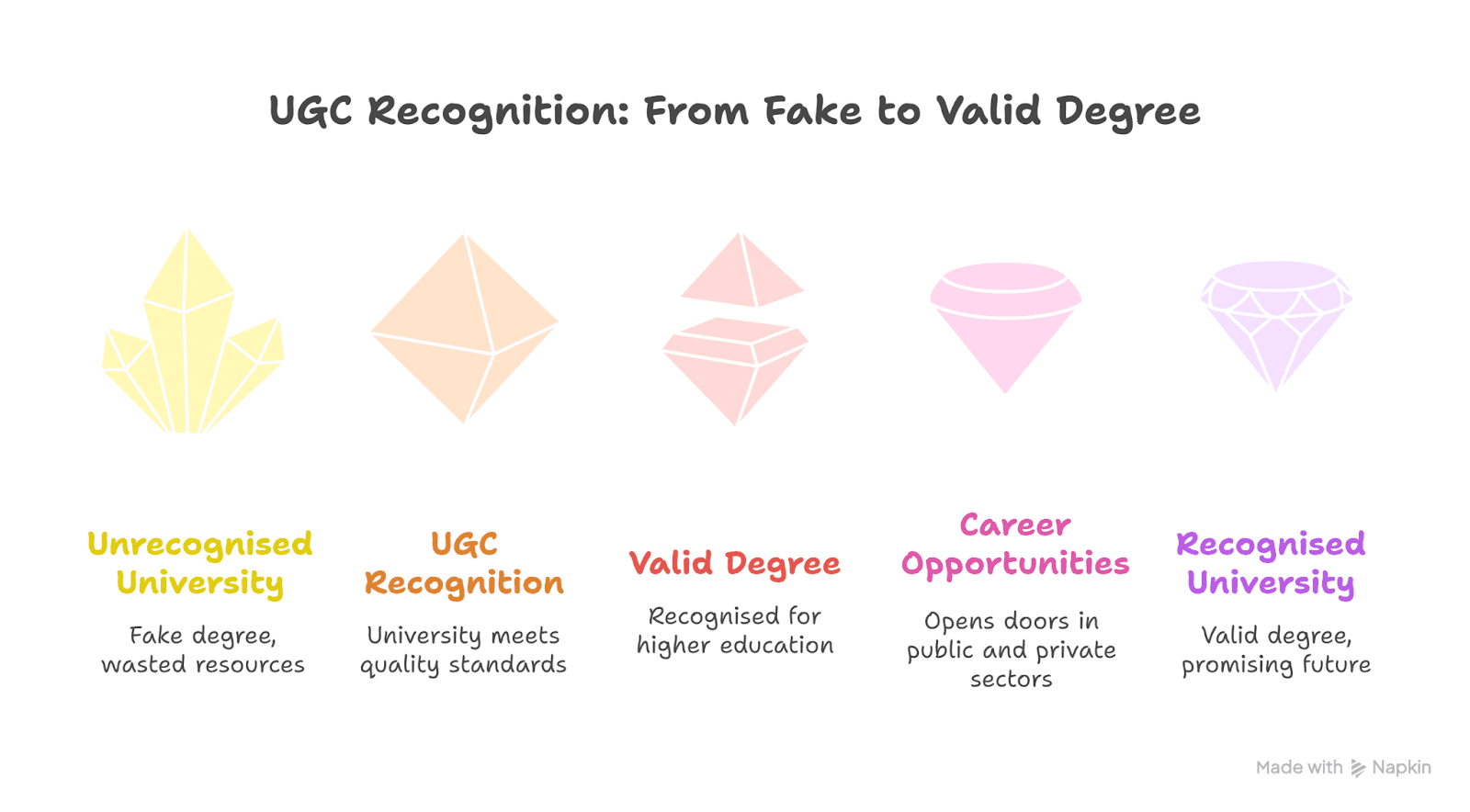
Your degree shall only be valid if it is pursued from a university or college that the UGC recognises. Only recognised universities, by the rule of law, can grant degrees in India. A university not recognised by UGC offering degrees is deemed to be fake, and also the courses are not valid for higher education or for professional opportunities.
It makes the degree valid; you can also then apply for various government posts or examinations. Even if you meet all other qualifications but do not have a valid degree from a recognised university, you shall not be able to attain any government position, even if you qualify for the exam.
Recognition by a university creates a sense of trust, indicating that the university provides a high level of education to its students. It also increases the chance of employability for the learners and opens more opportunities across industries, both in the public and private sectors. Employers also look for valid degrees from institutions recognised by the UGC.
Pursuing a degree from such an institution also makes you eligible for scholarships or financial aid if you come under any suitable category. You can benefit from such financial support and pursue your education without any stress.
Recognition of universities is also a sign of quality assurance, not just in terms of education but also in infrastructure standards. This means that the faculty will be highly knowledgeable, the curriculum shall be industry-relevant, high-quality research shall be followed, and there shall be highly developed student support systems.
A basic but the most practical way to explain why recognition matters is that you can effortlessly distinguish a fake university from a real one. A fake university shall never be recognised. Pursuing degrees from such institutions shall only be a waste of time and your financial resources. Only UGC-recognised universities offer valid degrees that are recognised both for higher education and career opportunities.
Is a University UGC Approved or Not? Know To How!
If you’re wondering how you can distinguish between a university that UGC approves and a fake one, here are simple steps on how you can check the UGC approval status for a university:
First, you need to visit the official UGC website and navigate to the university section.
On the homepage, when you click on the ‘University’ tab, it will open up several sub-categories like Central University, State University, Deemed Universities, and Private Universities.
Depending on the category that the university you are checking falls into, you can select that type of university.
Next, you can easily scroll to the ‘Find’ bar section and type in the name of the university to search for it quickly.
It will easily display the name of the university, its location, and the date of establishment.
Apart from this, UGC also publishes a list of fake universities each year, which you can cross-check to make sure that the particular university you are checking out is not blacklisted.
As we know, UGC also gives recognition to the online programmes offered by universities. For this, there is a separate UGC-DEB or University Grants Commission Distance Education Bureau, which provides recognition to the universities offering online and distance programmes.
Difference Between UGC and Other Regulatory Bodies
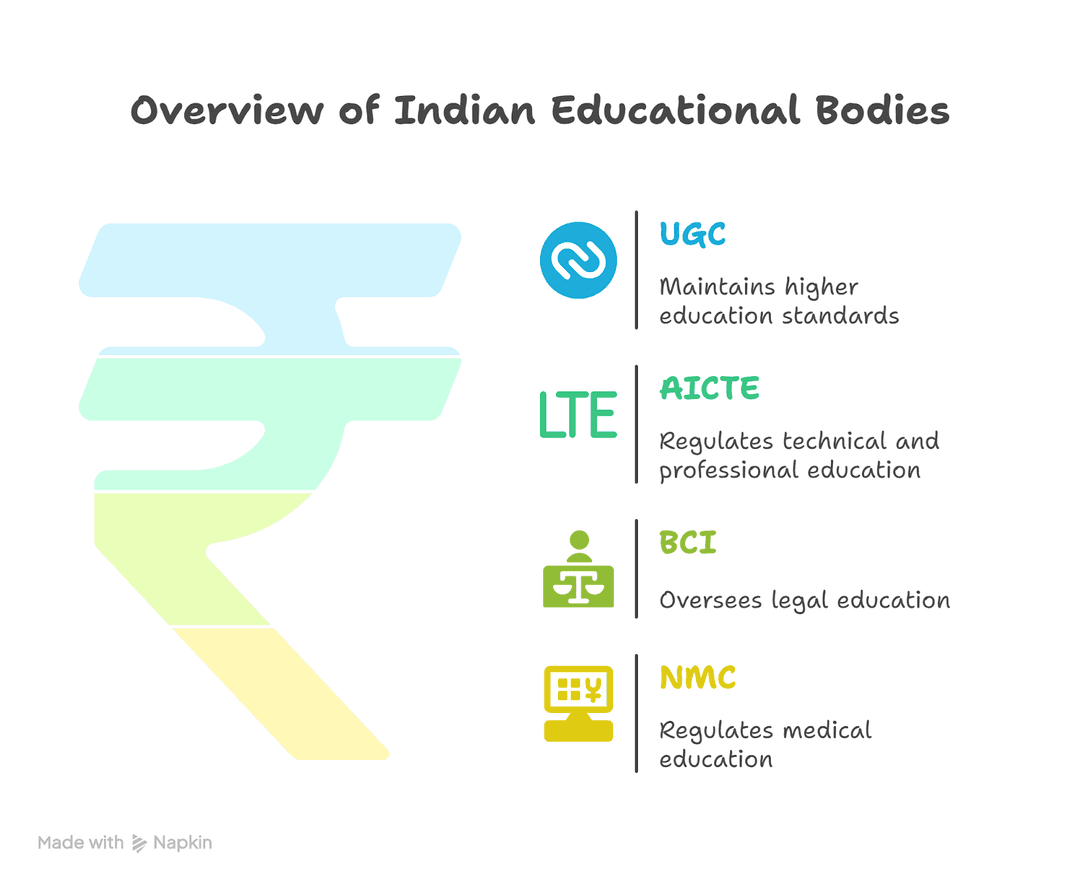
Established in 1956, the University Grants Commission (UGC) acts as the central body responsible for maintaining, coordinating, and determining higher education and infrastructure standards in India. It grants recognition to universities and colleges offering degrees such as BA, BSc, MA, MSc, MPhil, PhD, etc.
Apart from UGC, several other statutory educational bodies oversee specific professional fields. Have a look here:
AICTE (All India Council for Technical Education): Regulates technical and professional education, including programmes like B.Tech, M.Tech, MBA, PGDM, MCA, etc.
BCI (Bar Council of India): Oversees legal education and institutions in India for courses like LL.B., B.A. LL.B., and LL.M.
NMC (National Medical Commission): Regulates medical education in India and approves courses like MBBS, MD, etc.
What if a University Fails to have UGC Recognition?
We have so far discussed UGC-recognised universities and how they earn recognition in terms of the quality education they provide to learners. However, what happens if your university fails to acquire it? Let’s discuss in detail.
Pursuing a degree not recognised by the UGC can have serious professional consequences. Since UGC access is a legal stamp that shows quality education being provided by institutions, a university, upon failure to achieve that, should not be deemed valid, and all of its degrees, therefore, shall have no credibility.
Invalid degrees—shown by institutions not approved by UGC – shall not be considered for employment opportunities or for higher education.
No professional opportunities—not only for higher education opportunities, but also for pursuing a degree if you’re looking for a professional career or growth.
Financial and emotional loss—imagine wasting 3 to 4 years of your life investing in a degree that is later discarded or deemed invalid. Therefore, it is important to recognise universities that are fake or inappropriate for you so that there is no wasted money or time on such courses.
No financial scholarships—if a student has passed their degree from a non-recognised university, they should not be able to pursue education or be eligible to avail themselves of any scholarship or financial aid. Even if you are an eligible candidate for it, you might also be blacklisted from passing any further degrees if your university is not approved.
Takeaway
The University Grants Commission (UGC) is a statutory commission established to ensure the academic and infrastructure standards of universities in India. Universities that receive approval and recognition from the UGC demonstrate their commitment to providing learners with high-quality education. It is a trademark of legitimate degrees having validity and credibility. Pursuing degrees from institutions that are not UGC-recognised shall mean that your degree is invalid and that your financial and time investment is all a waste. Also, beyond regular courses, UGC-DEB also recognises online and distance programmes offered by the universities. Always ensure that whichever university or college you are applying to has received UGC approval.
Every query is necessary.
Our team of experts, or experienced individuals, will answer it over online meet. Book your slot now!
Narayani Bhardwaj is an experienced academic web content writer @Learning Routes with a strong focus on developing clarity, research, and learner-friendly content. With three years of versatile experience as a blog writer, SEO writer, social media post writer, and subject matter expert, she additionally holds a master's in computer applications. The technical background provides her with a strong understanding of technological and subject-based writing across various niches. Her expertise helps simplify complex topics and present them in a well-structured and engaging way to help her audience discover the best of what they are looking for.
Isha Jain holds a Bachelor's degree in Literature along with a Diploma in Digital Marketing, bringing a strong foundation in communication and content creation. With over 7 years of hands-on experience in the education domain, she has crafted impactful content across various formats - ranging from educational blogs and news articles to video scripts, newsletters, and learner-focused campaigns.
As the editorial lead at Learning Routes, Isha plays a key role in shaping content that empowers students and working professionals to make confident choices about online courses and career-building certifications. Her deep understanding of the online education space is reflected in her writing, which aims to simplify complex decisions and provide real-world clarity to learners.
Beyond her professional role, Isha has also written extensively on lifestyle and digital learning trends. She is passionate about guiding students and loves engaging in conversations around career development on platforms like LinkedIn, Quora, and Reddit. Whether it's recommending the right upskilling path or demystifying online education, she has helped countless learners take confident steps toward their goals.
In her spare time, you’ll find Isha reading, traveling, or playing sports to stay active and inspired.

 Refer and Earn ₹ 5000