Explore Courses
Top University
Search anything
 Refer and Earn ₹ 5000
Aarshi
Published on 18 February, 2026

Learning Routes Editorial Team
Reviewed and updated
A letter that speaks and verifies your skills and experience is called an Experience Letter. Are you planning a job switch? Remember, your experience letter is basically proof/evidence of your work. It is a crucial element for background checks, new job offers, visa applications, and sometimes higher education as well. Every experience letter has important details, such as employment history, skills, performance, and finally, work responsibility. Whether you are an HR, employer, or employee, you must be aware of the basic experience letter format in India. In this blog, we explore the meaning, the difference between an experience letter and a reliving letter, different formats, common mistakes, and more. Stay tuned till the end.
Are you also wondering what is an experience letter? An experience letter is one of the most important formal letters. It plays a crucial role in your professional journey. Typically, your employer would issue this letter once you switch or resign from your existing company. This document indicates that you worked in this particular company and were assigned your particular job role. If you look closer at the document, there are several sections in an experience letter in India. Some of these sections include employee role and responsibilities, duration of the employment, job description, general review of performance, and employer signature.
Also read: Guide to Writing Effective Formal Letters: Format, Tips and Techniques
Confused between an experience letter and a relieving letter, don’t worry, we have got you. It is easy to get confused between the two; however, both of these letters have different purposes. Let’s compare the two and understand them:`
An experience letter verifies the skills and experience you mention in your resume, cover letter, or CV. You are often required to add this letter to your portfolio. This document is proof of the time you spend working with the company. Your HR Manager drafts your experience letter. However, if you work with a small-scale company, the business owner might draft it for you. This letter is handed over to you at the end of your employment at that company. Let’s take a look at the other advantages of an experience letter:
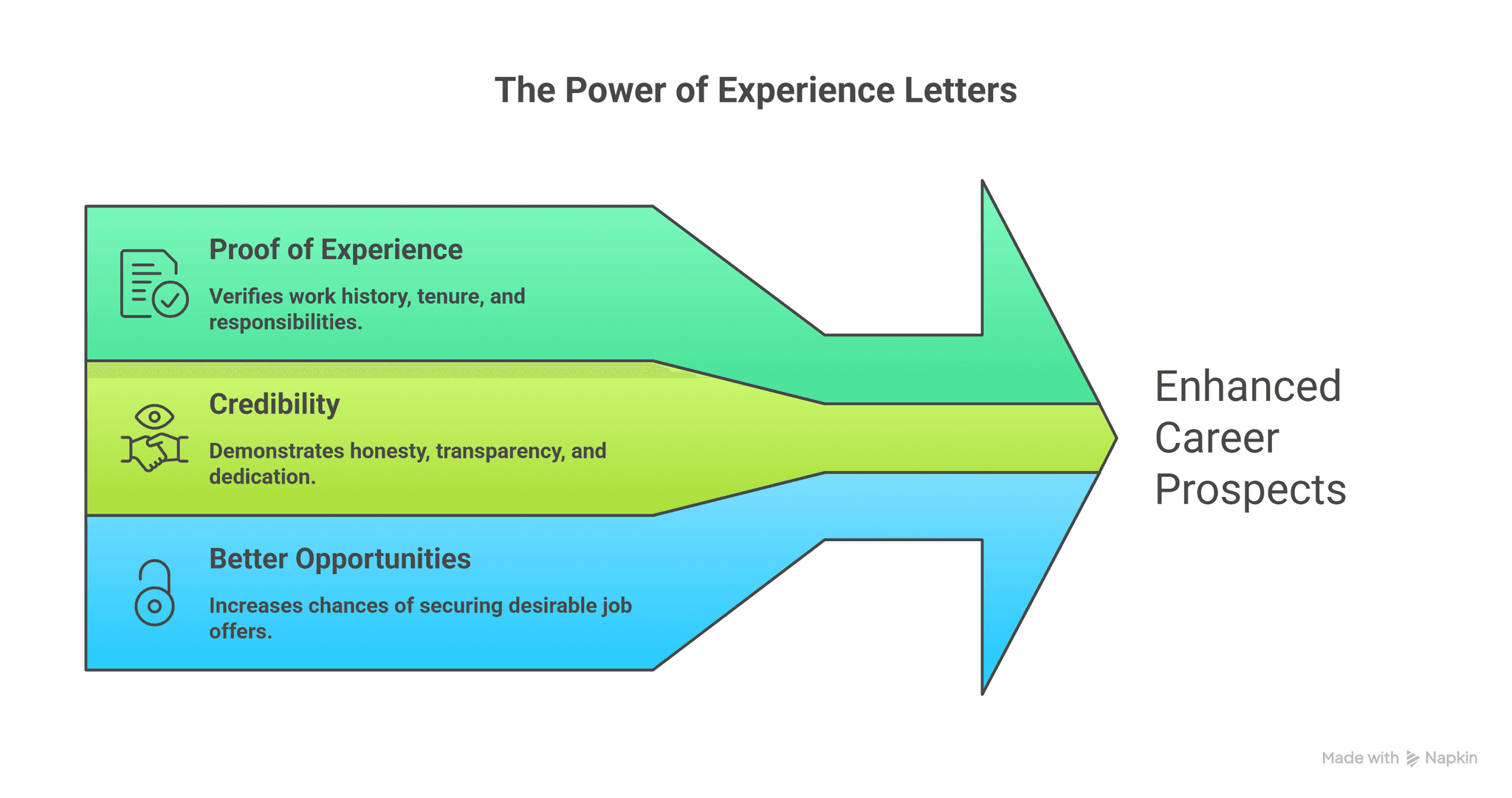
✅ Proof of Experience: An experience letter acts as evidence for the work you did in an organisation. It verifies your tenure, job title, and responsibilities.
✅ Build Credibility: Once your background is verified by a prospective employer, this experience letter indicates your honesty, transparency, and dedication.
✅ Better Opportunities: After completing employment successfully, you have a higher chance of getting good job opportunities.
Here is a list of all the components of a valid experience letter:
Your details, like name, designation, etc., must be included in the letter. The idea is to avoid confusion and prevent future employers from being misled.
The employer must use its letterhead to issue the said letter. The letterhead shall contain the company’s details, such as name, address, contact numbers, etc. This will help if some cross-verification is needed in the future.
In an experience letter, it is crucial to mention the issuing date clearly. It will help prospective employers assess your employment journey.
The issuing company must mention the dates when the employee joined and when they left. This information helps a future employer determine the employee’s previous service period if needed.
A standard experience letter must contain your job role and responsibilities in the organisation. It helps assess you
The company should also mention the employee’s achievements and significant contributions to the company.
At the end, the issuing company must close it with the final statement. It must have a positive connotation and promote good relations between the employer and you. It gives warmth to the letter.
The signatory’s details, like name, designation, contact information, etc., should also be clearly mentioned with an official stamp. This gives weight to the letter and also helps
The experience letter has a common template, mostly. However, the content might differ in some cases. Let’s take a look at the most used template of an experience letter:
As mentioned above, there might be some differences in the experience letter depending on the roles, such as a software developer, a content writer, an HR executive, and more. Let’s check it out:
As mentioned above, there might be some differences in the experience letter depending on the roles, such as a software developer, a content writer, an HR executive, and more. Let’s check it out:
Whether you are an employer or an HR writing an experience letter, you must have understood different experience letter formats in India. However, another important thing is to avoid errors. Here are some common mistakes that you must avoid:
An experience letter not just talks about an employee's skills but also about the company’s interest and ability to appreciate their employees. A well-written experience letter format can simplify the verification process in future. This is why, in this blog, we have discussed a common template and different job-role formats for an experience letter. Moreover, the blog contains all the essential information a letter must contain. Use this guide for writing a stellar experience letter format in your office. Just make sure to avoid the above-mentioned common mistakes.
A letter of experience includes employment history, skills, performance, and finally, work responsibility.
To make an experience letter format in India, first of all you must write it on the company letterhead. Mention the date followed by a professional salutation, employee introduction, job duration, job description, roles, and skills. Then a description of the employee's achievements and skills, and finally a salutation with the company seal and signature.
Typically, to get an experience letter in India pdf from your company, you need to reach out to the HR or your manager after you submit your resignation letter.
An experience letter plays a crucial role in your professional journey. This document indicates that you worked in this particular company and were assigned your particular job role.
Your employer, manager, or the HR team shall provide you with the experience letter in India.
Our team of experts, or experienced individuals, will answer it over online meet. Book your slot now!
Book Free Online Counselling
Get Free Career Guidance