Data Science Subjects: Complete Syllabus, Semester-Wise Subjects, Courses & Career Skills

Data Science Subjects: Complete Syllabus, Semester-Wise Subjects, Courses & Career Skills

Summarize this blog post with:

Overview of Data Science Subjects

A typical data science course syllabus focuses on machine learning, business statistics and mathematics, and Python programming, among others. Depending on the programme (degree, diploma, & certificate), subjects vary by institute and course.


✅ Data cleaning, data visualisation, SQL, big data, and programming languages (Python/R) are the common topics covered across core data science subjects.

✅ Further, the syllabus for data science courses generally includes theory and practical subjects, along with electives and capstone projects.

✅ Data science courses from top institutions also include internship opportunities and research work for industry experience.

✅ Bachelor's degrees in data science cover 20-40+ subjects.

✅ Popular data science degrees in India include a BTech CSE with Data Science, BSc in Data Science, BCA in Data Science, followed by master's.


This blog is a detailed guide to data science subjects, covering core courses, practical subjects, and training. Learn about the typical syllabus of undergraduate degrees in data science. Explore the crucial tools and skills covered in a data science programme, top regular and online data science programmes, and more.

What subjects are covered in a typical data science course?

A typical data science course includes core subjects, specialised elective courses, capstone projects, and opportunities for hands-on experience such as internships. The programme usually focuses on mathematics, machine learning, statistics, and programming languages. Apart from the basics, you also explore subjects such as deep learning, natural language processing (NLP), and data ethics and privacy. Each subject targets specific areas of data science and industry-relevant skills. However, the subjects in data science vary by type as follows:


Course Type & Duration

Number of Subjects

Core Subjects/Topics

Bachelor's Degree (3-4 Years)

20 - 40+

Programming

Mathematics

Statistics

Data Structures

Database Management

Data Visualisation

Machine Learning

Big Data and AI

Master's Degree (2 Years)

12 - 25+

Advanced Statistics

Machine Learning

Deep Learning

Predictive Analytics

Data Mining

Big Data Analytics

AI and Research Projects

Diploma Courses (1-2 Years)

6 - 15

Python Programming

Probability and Statistics

Data Analysis

SQL

Machine Learning

Data Visualisation &

Practical Projects

Certificate Courses (3-9 Months)

3 - 10

Python or R

Data Analytics

SQL

Statistics Fundamentals

Excel

Power BI or Tableau

Introduction to Machine Learning

*Note that the subjects covered vary by course and your chosen specialisations for each type.

Core Data Science Subjects & What They Cover

Core subjects in data science include mathematics, Python/R programming, data visualisation, and machine learning. These subjects build your foundation to understand advanced topics of data science that may include deep learning, data mining, and big data analytics, among others. Here is the list of essential subjects that are generally covered in a data science course, regardless of its type. Explore what these subjects cover and teach you about:


Data Science Subjects

Details

Mathematics and Statistics

It covers probability, statistical methods, linear algebra & calculus, among others. It provides you with the foundation for analysing data, identifying patterns & making reliable predictions. 

Data Wrangling and Cleaning

This subject focuses on preparing raw data for analysis. It teaches you to correct errors, handle missing values, and remove duplicates. You may study data integration, missing data handling, and error detection in this course.

Databases and Big Data

You learn how to store, retrieve and manage large datasets. It covers the use of SQL, database systems & big data technologies such as Hadoop and Spark.

Programming Languages

Introduces you to coding languages such as Python and R. These languages help with data processing, statistical analysis, automation and model development. Further, you shall also learn to use relevant libraries and tools.

Machine Learning

Study supervised learning, unsupervised learning, regression and model evaluation. It allows you to explore how computers learn patterns from data to make predictions or classifications. 

Data Visualisation

Learn to present data by using charts, graphs, dashboards and reports. Tools like Tableau, Power BI and Python visualisation libraries are also covered in many programmes.

Ethics and Data Privacy

It teaches you to use data responsibly. Ensure user consent, confidentiality, algorithmic bias, fairness and data protection principles when collecting and analysing information.

Capstone Projects

A major project generally included in most of the programmes, allowing you to apply your skills. It may include the use of techniques like data collection, cleaning, analysing, and developing new models.

Data Science Practical Subjects & Project Work

Along with theory, you would also study subjects in a data science course that focus on skills development. You would learn about tools like SQL, Python, and data science labs to gain practical exposure. Moreover, you may also get to work on a capstone project by the end of the programme so that you can apply your learning in real-world scenarios. Here are some of the practical subjects that are covered in many data science courses:

Python and R Programming

Both Python and R are used in data science; however, they serve distinct purposes. Python helps with machine learning, production deployment, and making workflows scalable. R, conversely, focuses more on statistical computing, scientific visualisation, and data reporting. In this subject, you would learn to write code and use it to perform multiple tasks.

SQL and Database

SQL is a special programming language that primarily works with databases. It teaches you to retrieve, filter, and manage data stored in databases. It is used for cleaning data before it can be finally applied for machine learning.

Data Science Lab

This subject contains various hands-on exercises using datasets, allowing you to practise analytical methods and solve problems related to data. It enhances your problem-solving and critical thinking skills.

Big Data Analytics Lab

Big data is about managing large and complex sets of data. In this subject, you learn to work with large datasets with the help of distributed data processing tools and frameworks.

Data Science Research Project

Many undergraduate and postgraduate programmes in data science include research projects. In this, you may investigate a real-world problem and analyse your findings to prepare a technical report. Research-based projects strengthen your knowledge and practical understanding of different application areas that can be beneficial for securing jobs.

Capstone Project and Internship

These are typically included in most of the top data science courses, while opportunities for internships may vary. The end-to-end project work allows you to recall and apply most of the skills you have learnt in the programme. Internships, on the other hand, can be useful to gain real industry experience.

Data Science Syllabus: Semester-Wise Subjects

Data science course subjects depend on the institute and the type of course you select. Typically, UG and PG degrees cover foundational subjects, programming languages, electives, and dissertation/project. The first year of the programme generally focuses on core subjects. The second and third years often emphasise specialised learning, practical work, and training. Here is the general syllabus of a three-year data science course:


Semester

Data Science Subjects

Semester I

  • Introduction to Data Science

  • Programming Fundamentals

  • Mathematical Foundations

  • Communication and Technical Writing

  • Computer Organisation and Architecture

Semester II

  • Object-Oriented Programming

  • Discrete Mathematics

  • Operating Systems

  • Probability and Statistical Methods

  • Relational Database Management Systems (RDBMS)

Semester III

  • Data Structures and Algorithms

  • Exploratory Data Analysis

  • Software Engineering

  • Statistical Computing

  • Data Warehousing and Data Mining

Semester IV

  • Regression Analysis

  • Big Data Technologies

  • Optimisation Techniques

  • Machine Learning Fundamentals

  • Data Visualisation and Reporting

Semester V

  • Deep Learning Fundamentals

  • Natural Language Processing

  • Cloud Computing for Data Science

  • Data Governance and Privacy

  • Time Series Analysis and Forecasting

Semester VI

  • Advanced Data Engineering

  • Research Methodology

  • Predictive Analytics and Model Evaluation

  • Business Intelligence and Decision Support

  • Major Project or Internship

Data Science Subjects UG: BSc, BTech, & BCA

Popular courses in data science include a BSc, BTech, and a BCA programme. These are undergraduate degrees that you can pursue after 12th in the data science field. Each course has its own curriculum and focus area. However, Python programming, mathematics and statistics, machine learning, and big data are some of the common subjects covered in these data science courses. You may explore the general data science subjects and syllabus covered in these courses:

BSc Data Science Subjects

A BSc course with a specialisation in data science lasts three years. It focuses on building your mathematical and analytical foundations. Furthermore, it covers subjects such as probability, Python programming, machine learning, and statistics, among others. Here is an overview of the general BSc in data science subjects, semester-wise:

BSc Data Science Subjects 1st Year

Semester I

Semester II

Descriptive Statistics

Object-Oriented Programming

Introduction to Data Science

Linear Algebra

Fundamentals of Programming

Probability Theory

Mathematics for Data Science

Database Management Systems

Computer Fundamentals

Data Structures and Algorithms

BSc Data Science Subjects 2nd Year

Semester III

Semester IV

Python for Data Analysis

Data Visualisation

Statistical Inference

Machine Learning

Data Cleaning and Preprocessing

Big Data Analytics

Exploratory Data Analysis

Regression Analysis

Operating Systems

Data Warehousing and Data Mining

BSc Data Science Subjects 3rd Year

Semester V

Semester VI

Cloud Computing

Research Methodology

Time Series Analysis

Business Intelligence

Deep Learning

Advanced Machine Learning

Natural Language Processing

Elective Subject

Data Ethics and Privacy

Major Project or Internship

BTech CSE Data Science Subjects

A BTech in Computer Science and Engineering with Data Science as specialisation is a four-year programme. It consists of eight semesters, focused on the advanced areas of data science and computer engineering. Learn about MLOps, cloud engineering, data visualisation, big data, and more. Check out the semester-wise subjects covered in a BTech CSE data science course:


Semester I

Semester II

Engineering Mathematics I

Digital Logic Design

Engineering Physics

Engineering Chemistry

Engineering Design and Workshop

Engineering Mathematics II

Fundamentals of Electrical & Electronics Engineering

Object-Oriented Programming with C++

Computational Problem-Solving

Computer Programming and Systems Lab


Semester III

Semester IV

Web Application Development

Design and Analysis of Algorithms

Operating Systems

Data Science and Visualisation

Computer Organisation and Architecture

Computer Networks

Object-Oriented Programming with Java

Enterprise Data Warehousing

Discrete Mathematics and Graph Theory

Software Engineering and Testing


Semester V

Semester VI

Feature Engineering and Selection

Deep Learning Architectures

Cloud Data Engineering

Natural Language Technologies

Big Data Processing Frameworks

NoSQL and Distributed Databases

Business Intelligence Tools

DevOps and MLOps

Artificial Intelligence Principles

Information Security for Data Systems


Semester VII

Semester VIII

Advanced Data Science Applications

Data Governance and Responsible AI

Scalable Computing & Distributed Processing

Advanced Elective(s)

Data Science for Artificial Intelligence

Technical Seminar & Research Presentation

Elective(s)

Capstone Project II

Capstone Project I

Industry Internship/Training

BCA Data Science Subjects

A BCA in data science combines the areas of computer applications with practical data analysis skills. The programme typically follows a duration of three years, comprising six semesters. It typically covers programming in C and Python, business statistics, machine learning, etc. You may look at the generally covered BCA in data science subjects:


Semester I

Semester II

Fundamentals of Information Technology

Data Structures using C

Business Mathematics

Programming in Python

Programming in C

Database Concepts and SQL

Digital Computer Fundamentals

Business Statistics

Professional Communication

Computer Networks Fundamentals


Semester III

Semester IV

Data Management and Preparation

Data Mining & Techniques

Java Programming

Business Data Analytics

Web Technologies

Linux and Shell Scripting

Software Project Management

Introduction to Machine Learning

Statistical Methods for Data Analysis

Data Reporting and Dashboard Design


Semester V

Semester VI

Introduction to Artificial Intelligence

Research & Technical Documentation

Predictive Modelling

Cloud-Based Data Applications

Big Data Fundamentals

Advanced Analytics Applications

Mobile Application Development

Data Security and Information Privacy

Business Intelligence Applications

Major Project/Industry Internship

*Note: Actual subjects and syllabus depend on the institution and the particular programme. We have mentioned the general curriculum for each course.

Skills & Tools Covered in Data Science Subjects

Python, Tableau, R, SQL (Structured Query Language), and problem-solving are some of the critical skills and tools that you usually learn in data science subjects. You gain hands-on experience across these multiple tools so that you can apply them to projects. Here is the list of crucial data science skills and tools that are covered across many courses:
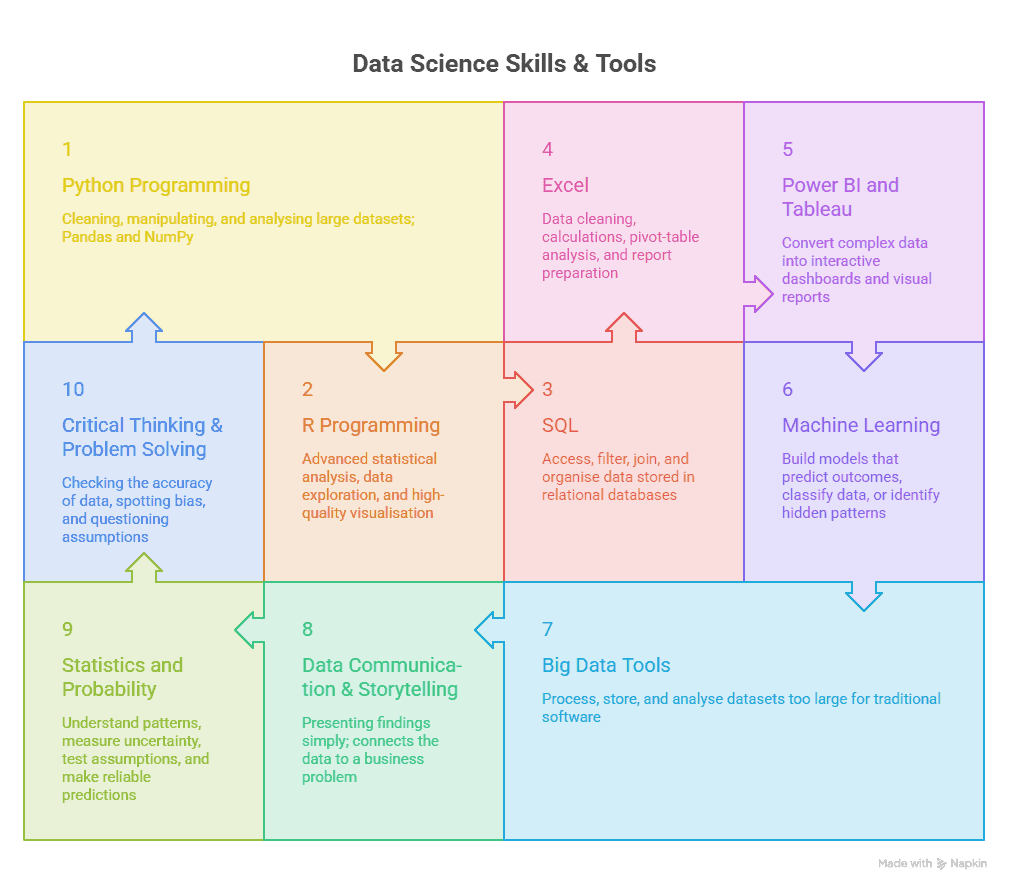
 

image.png

Python Programming

Python helps you with cleaning, manipulating, and analysing large datasets efficiently. You learn to use libraries such as Pandas and NumPy. It also supports automation and the development of machine learning models for real-world data problems.

R Programming

This is another coding language that helps you perform advanced statistical analysis. It is also used in data exploration and high-quality visualisation. Moreover, you can identify trends, test hypotheses, and present evidence-based insights with this tool.

SQL

It is a tool and a language that allows you to access, filter, join, and organise data stored in relational databases. It helps you extract the exact information required to answer business and analytical questions. Common queries that you may learn include JOIN, GROUP BY, SELECT, ORDER BY, etc.

Excel

It is used for data cleaning, calculations, pivot-table analysis, and report preparation. This is a practical tool to manage smaller datasets and supports you in communicating your findings in an accessible format. IF, SUMIFS, VLOOKUP, and XLOOKUP are some of the crucial formulas of Excel used in data analysis.

Power BI and Tableau

These are two different tools that help you convert complex data into interactive dashboards and visual reports. With these, you can make patterns, performance metrics, and insights easy to understand for those responsible for decision-making.

Machine Learning

It educates you on how to build models that can predict outcomes, classify data, or identify hidden patterns. You can apply it to areas such as sales forecasting, customer segmentation, and risk detection.

Big Data Tools

Tools used to handle big data help you process, store, and analyse datasets that are too large to be managed by traditional software. You can use them for data cleaning of large datasets, making the analysis process faster, and scalability.

Data Communication & Storytelling

Data communication refers to presenting findings in an explicit and simple way so that both technical and non-technical audiences can understand the insight. Storytelling, on the other hand, connects the data to a business problem and suggests what action should be taken. Tableau, Looker, and Power BI are common tools used for these purposes.

Statistics and Probability

Learn to understand patterns, measure uncertainty, test assumptions, and make reliable predictions. These skills build a foundation for A/B testing, forecasting, risk analysis, and machine learning in data science.

Critical Thinking & Problem Solving

You would need these skills for various purposes, such as checking the accuracy of data, spotting bias, and questioning assumptions. It helps you with analysing data, testing hypotheses, and evaluating models.

Best Data Science Courses in India

UPES Dehradun, Amrita University, Vellore Institute of Technology (VIT) and IITs are some of the top data science course providers in India. Depending on the institution, you can pursue a BTech, BCA, BSc, BS, MTech, MCA, MSc, MS, or diplomas and certificates in the field of data science. However, the offered courses and their curriculum vary for each institute. Below is a list of several top data science courses in India with fees:


Institute

Course

Data Science Courses Fees

Amrita Vishwa Vidyapeetham, Mysuru

MCA in AI & Data Science

INR 3,58,000 - INR 5,10,000

UPES Dehradun

MCA Data Science

INR 5,54,300

Uttaranchal University Dehradun

BTech (Hons) CSE with Data Science

INR 1,69,300 - INR 2,29,300

(First year only)

Galgotias University

BTech CSE Data Science

INR 7,36,000 (Total tuition fees only)

Sharda University

BSc Data Science and Analytics

INR 4,01,817

List of Top 11 Data Science Courses Online

Apart from regular mode, you can choose to enrol in a data science course online as well. An online BS is a 4-year degree offered by IIT Madras in the field of data science with multiple exit options. Similarly, BITS Pilani, Amity Online, and IIT Roorkee are other top providers of online data science courses in India. Check out the list of several popular online data science courses with fees:


Platform

Course Name

Data Science Courses Fees

IIT Madras

BS in Data Science and Applications

INR 3,86,000 - INR 4,50,000

Amity University Online

MBA in Data Science

INR 2,25,000

Online Manipal Jaipur

MCA in AI and Data Science

INR 1,64,000

BITS Pilani Digital

BSc in Data Science and AI

INR 3,40,710

Chandigarh University Online

BCA in Data Science

INR 1,77,000

Amrita Online

BCA in AI and Data Science

INR 1,65,000

IIT Roorkee + IntelliPaat

Data Science Course

INR 70,053

upGrad + Liverpool Business School

MS in Data Science

INR 4,85,000

SRM Online

Diploma in Data Science & ML

INR 36,000

IBM + edX

IBM Data Science Professional Certificate

USD 970

Datamites

Data Science Courses Online

INR 1,10,000

Conclusion

Data science subjects vary from course to course and by institution. Typically covered subjects include programming languages, particularly in Python and R, statistics, mathematics, data visualisation, and machine learning. Furthermore, you may be provided with elective courses to choose from in the areas of NLP, deep learning, large language models, etc. Bachelor's degrees like BSc, BCA or BTech cover 20-40 subjects, including core courses, electives, and project work or dissertation. For specialised courses, you can opt for certificate programmes. Check the subjects and syllabus thoroughly to ensure practical training and industry relevance.

FAQs

Q1. What is data science courses?

Data science courses refer to the degrees, diplomas, and certification programmes that focus on data analysis, machine learning, data visualisation, and subjects and projects related to data. 

Q2. Why data science is important?

Data science helps in the process of extracting insights from raw, large, and complex datasets and using them in the development of predictive models to guide and solve business problems across industries.

Q3. Does data science have a future?

Yes, data science has a growing and strong future in terms of job prospects across industries. However, the demand for the role is shifting towards data cleaning, AI collaboration, and decision-making, rather than basic coding only.

Q4. Is maths compulsory for data science?

Yes, the field of data science requires maths. However, proficiency in advanced topics depends on the type of role you want to pursue. Probability and statistics are the basic subjects covered, while linear algebra and calculus can be useful for machine learning models.

Q5. What is the difference between data science and data analytics?

Data science is a vast field that covers machine learning, AI, and advanced algorithms, whereas data analytics is a specific area that includes the process of data cleaning, organising, and finding insights to solve real-world business issues.

Every query is necessary.

Our team of experts, or experienced individuals, will answer it over online meet. Book your slot now!

Book Free Online Counselling

Narayani - Author

Narayani SEO Writer

LinkedIn Profile

Narayani Bhardwaj is an experienced academic web content writer @Learning Routes with a strong focus on developing clarity, research, and learner-friendly content. With three years of versatile experience as a blog writer, SEO writer, social media post writer, and subject matter expert, she additionally holds a master's in computer applications. The technical background provides her with a strong understanding of technological and subject-based writing across various niches. Her expertise helps simplify complex topics and present them in a well-structured and engaging way to help her audience discover the best of what they are looking for.

Read more
Isha - Editor

Edited by: Isha Education Counsellor / Editor

LinkedIn Profile

Isha Jain holds a Bachelor's degree in Literature along with a Diploma in Digital Marketing, bringing a strong foundation in communication and content creation. With over 7 years of hands-on experience in the education domain, she has crafted impactful content across various formats - ranging from educational blogs and news articles to video scripts, newsletters, and learner-focused campaigns. As the editorial lead at Learning Routes, Isha plays a key role in shaping content that empowers students and working professionals to make confident choices about online courses and career-building certifications. Her deep understanding of the online education space is reflected in her writing, which aims to simplify complex decisions and provide real-world clarity to learners. Beyond her professional role, Isha has also written extensively on lifestyle and digital learning trends. She is passionate about guiding students and loves engaging in conversations around career development on platforms like LinkedIn, Quora, and Reddit. Whether it's recommending the right upskilling path or demystifying online education, she has helped countless learners take confident steps toward their goals. In her spare time, you’ll find Isha reading, traveling, or playing sports to stay active and inspired.

Get Free Career Guidance

enquiry
logo
The intend of Learning Routes is to provide unbiased, precise information & comparative guidance on Universities and its Programmes of Study to the Admission Aspirants. The contents of the Learning Routes Site, such as Texts, Graphics, Images, Blogs, Videos University Logos, and other materials (collectively, 'Content') are for information purpose only. The content is not intended to be a substitute for in any form on offerings of its academia partners. Infringing on intellectual property or associated rights is not intended or deliberately acted upon. The information provided by Learning Routes on www.learningroutes.in is for general information purposes only. All information on the site is provided in good faith with accuracy and to the best of our knowledge, however, we make no representation or warranty of any kind, express or implied, regarding the accuracy, adequacy, validity, reliability, or completeness of any information on the Site. Learning Routes & its fraternity will not be liable for any errors, omissions, damages, or losses resultant, if any, from the usage of fit information.
Contact Us:
Get Free Counselling
07965800489

Scholarships UPTO 10% for online degrees

Enquire Now