Explore Courses
Top University
Search anything
 Refer and Earn ₹ 5000
The field of data is set to create millions of jobs globally. From entry-level to advanced positions, data analytics has become crucial across businesses. Data analytics courses syllabus generally focus on topics like data visualisation, Python/R programming, SQL, and machine learning. Data cleaning, data storytelling, statistical analysis, and advanced Excel are among the crucial skills that you can learn through data analytics courses. Many top-rated universities, institutions, and platforms offer data analytics courses in online and offline modes.
However, the syllabus for data analytics varies for each course depending . You can enrol in a course that suits your learning level as a beginner or seasoned professional. With this blog, we shall discuss the data analytics courses syllabus in detail. You would learn about core subjects, essential skills, and tools covered in the course for data analysis. Dive in to learn about the data analytics course syllabus for top learning platforms and more.
A data analytics course is an educational programme that teaches the process of how you can collect, organise, and analyse raw data. You learn how to use this processed data to find useful patterns and insights that can help businesses make effective decisions. Data analytics courses can be of different types. It could be a certification, diploma, or a degree programme. Moreover, the field of data analytics is categorised into four main parts:
✅ Descriptive Analytics
✅ Predictive Analytics
✅ Diagnostic Analytics
✅ Prescriptive Analytics
There are multiple courses available that discuss these fields individually. Pursuing a course in any of these fields shall also be considered part of data analytics courses.
The duration of a data analytics course depends on its type and curriculum. Based on the programme length, data analytics courses are divided into two parts: short-term courses and long-duration courses. Short-term programmes generally include certification courses, while long-duration courses cover diplomas and degree programmes. Here is an average programme length of data analytics courses:
✅ The global data analytics market is expected to reach 738.6 billion dollars by 2033, up from a market estimate of 107 billion dollars in 2026.
✅ According to Grand View Research (2026), it is growing at a CAGR of 31.8% (2026-33).
✅ 11 million new jobs are projected to be created in the AI and data processing sectors by 2030, as per the WEF Report 2025.
Also Read: Data Analytics Course Fees in India: Certification, Diploma & Degree Costs
Data analytics is a broad field covering different areas of tools and technologies. Data analytics course structure covers a variety of crucial subjects, including Python/R, machine learning, data visualisation, and mathematics & statistics. Depending on the type of course you enroll in, the specialised areas may vary. Here are several core subjects covered in the data analytics courses syllabus:
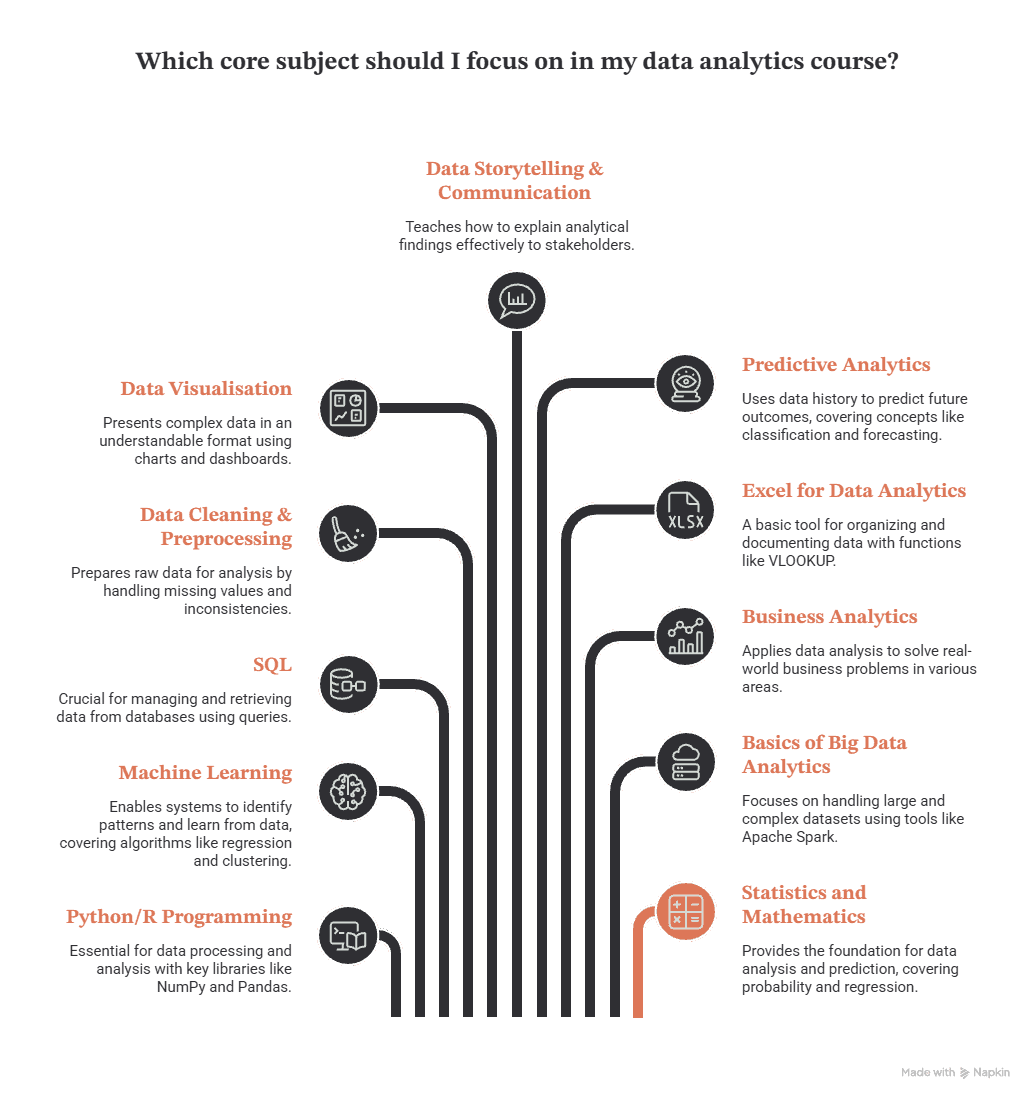
These are the crucial programming languages used to process datasets. The key libraries you study in Python include NumPy, Pandas, and Matplotlib. R programming, on the other hand, focuses more on statistical analysis, using packages such as ggplot2 and dplyr.
You learn about algorithms that help systems to identify data patterns and learn from them. It covers concepts such as regression, model evaluation, clustering, and supervised & unsupervised learning. Learning the fundamentals of machine learning can help you with advanced data analytics in future.
SQL teaches you to retrieve and manage data from databases by using queries such as GROUP BY, SELECT, and JOIN. It is one of the crucial subjects in data analytics, which is commonly used in real-world industry projects.
Data cleaning prepares raw data for analysis. You learn to handle missing values, discard duplicates, and spot and correct inconsistencies. Excel, Python, Power Query and SQL are some of the tools that help you develop reliable datasets.
Another crucial subject covered in data analytics courses syllabus is data visualisation. It helps present complex data in the form of charts, dashboards, and graphs, which are easy to understand. Tableau and Power BI are commonly used tools in workplaces, making data easily understandable for stakeholders and decision-makers.
It teaches you to explain your analytical findings from data to stakeholders in a proper and engaging way. You learn to communicate insights, highlight the key trends, and make recommendations effectively by using visualisation and presentation techniques.
This is a field of data analytics that uses data history to predict future outcomes. It covers various concepts such as classification, regression, and forecasting. Python and R are the programming languages in this field that help you build predictive models for better decision-making.
Excel is the core tool for data analytics, which is widely used by data analysts to organise and document data. It is generally the most basic tool that you can learn as a beginner. It teaches you various functions such as LOOKUP, VLOOKUP, AVERAGE, & CORELL. You also learn pivot tables, charts, and data cleaning methods.
Learn how to apply data analysis to solve real-world business problems. It is used in various business areas such as sales, marketing, finance, consumer behaviour, and KPI performance. Moreover, the subject enhances your ability to connect business goals with data insights, supporting strategic decision-making.
Big data is about handling large and complex sets of data efficiently. It covers tools and techniques used in big data such as Apache Spark, Hadoop, and cloud technologies. It is an advanced subject that focuses on how businesses handle and process large volumes of data across fields.
Mathematics and statistics are the core of data analytics. The subjects cover many crucial topics such as probability, standard deviation, correlation, mean, median, regression, etc. These topics help with the data analysis process and make predictions. By studying these, you can improve your analytical skills, needed to make data-backed decisions.
An MBA in data analytics is a full-length 2-year degree programme. Comprising four semesters, it covers the essential areas of management and data analytics comprehensively. The syllabus of an MBA in data analytics varies by institutes and their curriculum. Typically, a Master of Business Administration in data analytics focuses on core subjects in the first year, while covering specialised subjects or electives in the final year. Below is a general syllabus of an MBA in data analytics semester-wise:
The syllabus for data analytics courses differs for each institution depending on the type of course and its curriculum. However, core topics such as data visualisation, Python, machine learning, data cleaning, etc., generally remain the same in most of the programmes. You can understand this better by exploring the syllabus for several top data analytics courses. Here are the best data analytics courses syllabus offered by top online learning platforms:
This is a professional certificate programme offered by Google, which is hosted on Coursera. It is a series of 9 courses that lasts six months. This is a certification programme in data analytics that you can complete at your pace. Here is the data analytics courses syllabus for the Google certificate:
This is one of the most popular data analytics courses by DataMites. It is a 6-month course that involves a live project. The programme is available in online, blended, and in-person classroom modes. Moreover, it also ensures placement assistance for career support.
This data analytics course by SimpliLearn is offered in collaboration with Microsoft Azure. It is an online certification course that lasts eleven months, focusing on various concepts, tools, skills, and project work. The programme covers various industry tools such as MS Excel, Python, Power BI, R, Tableau, and MySQL, among others. You may take a look at the data analytics courses syllabus by SimpliLearn:
E&ICT Academy and IIT Roorkee together offer this data analytics certification programme in collaboration. The 6-month course is available online for aspiring graduates or those pursuing college studies. It includes an optional campus immersion for learners to experience immersive learning. Deserving candidates can also receive placement assistance, provided that they meet certain eligibility requirements. Take a look at the data analytics courses syllabus and subjects for the programme:
This is an online data analytics certification course that lasts 10 months. IIM Kozhikode offers this programme in collaboration with Emeritus Learning. It includes live online sessions and a capstone project for a hands-on learning experience. The programme is open to graduates and diploma holders with at least 1 year of work experience. Check out the data analytics courses syllabus for IIM Kozhikode’s certification programme:
*Note that the mentioned above are the core topics and subjects that have been covered in these courses. The actual syllabus varies for the above programmes based on many modules, tools, and technologies covered.
The syllabus for data analytics courses varies for degree and certification programmes. A degree course lasts for 2-3 years, whereas certification programmes take from a few hours to several months (3-9 months typically). Degree courses in data analytics typically focus on comprehensive learning inclusive of basic to advanced topics, industry tools, and capstone projects. Certification courses, on the other hand, last for a shorter duration as compared to full-length degrees. Therefore, the topics and skills covered in these courses are also specific and limited, as they are more training-focused. Explore the detailed differences between the curriculum of degrees and certifications in data analytics:
A data analytics course syllabus generally covers crucial skills that data analysts regularly work with. Moreover, data analysts need both technical and soft skills. Technical skills such as coding, advanced Excel, and Power BI/Tableau help with processing data practically. Soft skills are needed to communicate the findings with the team and stakeholders for better decision-making and also to understand patterns. Here are the essential skills commonly covered in data analytics courses syllabus:
Structured Query Language (SQL), Power BI, Tableau, MS Excel, and Python/R are some of the important industry tools covered in data analytics courses. Each tool has a different function and requires you to have hands-on experience to learn data analytics effectively. Check out the list of crucial tools generally covered in data analysis courses syllabus:
The syllabus of a typical data analytics certification course generally focuses on core topics such as data analysis, Python programming, data visualisation, machine learning basics, and SQL. Specialised data analytics courses may also cover industry-oriented tools like Power BI, Tableau, and MySQL. The exact syllabus of the certification programme depends on its curriculum and the areas of data analytics it is focusing on. For example, predictive analytics, data analytics with AI, analytics with machine learning, etc.
Many global learning platforms, universities, and institutions offer advanced data analytics certificate courses. The exact syllabus for each programme varies by institute, skills covered, and curriculum. You can find the detailed syllabus for these certification courses on the official website of the course provider. Generally, the syllabus is mentioned on websites that you can view for free. Some portals may ask you to sign up or register with your mobile number to download brochures, where you can find the actual and comprehensive syllabus and subjects.
The data analytics courses syllabus is generally vast for long-duration or comprehensive courses. Short-term data analytics certificates typically focus on specific areas of data analytics such as predictive analysis, data visualisation techniques, or data analytics for GenAI. You can choose the course that covers the essential skills and tools that you wish to learn in data analytics. Beginners can focus on learning MS Excel, SQL, and basic data visualisation techniques before jumping on to the advanced concepts. Explore the syllabus for your desired course before enrolling.
The key topics in data analytics courses generally include data analysis, data visualisation, SQL, MS Excel, and the Python programming language.
A data analyst is basically a blend of technology and business domain. It requires technical skills such as programming, SQL, Tableau, etc., and knowledge of business operations to identify and predict relevant patterns and trends for decision-making.
SQL, Python, and MS Excel are the three core skills that data analysts need to perform their daily operations, such as data modelling, documenting findings, and handling datasets in databases.
Yes, you can become a data analyst without any prior work experience, provided that you develop relevant foundational skills such as advanced Excel, SQL, and Python programming. You can build small projects first to apply your learning and then consider entry-level posts in data analytics to move ahead in this career.
There is no particular educational or work experience requirement to become a data analyst. Having studied subjects like mathematics, statistics, or computer science can be beneficial to begin your career in the data analytics field. You can build relevant skills such as SQL, Python, Power BI, and MS Excel to seek opportunities in the same field.
Our team of experts, or experienced individuals, will answer it over online meet. Book your slot now!
Book Free Online Counselling


Get Free Career Guidance