Cyber Security Syllabus 2026: Subjects, Semester-Wise Curriculum, Courses & Duration in India

Cyber Security Syllabus 2026: Subjects, Semester-Wise Curriculum, Courses & Duration in India

Summarize this blog post with:

Full-length cyber security programmes duration are from 1-4 years, depending on their type, degree or diploma. However, if you opt for a certification programme, the duration may vary from a few months to one year. Based on the duration, cyber security syllabus differs from course to course and institute to institute.


✅ The syllabus of cyber security typically covers subjects like computer networks, operating systems, digital forensics, incident response, and programming languages, among others.

✅ Usually, 20-30 primary subjects are covered in the full-length cyber security courses.

✅ In India, you can pursue a bachelor's degree, master's degree, UG/PG diploma, or certificate in cyber security, depending on your requirements.


Dive in to explore the cyber security course syllabus in detail. Learn about the typical subjects covered in bachelor's degrees and master's degrees. Discover the type of courses you can enroll in this field, online platforms that offer cyber security courses and more.


According to the IMARC Group (2026) report, the Indian cyber security market is expected to reach 8.4 billion dollars by 2034, up from 2.8 billion US dollars in 2025, growing at an estimated CAGR of 12.53% between 2026-34.

How long does a cybersecurity course last?

The typical duration of a cybersecurity course depends on the programme type. It can vary from 3 months to 4 years, depending on the course type and institution. Cybersecurity courses that last from 3-12 months are generally the certification programmes. In contrast, programmes that span a curriculum of 2-4 years can be degrees or diplomas. Keep reading to explore the types of cyber security courses, depending on which the syllabus may vary.

Types of Cybersecurity Courses That You Can Pursue

There are multiple types of cyber security courses available depending on their programme length. Each course type is designed to cater to the learning requirements of a specific segment of learners. Check out the different types of cybersecurity programmes that you can consider:

Bachelor's Degree in Cyber Security

A bachelor's or UG degree in cyber security can last from 3-4 years depending on its coursework. Students who have completed their 10+2 qualification can opt for it. Popular bachelor's degrees in cyber security include a BTech, BCA, and BSc.

Master's Degree in Cyber Security

Postgraduate degrees generally have a duration of two years. Graduates can opt for a master's in cyber security after completing their bachelor's in a relevant domain. MTech, MBA, MSc, and MCA are several popular master's degrees offered in this domain.

Diploma/ PG Diploma in Cyber Security

There are two types of diplomas that you can pursue in cyber security: UG & PG diploma. Candidates who have passed class 12th can consider a UG diploma in cyber security, while graduates can opt for a PG diploma. The duration of these courses may vary from 1-2 years.

Certification in Cyber Security 

The duration for certificate courses generally depends on the institution. It may range between 3 and 12 months. You can opt for an academic or professional certificate depending on your requirements. There are both free cybersecurity courses and paid certificates available.

How many subjects are in cyber security?

The number of core subjects in a cyber security course can vary from 15 to 20, depending on the programme and platform. For full-length degrees, there are 5-7 subjects covered in each semester. Certification or short-duration courses typically cover 10-15 subjects in total, primarily focusing on skill-based learning. Foundational subjects typically include programming languages, operating systems, computer networks, DBMS, and discrete mathematics.


Furthermore, core cybersecurity-related subjects generally covered include cryptography, ethical hacking & penetration testing, cyber law & ethics, and network security. Apart from this, specialised subjects are also covered, such as cloud security, digital forensics, IoT (Internet of Things), and malware analysis.

Crucial Subjects Covered in a Typical Cyber Security Course

Depending on the course, the cyber security syllabus and subjects vary. Typical subjects that many foundational programmes cover include cyber security fundamentals, digital forensics, incident response, and network security, among others. Here are some of the core subjects that a cyber security syllabus generally covers:


Cyber Security Subjects

Details

Cybersecurity Fundamentals

It discusses security principles, cyber threats, vulnerabilities & basic defence methods.

Computer & Network Security

Explains networks, protocols, firewalls, access controls & attacks based on networks.

Ethical Hacking

Teaches you to identify vulnerabilities through authorised security testing and penetration testing.

Cryptography

Covers encryption, hashing, digital signatures and secure data communication.

Web & Application Security

Learn about common web vulnerabilities & methods for securing applications and APIs.

Digital Forensics

You study collecting, preserving and analysing digital evidence after cyber incidents.

Cyber Laws & Compliance

Educates you on the cyber regulations, legal aspects, privacy, security standards & compliance.

What are the 7 types of cyber security?

Cyber security is a broad field. It is used to protect various systems, including networks, operating systems, etc. Moreover, there are seven primary types of cyber security that are also offered as electives across many institutions. Here they are:
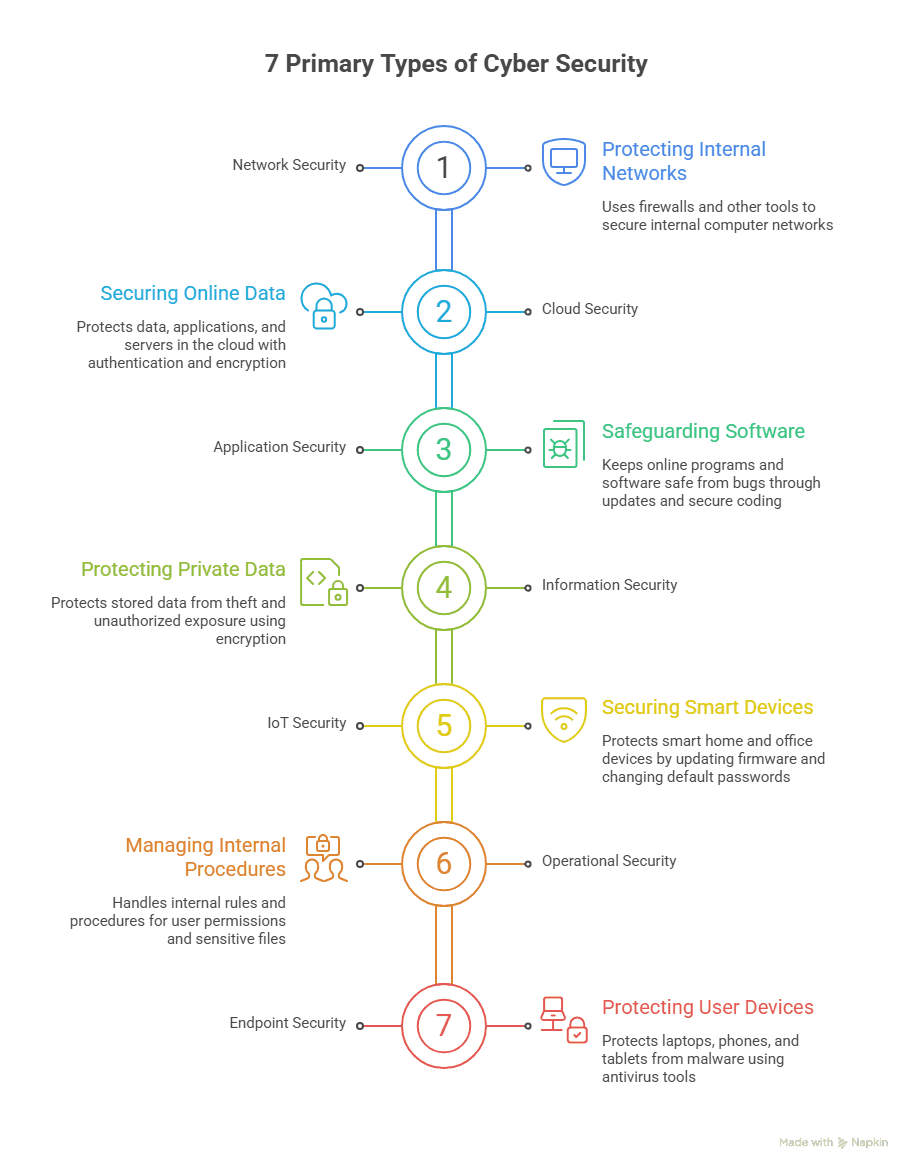
 

image.png


✅ Network Security: Protects internal computer networks from hackers and unauthorised access with the help of tools such as firewalls.


✅ Cloud Security: It secures data, online platforms, applications and remote servers by using multi-factor authentication and encrypted storage.


✅ Application Security: It keeps the programmes stored online and software safe from bugs by making regular updates and secure coding.


✅ Information Security: Protects privately stored data from theft or unauthorised exposure with the help of encryption and other techniques.


✅ Internet of Things (IoT) Security: It secures smart home devices and office devices by updating firmware and changing default passwords.


✅ Operational Security: Handles the internal procedures and rules that organisations often use to manage and protect user permissions & sensitive files.


✅ Endpoint Security: Used to protect physical user devices such as laptops, mobile phones, and tablets from malicious software by using antivirus tools.

What is the typical cyber security syllabus for undergraduate courses in India?

Undergraduate degrees in cybersecurity in India typically last 3 years. Depending on the institute and its curriculum, they may follow a semester-wise or term-based programme structure. These bachelor's degrees typically cover the basics of computer science, data structures, network security, cryptography, cloud security, etc. The actual syllabus for bachelor's degrees varies by institute based on their focus area and electives offered. Here is an overview of the general syllabus of cyber security:


Semester I

Semester II

Computing Fundamentals

Data Structures

Introduction to Cybersecurity

Computer Architecture

Digital Systems

Cyber Threats & Risk

Communication Skills

Database Fundamentals

Mathematics for Computing

Operating Systems

Programming Basics

Web Technologies


Semester III

Semester IV

Computer Networks

Network Defence

Secure Programming

Web & Application Security

Cryptography

Cyber Laws & Ethics

Information Security

Ethical Hacking

Linux & System Administration

Vulnerability Assessment

Cybersecurity Lab

Security Tools Lab


Semester V

Semester VI

Digital Forensics

Penetration Testing

Cloud Security

Security Auditing

Identity & Access Management

Mobile & IoT Security

Incident Response

Cyber Risk Management

Malware & Reverse Engineering

Cybercrime Investigation

Security Operations

Major Project/Internship

Cybersecurity Syllabus for Post Graduate Courses in India

Master's degrees in cyber security generally cover advanced areas of cryptography, ethical hacking, and security analysis. Generally, postgraduate degrees span a curriculum of two years, consisting of four semesters. After graduation, you can consider pursuing an MTech, MCA, MBA, or MSc in cyber security depending on your choice. The cyber security syllabus for postgraduate degrees varies by programmes and institutions. You may explore the general cyber security course syllabus for PG courses:


Semester I

Semester II

Applied Cryptography

Network & System Security

Cybersecurity Foundations

Web & Application Security

Advanced Computer Networks

Ethical Hacking

Secure Programming

Digital Forensics

Information Security

Malware Analysis

Security Laboratory

Security Assessment


Semester III

Semester IV

Cyber Threat Intelligence

Advanced Cybersecurity Elective

Cloud & IoT Security

Security Research

Privacy & Data Protection

Security Operations & Incident Response

Cybersecurity Risk Management

Industry Internship or Project

Dissertation/Major Project

N/A

Electives

N/A

Cyber Security Course Syllabus: Programme-Wise

Cyber security is one of the most in-demand fields in computer science. A Bachelor of Technology (BTech), Bachelor of Science (BSc), and Bachelor of Computer Applications (BCA) are some of the most popular programmes in cyber security. Although the actual cyber security syllabus varies by institute and course duration, let us explore the general semester-wise syllabus for these courses:

B Tech Cyber Security Syllabus

BTech in cyber security is generally focused on an in-depth curriculum, blending theoretical knowledge and applied skills with training modules. The programme generally follows a duration of four years, comprising eight semesters. Here is a general B Tech CSE cyber security syllabus:


Semester I

Semester II

Engineering Mathematics

Object-Oriented Programming

Computer Fundamentals

Discrete Mathematics

Engineering Physics

Data Structures

Fundamentals of Programming

Probability & Statistics

Communication Skills

Computer Organisation

Basic Electronics

Programming Lab


Semester III

Semester IV

Operating Systems

Software Engineering

Computer Networks

Network Security

Web Technologies

Linux/System Administration

Database Management Systems

Theory of Computation

Design & Analysis of Algorithms

Cryptography

Cybersecurity Fundamentals

Cybersecurity Lab


Semester V

Semester VI

Digital Forensics - I

Cybercrime & Cyber Laws

Web Application Security

Incident Response

Ethical Hacking

Security Operations

Information Security

Malware Analysis

Cloud Computing

Cloud Security

Vulnerability Assessment & Penetration Testing

Cybersecurity Electives


Semester VII

Semester VIII

Cyber Defence

Advanced Electives

Advanced Cybersecurity

Industry Project

Digital Forensics - II

Research/Dissertation

Security Auditing

Internship or Project Evaluation

Cybersecurity Management

N/A

Major Project/Internship

N/A

B Sc Cyber Security Syllabus

A Bachelor of Science or BSc programme lasts three years. It spans a curriculum of six semesters. The course with a specialisation in cyber security focuses on computer networks, security fundamentals, and programming languages. Look at the general BSc in Cyber Security syllabus:


Semester I

Semester II

Basics of Computers & Problem Solving

SQL (Structured Query Language)

Computer Networks

Python Programming

Fundamentals of Operating Systems

Introduction to Cyber Security

C++ Programming

Forms of Cyber Crime

Network Lab

Internet Security Lab

Kali Linux Lab

Advanced Networking & Communication Protocols


Semester III

Semester IV

Mobile & Web Application Security

Intrusion Detection & Prevention Systems

Data Privacy

Criminal Laws & Cybercrimes

Cloud Computing

Data Storage

Cyber Criminology

Database Management & Data Structures

Advanced Internet Security Tools Lab

IDPS Lab


Semester V

Semester VI

Cyber Laws & IPR

Cyber Forensics & Investigation

Cryptography

Computational Intelligence

Information Security & Audit

Cloud Technology & Security

Cryptography Lab

Cyber Risk Management

Project/Case Study

Firewall & Internet Security

Ethical Hacking

Security Architecture & Design

Cyber Forensics Lab

Internship/Dissertation

BCA Cyber Security Syllabus

Another popular degree in the field of cyber security is a Bachelor of Computer Applications (BCA). This programme lasts three years and consists of six semesters. The programme blends comprehensive knowledge of computer applications as well as cyber security principles. Check out the general BCA in Cyber Security syllabus:


Semester I

Semester II

Programming in C

Computer Organisation

Communication Skills

Data Structures

Computer Fundamentals

Object-Oriented Programming

Digital Logic

Cybersecurity Fundamentals

Web Technologies

Python Programming

Mathematics

Database Management Systems


Semester III

Semester IV

Computer Networks

Ethical Hacking

Operating Systems

Network Security

Software Engineering

Cyber Laws

Cryptography

Linux/System Administration

Web Application Security

Information Security

Cybersecurity Lab

Cybersecurity Tools


Semester V

Semester VI

Cloud Security

Advanced Cybersecurity

Penetration Testing

Incident Response

Digital Forensics

Security Operations

Cybercrime Investigation

Malware Analysis

Security Auditing

Cyber Risk Management

Vulnerability Assessment

Major Project/Internship

Can you suggest online platforms offering a cyber security syllabus for beginners?

There are many online learning platforms that offer cyber security courses. Degrees and diplomas in cyber security are typically offered by institutions. Certification courses, on the other hand, are provided by various platforms such as MOOCs, institutions, universities, etc. Moreover, the syllabus of cyber security can be checked on the official page for that particular institute. Here are several online platforms offering cyber security courses for beginners:


Platforms

Courses Offered

Amity University Online

Online MCA in Cyber Security

Chitkara University CDOE

Online MBA in Cyber Security

Online Manipal (MAHE)

Online MCA in Cyber Security

EC-Council University

Online MBA in Cyber Security

Amrita Online

Online MCA in Cybersecurity & AI

Online Manipal Jaipur

Online BCA in Cyber Security

Jain University Online

Online BCA in Cyber Security & AI

Chandigarh University Online

Online BCA in Cloud Computing & Cyber Security

Udemy

  • Cyber Security: From Beginner to Expert

  • Cybersecurity - Automotive

IntelliPaat + IIT Roorkee

AI-Powered Cyber Security Course

Coursera

  • Google Cybersecurity Professional Certificate

  • Introduction to Cybersecurity Essentials by IBM

IIT Kanpur

PG Diploma (Online) in Cyber Security

edX

  • Cybersecurity Analyst Professional Certificate by IBM

  • HarvardX: CS50's Introduction to Cybersecurity

Conclusion

Cyber security syllabus consists of various foundational and specialised subjects. Depending on the type of programme you choose, the number and choice of subjects vary. Learners can pursue a bachelor's degree, master's degree, diploma or even a certification programme in cyber security, being offered by many institutions and platforms.


The actual syllabus of cyber security shall depend on a particular institution and course. You can visit the official website or page for your chosen programme to learn about its syllabus in detail. Look for the core subjects covered, offered electives, and project work, dissertation or internship opportunities for practical training.

FAQs

Q1. Why cyber security is important?

With growing cybercrimes and thefts, the need to protect these systems, confidential information, and internal networks from malicious attacks has increased across organisations, making cyber security crucial.

Q2. How cyber security works?

Cyber security requires skilled candidates and several specific tools and technologies to perform the processes that can prevent cyberattacks and protect devices, servers, and sensitive data from breaches and attacks.

Q3. What are the subjects for cyber security?

Cybersecurity fundamentals, digital forensics, cyber laws, cryptography, Internet of Things (IoT), and ethical hacking & penetration testing are some of the essential subjects covered in the cyber security syllabus.

Q4. How many years for cyber security?

Cyber security courses can last from a few months to 4 years, depending on the type of programme you enrol in. Full-length degrees can span a curriculum of 2-4 years, based on UG & PG type. On the other hand, certificate courses may last from 3 to 12 months, while free courses may be available to complete within weeks to 1-2 months.

Q5. Is math compulsory for cyber security?

Cyber security syllabus generally focuses on problem solving, computer networks, and operating systems rather than advanced mathematics such as calculus. Entry-level roles require typical knowledge of discrete mathematics and statistics rather than complex mathematical problems.

Every query is necessary.

Our team of experts, or experienced individuals, will answer it over online meet. Book your slot now!

Book Free Online Counselling

Narayani - Author

Narayani SEO Writer

LinkedIn Profile

Narayani Bhardwaj is an experienced academic web content writer @Learning Routes with a strong focus on developing clarity, research, and learner-friendly content. With three years of versatile experience as a blog writer, SEO writer, social media post writer, and subject matter expert, she additionally holds a master's in computer applications. The technical background provides her with a strong understanding of technological and subject-based writing across various niches. Her expertise helps simplify complex topics and present them in a well-structured and engaging way to help her audience discover the best of what they are looking for.

Read more
Isha - Editor

Edited by: Isha Education Counsellor / Editor

LinkedIn Profile

Isha Jain holds a Bachelor's degree in Literature along with a Diploma in Digital Marketing, bringing a strong foundation in communication and content creation. With over 7 years of hands-on experience in the education domain, she has crafted impactful content across various formats - ranging from educational blogs and news articles to video scripts, newsletters, and learner-focused campaigns. As the editorial lead at Learning Routes, Isha plays a key role in shaping content that empowers students and working professionals to make confident choices about online courses and career-building certifications. Her deep understanding of the online education space is reflected in her writing, which aims to simplify complex decisions and provide real-world clarity to learners. Beyond her professional role, Isha has also written extensively on lifestyle and digital learning trends. She is passionate about guiding students and loves engaging in conversations around career development on platforms like LinkedIn, Quora, and Reddit. Whether it's recommending the right upskilling path or demystifying online education, she has helped countless learners take confident steps toward their goals. In her spare time, you’ll find Isha reading, traveling, or playing sports to stay active and inspired.

Get Free Career Guidance

enquiry
logo
The intend of Learning Routes is to provide unbiased, precise information & comparative guidance on Universities and its Programmes of Study to the Admission Aspirants. The contents of the Learning Routes Site, such as Texts, Graphics, Images, Blogs, Videos University Logos, and other materials (collectively, 'Content') are for information purpose only. The content is not intended to be a substitute for in any form on offerings of its academia partners. Infringing on intellectual property or associated rights is not intended or deliberately acted upon. The information provided by Learning Routes on www.learningroutes.in is for general information purposes only. All information on the site is provided in good faith with accuracy and to the best of our knowledge, however, we make no representation or warranty of any kind, express or implied, regarding the accuracy, adequacy, validity, reliability, or completeness of any information on the Site. Learning Routes & its fraternity will not be liable for any errors, omissions, damages, or losses resultant, if any, from the usage of fit information.
Contact Us:
Get Free Counselling
07965800489

Scholarships UPTO 10% for online degrees

Enquire Now