
Explore Courses
Top University
Search anything
 Refer and Earn ₹ 5000
Isha
Published on 06 April, 2026

Learning Routes Editorial Team
Reviewed and updated

Upon completing 12th grade, students who have an interest in the areas of business, finance, management, etc., often choose to go for a Bachelor of Commerce as their undergraduate degree. If you are interested in gaining more specialised knowledge in accounting and finance rather than studying general subjects, a BAF can be the perfect degree for you. The full form of BAF in commerce is Bachelor of Accounting and Finance. It is a three-year bachelor-level programme that offers in-depth insight into the core areas of accounting and finance.
A BAF course opens up a lot of professional opportunities for students, making it a cost-effective degree for career growth. In India, many colleges and universities offer this specialised programme with BAF course fees between INR 20,000 and INR 2,00,000. With this blog, we shall explore the details of the BAF full form, its curriculum, the various opportunities it offers, eligibility, and other details. Let’s get started.
The full form of BAF is Bachelor of Accounting and Finance. Unlike a BCom degree, it provides students with more specialised knowledge in fields like finance, taxation, accounting, auditing, and several other areas to build relevant skills and expertise. The duration of the course can either be three years or four years, depending on which college/institute you pursue your degree from.
The focus of a BAF course subjects is on providing knowledge of the core areas of financial and accounting management so that students can prepare themselves for a professional career, such as chartered accountancy or company secretary or begin working right after attaining their degree. Alternatively, they can also go for higher studies like an MBA (Master of Business Administration).
| Details | BAF Course Details |
|---|---|
| BAF full form | BAF (Bachelor of Accounting and Finance) |
| Duration | 3 Years |
| Focus | Core areas of Accounting and Financial Management |
| Eligibility | 12th Grade Pass |
| Professional Opportunities | Accounting, Finance, Taxation, Auditing, Business Law |
| Average BAF Fees | INR 20,000 to INR 2,00,000 (varies by the institution) |
If you are wondering what course to pursue after 12th, and you are interested in subjects like finance, auditing, business, etc., but feel confused between choosing a BCom and a BAF as your undergraduate degree, here are a few reasons why, depending upon your interest and academic needs, a BAF degree might be a better choice for you. Let’s have a look at the BAF course details.
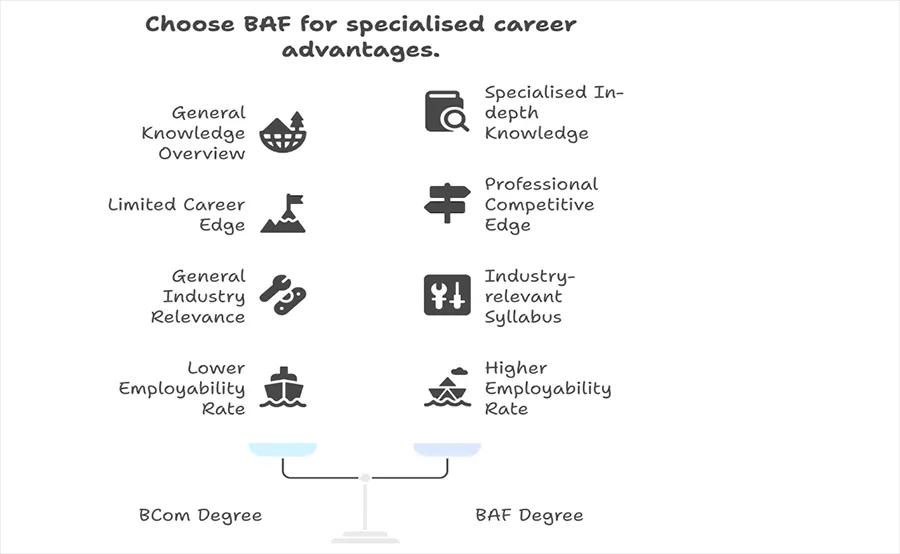
Apart from this, a BAF degree not only provides you with in-depth knowledge of accounting and finance but also equips you with a wide range of soft and hard skills that are highly valued if you wish to enter the industry as a professional upon completing your degree. The following are the skills you shall gain with a BAF degree:
As already discussed, BAF, a Bachelor of Accounting and Finance, provides advanced knowledge in core areas and related fields, therefore opening many professional opportunities for newcomers who are ready to step into industries as professionals. Please note that the salary figures may vary, depending upon the industry, location, type of organisation, experience, skills, any additional qualifications, etc. The table below lists the average pay scale offered to individuals with a BAF degree, depending on their skills, knowledge, and experience.
| Job Role | Average Salary Range |
|---|---|
| Accountant | INR 3.3 LPA – INR 5 LPA |
| Financial Analyst | INR 3.1 LPA – INR 6.2 LPA |
| Auditor | INR 3.8 LPA – INR 5.3 LPA |
| Tax Consultant | INR 3.4 LPA – INR 7.8 LPA |
| Investment Banker | INR 5.2 LPA – INR 12 LPA |
| Risk Manager | INR 4 LPA – INR 8.5 LPA |
| Credit Analyst | INR 4.7 LPA – INR 9.6 LPA |
| Business Analyst | INR 4.2 LPA – INR 8.6 LPA |
Source: AmbitionBox
The Bachelor of Accounting and Finance offers an industry-relevant curriculum designed by experts, blending both theoretical and practical aspects of finance and accounting. Some general subjects included in the curriculum are cost accounting, financial management, auditing, business economics, business law, etc. Below is the general overview of the syllabus and BAF course subjects spanning over 4 years. As already stated, the programme duration may vary according to the institution.
| Semester I | Semester II |
|---|---|
| Elements of Financial Accounting | Financial Accounting – Firms |
| Fundamentals of Financial Management | Elements of Cost Accounting |
| Open Electives: Microeconomics, Mathematical & Statistical Techniques – I, Media Culture and Studies, Basics of Food and Nutrition | Open Electives: Macroeconomics, Mathematical & Statistical Techniques – II, Business Analytics, Anthropology of Food |
| VSC/SEC: Business Laws, Basics of Financial Services, Presentations & Communication Techniques | VSC/SEC: Corporate Laws, Basic and Advanced Excel, Effective Business Communication, Understanding India |
| AEC: Environmental Studies | AEC |
| IKS: Indian Knowledge System | NSS / Cultural / Sports / Yoga |
| Semester III | Semester IV |
|---|---|
| Special Accounting Areas | Management Accounting |
| Strategic Financial Management | Indirect Taxes |
| Open Electives: Company Law / Operations Research I / Computer Programming I | Open Electives: Securities Law / Operations Research II / Computer Programming II |
| Electives: Corporate Accounting I / Foreign Exchange Market I / Marketing of Financial Services I | Electives: Corporate Accounting II / Foreign Exchange Market II / Marketing of Financial Services II |
| AEC: Language I — Hindi / Marathi / Gujarati / Sanskrit | AEC: Language II — Hindi / Marathi / Gujarati / Sanskrit |
| FP: Field Project | CEP: Community Engagement Project |
| NSS / Sports / Cultural / Yoga | NSS / Sports / Cultural / Yoga |
| Semester V | Semester VI |
|---|---|
| Methods of Costing | Advanced Cost Accounting I |
| Income Tax I | Income Tax II |
| Advanced Financial Accounting I | Advanced Financial Accounting II |
| Capital Markets | Ind AS |
| Fundamental and Technical Analysis | Financial Modelling and Valuation |
| Power BI | OJT |
| FP / CEP | N/A |
| Semester VII | Semester VIII |
|---|---|
| Ind AS | Forensic Accounting |
| Advanced Financial Accounting II | Advanced Financial Management |
| Advanced Cost Accounting II | International Accounting |
| Auditing I | Auditing II |
| Security Analysis and Portfolio Management / Foreign Exchange Markets | Corporate Financial Reporting / Personal Financial Planning and Wealth Management |
| Research Methodology | OJT |
The general eligibility criteria for admission to a BAF degree are similar to those for a BCom degree. Students must have passed 12th grade with an equivalent degree, with a minimum aggregate of 45% to 50%. However, some institutions may prefer students who had opted for commerce and its relevant subjects during their 12th grade. 5% relaxation is offered to the reserved categories. Here is the general eligibility criteria for the BAF course:
✅ Passed 10+2 in any stream from a recognised board (Some institutes may prefer the commerce stream).
✅ You should have scored at least 45% to 50% in 10+2.
✅ There is no upper age limit criterion.
The admission steps for a BAF course are quick and easy. You could apply for BAF through CUET UG or directly to your desired institute. Many universities accept applications online for a BAF course. However, you may need to visit campus for document submission or to make fee payments via DD (Demand Drafts). Now, let’s take a look at the general admission process briefly.
Bachelor’s of Accounting and Finance and Bachelor’s of Commerce are both undergraduate degrees that span over three years. While a B.Com degree offers general knowledge of various commerce subjects, BAF focuses prominently on accounting and financial management and offers an in-depth study of these two subjects. It is a specialised programme in the field of accounting and finance with high demand for professionals, and also gives a competitive edge in exams like CA, ACCA, CFA, etc.
Now, is a BAF better than a B.Com? It entirely depends upon a person’s individual choice, career aspirations, and academic expectations. A BCom degree offers general knowledge of various subjects and flexibility in terms of choosing a specialisation if offered by an institution. BAF, on the other hand, focuses primarily on accounting, finance, taxation, and auditing. Both of these degrees offer various opportunities with high-paying jobs and are beneficial in terms of career progression. Therefore, it depends on an individual’s goals whether a BAF degree or a B.Com degree is more suitable for them.
A Bachelor of Commerce is an undergraduate programme that follows a duration of 3 years. This is a general course that covers broader areas of accounting, commerce, and finance. BAF, on the other hand, is a specialised bachelor's degree programme in accounting and finance. Unlike BCom, it only emphasises areas of finance and accounting, such as auditing, banking, taxation, etc. Whereas, pursuing a BCom opens your pathways to banking, insurance, financial services, accounting, commerce, consulting, and more. You may check out the primary differences between BAF vs BCom:
Several colleges in India offer a Bachelor of Accounting and Finance (BAF) course. At some colleges, BAF is also referred to as the Bachelor of Commerce in Accounting and Finance. The course spans a three-year curriculum. Furthermore, BAF course fees vary by colleges and are subject to revision year on year. Here are some of the best colleges in India offering a BAF course:
Bachelor of Accounting and Finance (BAF) is a specialised programme. It creates possibilities for you across various financial, accounting, banking, and taxation domains. After completing a BAF course, you could consider a postgraduate degree, diploma, or certification. Interested aspirants can also choose a professional pathway, such as a Chartered Accountant (CA).
✅ CA/CFA: These are professional courses that require you to qualify for entrance exams. Qualifying for the CA and CFA exams makes you eligible for Chartered Accountant and Chief Financial Analyst, respectively. It allows you to pursue a high-paying corporate job or become self-employed.
✅ MBA: An MBA with specialisations in finance, banking and accounting, and marketing are among the in-demand PG courses after BAF. It helps you gain advanced knowledge and skills in the areas of finance and accounting.
✅ MCom: Considering an MCom after BAF is ideal for anyone seeking to build a career in the account, finance, and commerce domains.
✅ PGDM: You can pursue a PGDM in finance and banking after BAF. This is a programme equivalent to an MBA. However, its duration may vary from 1 to 2 years, depending on the college.
✅ Certificate in Finance or Banking: If you want to quickly upskill and secure a job without investing time in a two-year degree, certificate courses are a popular choice. These courses focus on skill development for job-readiness.
BAF is one of the most popular courses for commerce students. It is ideal for anyone seeking specialised expertise in finance, taxation, and accounting. The course has general eligibility requirements as of a BCom programme. However, the subject and score in the 10+2 requirements may vary from college to college. Additionally, the BAF course is a gateway to various professional opportunities in the corporate realm. Combining BAF with PG qualifications could be beneficial for a long-term career. Explore the top BAF colleges and apply to your desired one.
Depending on your personal choice and academic needs, both of these degrees offer numerous professional opportunities in the fields of commerce, finance, and related areas. A BAF degree is for those who wish for more in-depth knowledge and practical skills in accounting and finance.
A BAF degree may range between INR 20,000 and 2 lakhs in India, varying depending on the institution you take admission into.
Yes, a BAF degree is highly beneficial. The programme opens up a lot of opportunities in accounting and finance fields and offers tremendous career growth in commercial, business, and financial sectors.
A BAF is a three-four year undergraduate course that covers key subjects like cost accounting, financial management, indirect taxes, financial modelling, income tax, and capital markets, among others.
Yes, BAF is a good and career-focused undergraduate course after 12th, especially for those seeking a career in accounting, finance, and audit. The course focuses on specialised areas such as auditing, financial management, taxation, corporate laws, cost accounting, etc.
BAF stands for Bachelor of Accounting and Finance. This is a three-year undergraduate programme, which is also offered with a 4-year duration with a research or honours medium. The UG degree specialised in taxation, finance, banking, auditing, and accounting is ideal for students with a commerce stream or anyone seeking a career in finance, banking, and auditing.
Our team of experts, or experienced individuals, will answer it over online meet. Book your slot now!
Book Free Online Counselling
Get Free Career Guidance